On September 16, 2026, Japan’s Ministry of Land, Infrastructure, Transport and Tourism (MLIT) launched a nationwide online survey to assess how construction companies disclose necessary cost breakdowns in written estimates following the full enforcement of the revised Construction Business Act. The initiative aims to improve working conditions for construction technicians and ensure fair contracting practices by securing appropriate labor and material costs.
- Objectives and Overview of the Nationwide Survey Launched in September 2026
- Specific Survey Items and Impact on Field Operations
- Three New Rules under the Revised Construction Business Act Fully Enforced in December 2025
- Prohibition of Unreasonably Low Labor Costs and Practical Breakdown Operations
- Current Status and Challenges of Subcontracting Transactions Shown by Survey Data
- Building a Sustainable Construction Industry and Operational Efficiency via DX
Objectives and Overview of the Nationwide Survey Launched in September 2026
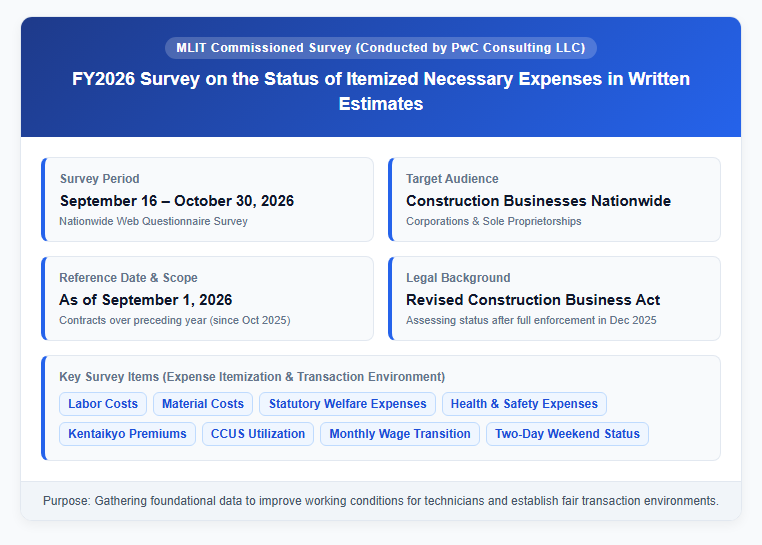
From September 16 to October 30, 2026, the Ministry of Land, Infrastructure, Transport and Tourism (MLIT) is conducting the “FY2026 Survey on the Status of Itemized Necessary Expenses in Written Estimates (Web Survey).” Commissioned to PwC Consulting LLC, this survey targets both corporate and individual construction businesses nationwide. The primary goal is to gain detailed insights into whether construction companies are properly itemizing necessary expenses—such as labor costs, material costs, and statutory welfare expenses—when submitting price estimates under the revised Construction Business Act, which took full effect in December 2025. The collected data will serve as foundational material for formulating future measures to improve the treatment and compensation of skilled construction workers. Set with a reference date of September 1, 2026, the survey investigates actual estimate submissions and contract negotiations over the preceding year (since October 2025). It stands as a pivotal policy initiative to quantitatively evaluate how deeply fair transaction practices have penetrated job sites.
Specific Survey Items and Impact on Field Operations
This questionnaire meticulously examines whether construction companies explicitly state various expense breakdowns in written estimates submitted to project owners and prime contractors. Key inquiry areas include the itemization of material and labor costs, safety and health expenses, premiums for the Construction Industry Retirement Allowance Mutual Aid (Kentaikyo), and statutory welfare expenses. Furthermore, the survey investigates multifaceted operational indicators, including the utilization rate of the Construction Career Up System (CCUS), progress in transitioning technicians to monthly salary systems, implementation of two-day weekend policies, and contractual agreements with sole proprietors (solo subcontractors). Through these inquiries, MLIT evaluates not only formal compliance in documentation but also whether these measures directly translate into higher wages and better working environments for field technicians. In day-to-day operations, moving away from traditional lump-sum estimates toward transparent cost calculations and clear negotiation baselines has become essential, significantly elevating the importance of rigorous administrative preparedness.
Full Enforcement of the Revised Construction Business Act and Background of Expense Breakdown
Three New Rules under the Revised Construction Business Act Fully Enforced in December 2025
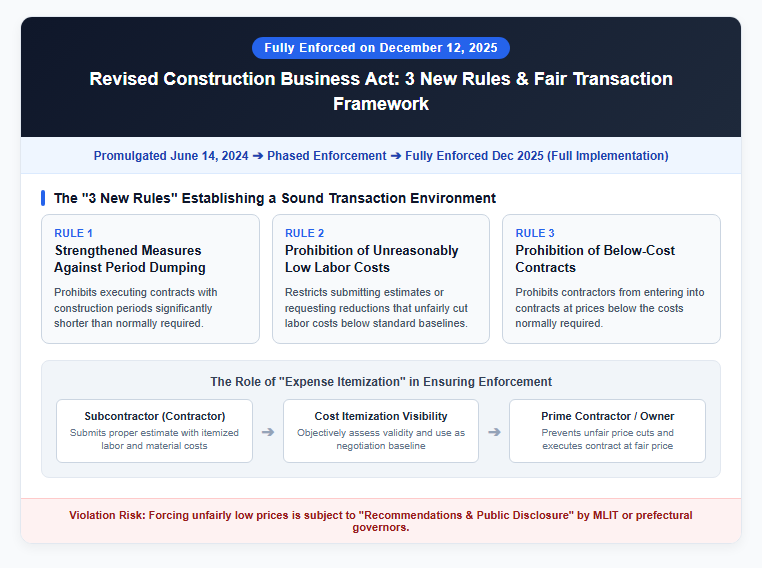
The survey takes place against the backdrop of the revised Construction Business Act, which was promulgated on June 14, 2024, and reached full implementation on December 12, 2025. This legal overhaul was driven by an urgent need to correct longstanding structural issues in the construction sector, such as unreasonably short construction periods and low contract prices, thereby establishing a sustainable industry framework. The reform centers on three core rules: strengthening measures against construction period dumping, prohibiting unreasonably low labor costs, and banning contracts below cost for contractors. In particular, securing proper wage resources for field technicians based on the “Standard Labor Costs” and “Labor Cost Standards” formulated and recommended by the Central Construction Industry Council has become a mandatory requirement. Administrative oversight against unfair reductions in labor costs has been intensified, making the establishment of sound, transparent contractual relationships a legal obligation for both clients and contractors.
Prohibition of Unreasonably Low Labor Costs and Practical Breakdown Operations
Under Article 20 of the revised Construction Business Act, submitting estimates with labor or material costs significantly below standard levels, as well as client requests for price reductions below these baselines, is explicitly prohibited. If a project owner forces a contract below acceptable thresholds, they risk being subjected to official recommendations and public disclosure of their corporate name by the Minister of Land, Infrastructure, Transport and Tourism. The key to giving this rule legal force is the explicit itemization of expenses in written estimates. Without visible breakdowns and calculation bases for labor and material costs, it is impossible for regulators to objectively assess price validity after the fact. For subcontractors, itemized estimates serve as a legitimate foundation for fair price negotiations; for prime contractors and project owners, they provide crucial documentation to demonstrate compliance and avoid administrative sanctions. MLIT is actively promoting the adoption of standard estimate formats to firmly establish negotiation practices that preserve standard labor costs.
Field Transaction Realities and Future Industry Outlook
Current Status and Challenges of Subcontracting Transactions Shown by Survey Data
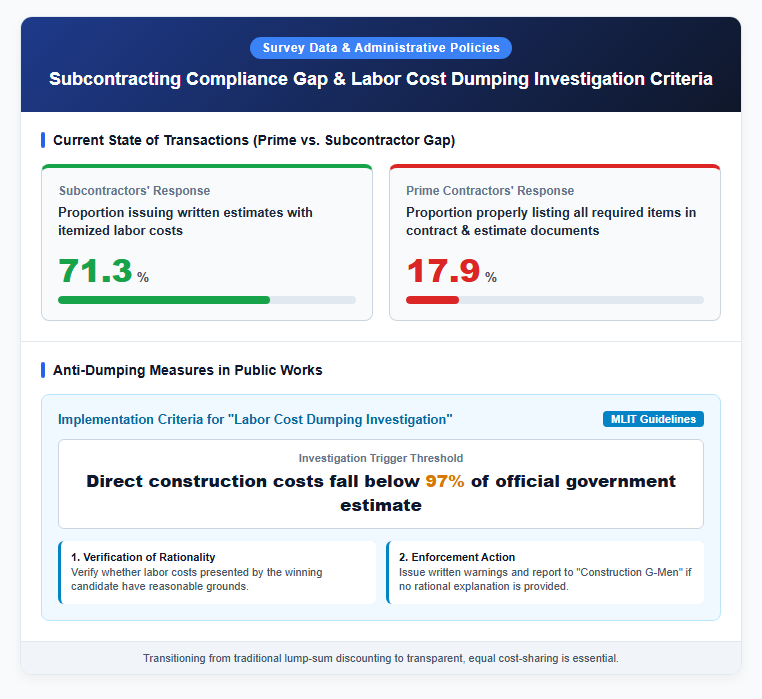
According to transaction status surveys conducted by MLIT and related agencies, over 70% of subcontractors now issue written estimates with itemized labor costs, leading to an increasing number of successful price negotiation outcomes. Conversely, the proportion of prime contractors who properly list all required items in contract documents and estimates issued to subcontractors remains at just 17.9%, revealing a substantial operational gap between main contractors and subcontractors. In public works, measures to combat predatory pricing are also progressing, such as mandatory labor cost dumping investigations whenever direct construction costs fall below 97% of official government estimates. Traditional commercial practices—such as unilaterally slashing subcontractor estimates via overall lump-sum discounts—are no longer permissible. There is an urgent need for a paradigm shift toward an equal partnership where prime contractors and subcontractors transparently share and approve legitimate cost structures.
Building a Sustainable Construction Industry and Operational Efficiency via DX
Thoroughly itemizing labor costs and administrative expenses is more than mere regulatory compliance; it forms the foundation for raising construction wages above other industry averages and attracting younger workers to the field. However, field managers frequently report heavy administrative burdens due to disparate estimate formats among subcontractors, requiring extensive manual data entry and cross-checking. To address these operational bottlenecks, construction DX solutions leveraging AI-OCR and Large Language Models (LLMs) to automatically capture and structure unstructured estimates are rapidly gaining traction. Digital automation and data assetization are essential to handle complex expense itemization without overwhelming staff capacities. Leveraging regulatory compliance as a catalyst to modernize analog workflows and shift toward transparent, data-driven management will be the cornerstone of growth in this new era.
Reference Pages
- 【FY2026 Survey on the Status of Itemized Necessary Expenses in Written Estimates】https://www.pwc.com/jp/ja/news-room/2026/mlit-research.html
- 【MLIT Labor Cost Standards Portal Site】https://roumuhi.mlit.go.jp/
- 【MLIT Revision of Construction Business Act and Public Contract Optimization Act】https://www.mlit.go.jp/tochi_fudousan_kensetsugyo/const/tochi_fudousan_kensetsugyo_const_tk1_000001_0033.html
【#ConstructionBusinessAct #MLIT #LaborCosts #WrittenEstimates #ConstructionDX #WorkStyleReform #PricePassThrough #PwC】

コメント