」_en.png)
The ‘No Entry’ initiative, which involves inspecting and investigating sewer pipes without people entering them, is gaining momentum. Behind this is the rapid aging of infrastructure, as well as a social situation where serious life-threatening accidents occur one after another within the jurisdiction.
- Definition of “No Entry” to avoid entry
- Serious aging and lessons from accidents behind it
- Limitations and Challenges of Traditional Inspection Methods
- Mandatory safety management through Sewerage Act amendments
- Ministry of Land, Infrastructure, Transport and Tourism’s Proposal for the ‘No Entry’ Principle
- Support Systems Supporting Technology Development and Adoption
- The Role of Drones Specialized for Confined Spaces
- AI-powered degradation diagnosis and automated data management
- Future Developments and Goals for Fiscal Year 2027
Definition of “No Entry” to avoid entry
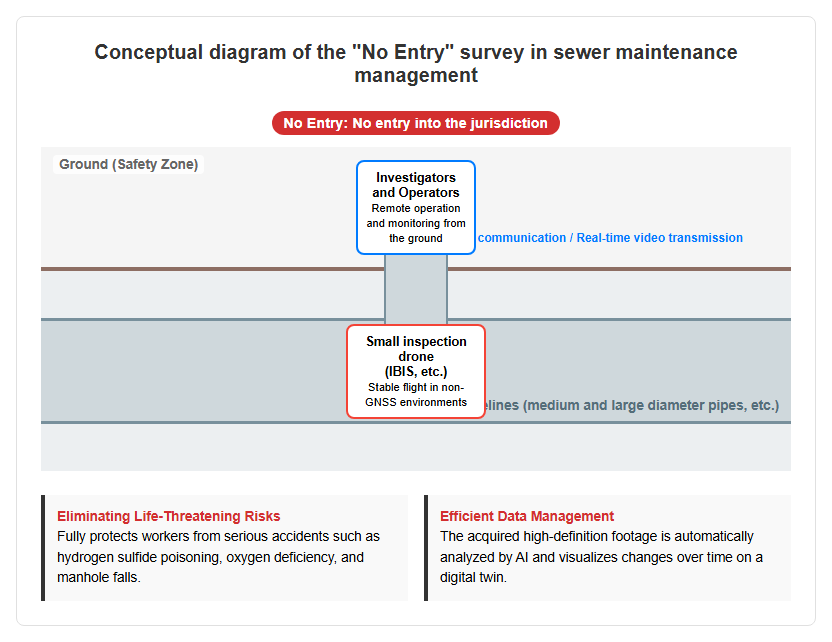
In sewer maintenance and management, “No Entry” refers to methods and business models in which inspectors do not directly enter the pipelines but instead use drones, robots, and AI (artificial intelligence) to conduct remote investigations. Traditionally, for medium and large-diameter pipes with an inner diameter of 800mm or more, it has been standard for workers to actually descend from the manhole underground and check the condition of the pipe walls visually or through photography.
However, sewer pipes are not only dark and narrow, but also a harsh environment where life-threatening risks such as the release of lethal toxic hydrogen sulfide gas and oxygen deficiency constantly loom. When the water level is high or the flow is fast, safe entry operations become physically difficult. The core goal of “No Entry” is to completely eliminate these hazardous tasks and achieve highly accurate inspections and investigations through remote operation and automatic patrols from the ground. The following diagram illustrates how investigations are conducted without human involvement.
Serious aging and lessons from accidents behind it
The biggest reason why promoting “No Entry” has become an urgent priority is the successive accidents caused by aging infrastructure nationwide. On January 31, 2025, a large-scale road subsidence accident occurred in Yashio City, Saitama Prefecture, caused by damage to an aging sewer pipe. This accident caused a moving truck to fall, resulting in the tragic death of the driver. The prefectural cause investigation committee has issued an interim report stating that soil and sand leaked out through gaps in sewer pipes corroded by hydrogen sulfide.
Furthermore, the safety of the inspection work itself is also a major challenge. On August 2, 2025, during a sewer inspection in Gyoda City, Saitama Prefecture, four workers fell into a manhole due to hydrogen sulfide poisoning, resulting in a serious occupational accident in which all died in a serious occupational accident. At that time, the investigation revealed that the concentration of hydrogen sulfide in the pipeline was measured at 150 ppm or more, which is 15 times the standard value. To eliminate these “preventable sacrifices,” expectations for technologies that do not allow people into dangerous spaces are rapidly increasing.
Limitations and Challenges of Traditional Inspection Methods
Currently, much of Japan’s sewer infrastructure was intensively developed during the period of rapid economic growth (1950s to the 1980s), and the number of pipelines exceeding the statutory service life of 40 years is increasing year by year. Of the approximately 500,000 km of sewer pipelines spread nationwide, the proportion of aging pipelines that have been in use for 50 years is expected to surge from about 8% now to about 40% in 20 years.
Continuing inspections of such a massive facility using traditional manual methods has reached its limits in terms of both cost and personnel. By 2030, Japan is projected to be short by about 6.44 million workers, making the shortage of personnel at inspection sites requiring specialized knowledge and skills particularly severe. Additionally, while the sewerage business is based on an independent financial system funded by usage fees, revenue declines due to population decline, along with rising labor and energy costs, are putting pressure on management, making a shift to more efficient and low-cost maintenance methods inevitable.
Institutional and Legal Background and National Promotion
Mandatory safety management through Sewerage Act amendments
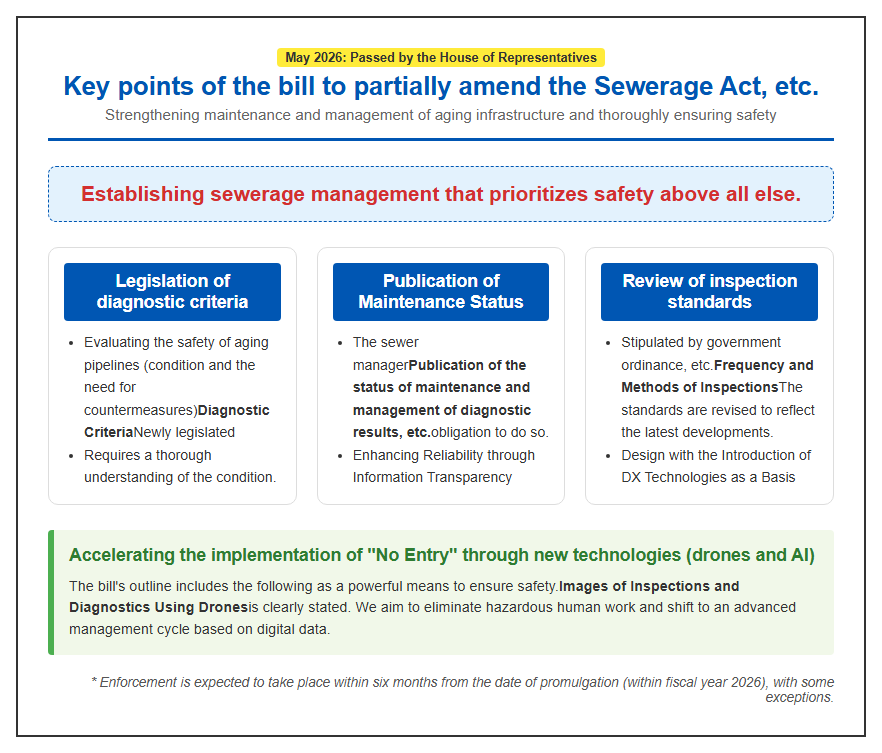
In response to a series of accidents and aging infrastructure, the government has strengthened measures through legal frameworks. In May 2026, the House of Representatives plenary session passed the “Bill to Partially Amend the Sewerage Act, etc.” as originally drafted. The main purpose of this legal amendment is to establish sewer management that prioritizes safety above all else.
The amended law newly established diagnostic criteria for evaluating the safety (condition and need of countermeasures) of aging pipelines. As a result, sewer managers are required to disclose maintenance status such as diagnostic results. The bill’s summary materials clearly state that inspections and diagnostics using drones are a powerful means to “prioritize safety.” With a few exceptions, enforcement is expected to take place within six months from the date of promulgation, and it is expected that the social implementation of “No Entry” type inspections and diagnostics using drones and similar devices will accelerate further within fiscal year 2026. The following chart summarizes the key points of the legal revision.
Ministry of Land, Infrastructure, Transport and Tourism’s Proposal for the ‘No Entry’ Principle
The Ministry of Land, Infrastructure, Transport and Tourism’s “Committee for Measures Based on Large-Scale Road Subsidence Accidents Caused by Sewerage and Other Systems” has outlined the future direction for ensuring safety in sewer pipelines, focusing on technological advancement and practical application. The guiding principle introduced was the concept of “No Entry,” which is based on ensuring work safety and reforming work styles, and conducting inspections and investigations as far as possible without people entering the pipelines.
Specifically, regarding the volume of drone surveys conducted by local governments, for example, under certain conditions such as large-diameter pipes, it is being considered to gradually introduce a goal setting such as “No Entry” as the principle. Additionally, the national government is working to support local governments in ordering drones by preparing quotation formats, standard labor rates (estimates of the number of workers per task), and technical documentation. This strategy not only promotes technology but also promotes the acceleration of production and cost reduction (affordability) of sewer pipe drones by creating an environment that makes it easier for local governments to place orders.
Support Systems Supporting Technology Development and Adoption
The government supports technology development across a wide range of stages, from research to practical application, to realize “No Entry.” Through frameworks such as the Ministry of Land, Infrastructure, Transport and Tourism’s “AB-Cross (Integrated Water and Sewage Integrated Technology Demonstration Project),” joint research by private companies, universities, and local governments is being solicited.
For example, as an applied research project in fiscal year 2025, Liberaware Inc. and CalTa Inc., “Sewer Pipe Inspection Technology Using Small Drones,” were selected. Additionally, under the SBIR system, which supports innovation creation by small and medium-sized enterprises, substantial subsidies are being invested in technology development that contributes to labor-saving and automation in construction and disaster information collection. Furthermore, for municipalities aiming to digitize pipeline information (paper-free), the “Sewerage Information Digitalization Support Project” is being implemented as a temporary measure until fiscal year 2026, providing backup systems from both technical and data perspectives.
The Frontline of Social Implementation and Future Prospects
The Role of Drones Specialized for Confined Spaces
A core technology gaining attention for realizing “No Entry” is domestically produced industrial drones developed by Japanese startups and others. In particular, the “IBIS” series provided by Liberaware Inc. is known as one of the world’s smallest inspection drones capable of flying even in confined spaces with a diameter of 50 cm.
Thanks to its unique flight control technology, this aircraft can stably fly even in non-GNSS environments where GPS signals cannot reach, as well as in dark, narrow sewer systems where dust is swirling. Furthermore, in addition to acquiring clear images with high-sensitivity cameras, we have also jointly developed and demonstrated technology with Nihon Hume Co., Ltd. that scientifically assesses the degree of deterioration by directly applying and spraying diagnostic reagents directly from drones onto tube walls to capture color changes caused by sulfuric acid degradation and measuring pH values. Thanks to these advances in aircraft, the previously difficult deterioration diagnosis that required personnel to enter can now be safely operated from the ground.
AI-powered degradation diagnosis and automated data management
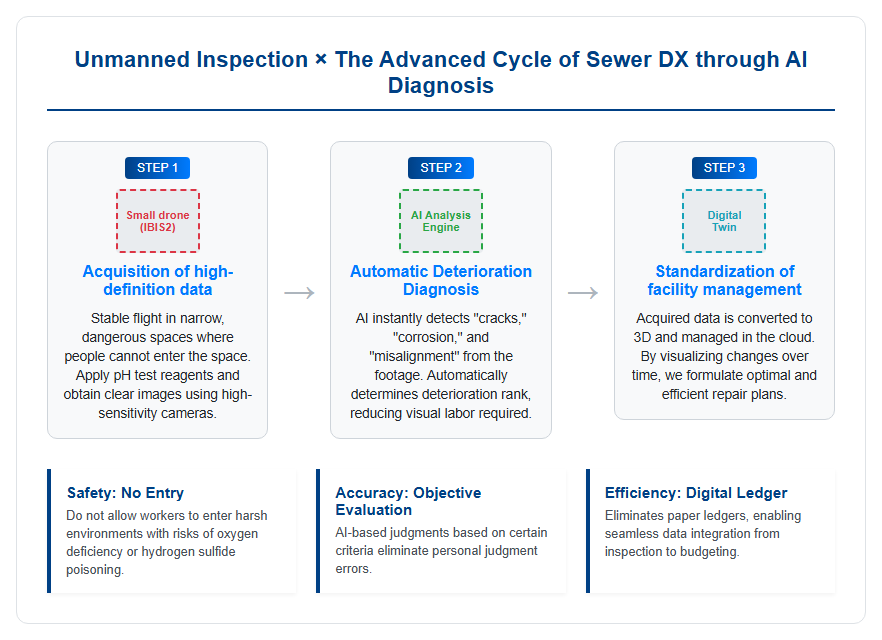
Alongside automating footage acquisition by drones, analyzing the vast amounts of data obtained is crucial. Traditionally, recorded footage from the facility required skilled workers from contracted contractors to visually inspect each pipe by hand to determine the deterioration grade, requiring significant time and expertise.
Pilot experiments to transition this judgment phase to AI-based automated diagnosis are progressing in various regions. AI instantly detects abnormalities such as cracks, corrosion, and joint misalignments from the acquired high-definition footage, and automatically assesses deterioration as severe, moderate, or mild. Additionally, by managing inspection results as digital twins (reproduction in virtual space), it becomes possible to visualize the condition of the facility in three dimensions and accurately capture changes over time. This not only greatly improves the accuracy and speed of diagnostics, but also establishes an efficient management cycle that digitally manages everything from inspections to repair planning and budgeting in one step. The diagram below shows a survey combining the latest drones and AI.
Future Developments and Goals for Fiscal Year 2027
The maintenance and management of sewers is currently undergoing a major turning point. The roadmap set by the Ministry of Land, Infrastructure, Transport and Tourism sets an ambitious goal to raise the adoption rate of DX technologies for maintenance in water and sewage systems nationwide across all water utilities and municipalities implementing sewerage projects to 100% by fiscal year 2027.
Additionally, all pipeline information is managed electronically, aiming to eliminate paper ledgers from the grid. Going forward, inspections using drones and AI will not be “special initiatives” but will become established as “standard tools” in infrastructure management. Unmanned inspections not only protect workers’ lives but also directly prevent road subsidence accidents by quickly detecting abnormalities. The spread of technology will increase transparency in sewer systems, which are considered “invisible infrastructure,” ultimately strengthening the foundation of a society where citizens can live safely and securely.
[#下水道 #ドローン #DX #NoEntry #インフラ老朽化 #国土強靭化 #AI診断]


コメント