Infostealing malware targeting soaring AI usage quotas and API keys is surging worldwide. Driven by the rapid adoption of generative AI and cloud infrastructure, cybercriminals have established sophisticated methods to impersonate legitimate users utilizing stolen login credentials and tokens.
- Compromised Accounts and the Threat to AI Infrastructure
- The Evolution of Malware Strains: Lumma’s Decline and Vidar 2.0’s Rise
- Weaponization of Session Cookies and Cloud Tokens
- Unofficial Proxy Services and the API Key Resale Ecosystem
- Agentic AI Exploits and Vulnerabilities in the Identity Layer
- Transitioning to Proactive Monitoring and Zero Trust Architecture
Compromised Accounts and the Threat to AI Infrastructure
As enterprises and research institutions accelerate their deployment of large language models (LLMs) and specialized AI services, high-value AI usage quotas, API keys, and cloud environment access privileges have emerged as prime targets for cybercriminals.
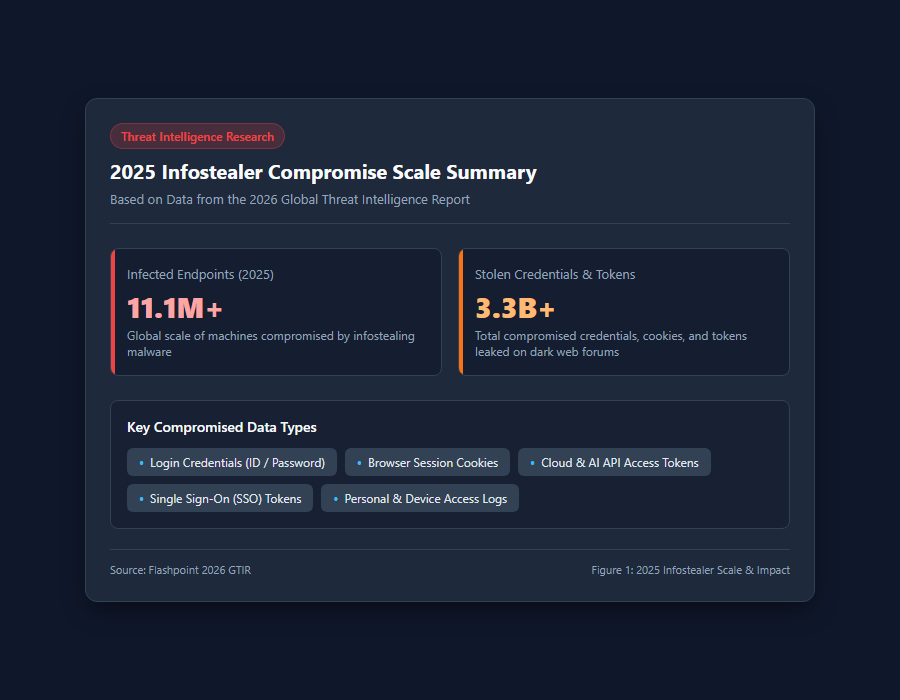
According to the “2026 Global Threat Intelligence Report” published by threat intelligence firm Flashpoint, over 11.1 million machines worldwide were infected with infostealing malware throughout 2025. This global epidemic fueled an inventory of more than 3.3 billion stolen login credentials, session cookies, and cloud tokens leaked across underground crime forums and illicit marketplaces.
The figure below highlights the trend and scale of compromised endpoints during 2025.
The damage extends far beyond personal devices, infiltrating developer environments and corporate networks alike. Threat actors exploit exfiltrated API keys and cloud credentials to consume expensive corporate AI compute resources without authorization or monetize them through unauthorized proxy services on the dark web.
The Evolution of Malware Strains: Lumma’s Decline and Vidar 2.0’s Rise
The infostealer ecosystem has undergone a significant structural shift. Malware strain “Lumma,” which previously dominated the market, suffered a severe loss in market share following targeted law enforcement actions in August 2025 that wiped centralized servers and seized over 2,500 domains.
Capitalizing on Lumma’s disruption, “Vidar 2.0” rapidly expanded its reach. By January 2026, Vidar 2.0 established itself as the leading infostealer variant utilized by threat actors across the cybercriminal landscape.
Next-generation malware strains like Vidar 2.0 do not merely harvest traditional web browser passwords; they comprehensively extract a broad spectrum of digital identity assets, including:
- Session cookies stored within web browsers
- API access tokens for cloud platforms and AI services
- Authentication tokens for Single Sign-On (SSO) infrastructure
- Access credentials from employee personal devices and partner networks
Because attackers harvest these critical tokens during the initial stage of compromise, victim organizations frequently face the risk of having their core AI infrastructure hijacked before detecting the initial breach.
From Breaking In to Logging In: The Dramatic Evolution of Attack Vectors
Weaponization of Session Cookies and Cloud Tokens
The underlying mechanics of cyberattacks have fundamentally evolved from “breaking in” via technical vulnerability exploitation to “logging in” using stolen legitimate credentials.
While multi-factor authentication (MFA) adoption continues to expand, attackers have perfected techniques to bypass these controls by reusing valid session cookies and cloud tokens harvested by infostealers. This allows adversaries to bypass additional authentication steps and infiltrate corporate networks disguised as legitimate users.
The diagram below illustrates how stolen credentials are traded and monetized within underground ecosystems.
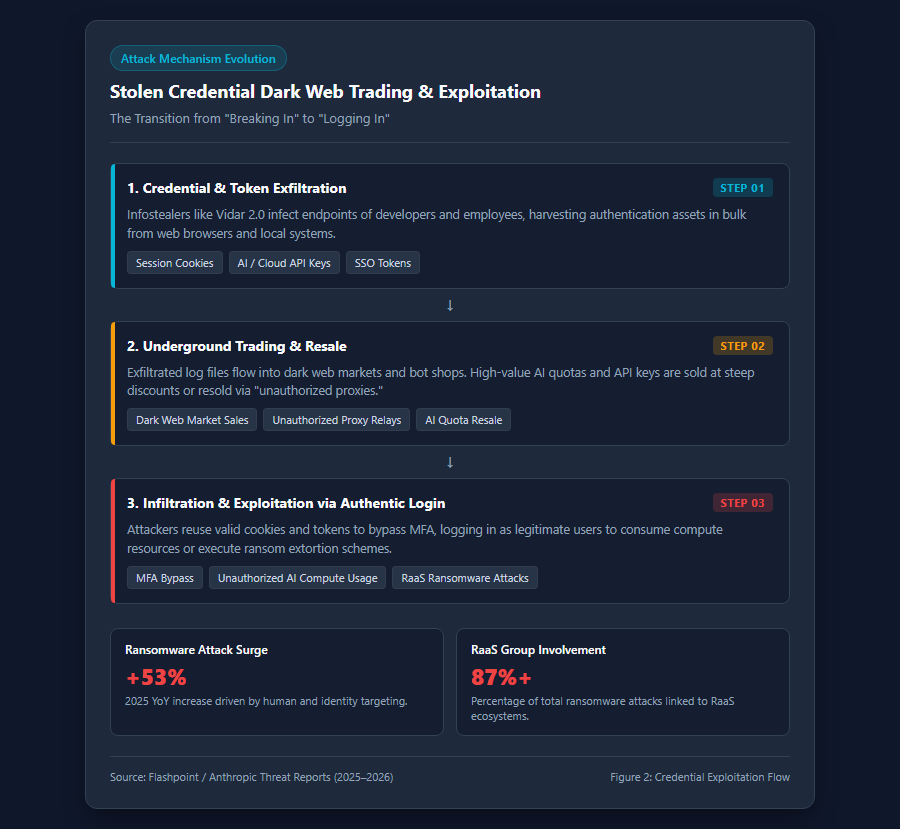
Flashpoint data shows that reported ransomware attacks surged by 53% year-over-year in 2025. This escalation is heavily fueled by threat actors abandoning traditional perimeter breach attempts in favor of exploiting human trust and compromised identities. Once an adversary gains access as an authenticated user, internal security controls fail to distinguish malicious activity from normal operations, leaving security operations center (SOC) teams unable to trigger timely alerts.
Unofficial Proxy Services and the API Key Resale Ecosystem
A threat intelligence report released by Anthropic in September 2026 provides an in-depth analysis of how stolen API keys and credentials are repurposed across the cybercriminal ecosystem.
High-cost AI access quotas and API keys exfiltrated from corporate environments are either sold at steep discounts on the dark web or resold via “unauthorized proxies”—illicit relay infrastructures operated by threat actors. Buyers gain access to advanced AI models at a fraction of the market price without establishing legitimate vendor agreements, deploying these resources to generate automated attack code and fuel fraud schemes.
This illicit supply chain triggers a cascading series of enterprise risks:
- Unintended cloud usage charges and sudden exhaustion of compute quotas for legitimate enterprise accounts
- Automated generation of sophisticated attack vectors leveraging stolen API access
- Secondary data spillages and breach risks as proprietary enterprise data flows through unauthorized AI relays
Consequently, the theft of AI access quotas represents far more than a financial loss; it turns an enterprise’s contractual AI assets into a launching pad for wider cyberattacks.
Organizational Risks and the Imperative for Defense
Agentic AI Exploits and Vulnerabilities in the Identity Layer
One of the most pressing cybersecurity challenges in 2026 is the convergence of autonomous, agentic AI systems with infostealing malware.
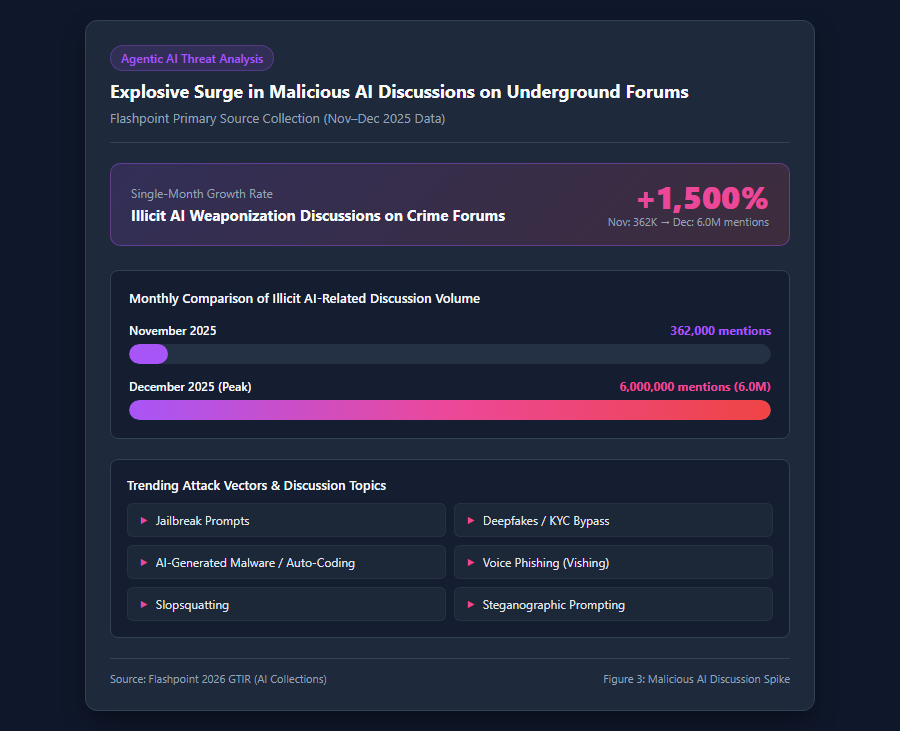
Flashpoint analysts observed a staggering 1,500% surge in illicit AI-related discussions across dark web forums between November and December 2025, reaching a peak volume of 6 million mentions. Cybercriminals are actively feeding massive volumes of exfiltrated infostealer logs directly into agentic AI frameworks to automate target selection, credential stuffing, and log concealment.
The chart below details the spike in illicit AI-focused discussions within threat actor communities.
Rather than exploiting mathematical flaws in AI models, adversaries are targeting the operational connective tissue—such as APIs, plugins, and identity services—that links AI assistants to enterprise environments. By exploiting these identity layers, attackers execute malicious commands at speeds and scales far exceeding manual attack methodologies.
Transitioning to Proactive Monitoring and Zero Trust Architecture
To counter the growing threat against AI quotas and digital identities, enterprises must transition from traditional perimeter defense to proactive, identity-centric protection.
Guidelines released by Japan’s Ministry of Internal Affairs and Communications (MIC), alongside industry best practices, emphasize implementing layered defense strategies for organizations managing AI infrastructure:
- Enforcing Zero Trust Network Access (ZTNA) to maintain continuous access verification and strict least-privilege policies
- Deploying Information Rights Management (IRM) solutions to enforce file- and token-level encryption and access restrictions
- Actively monitoring dark web forums and illicit marketplaces to detect compromised corporate credentials and exposed API keys in real time
- Centralizing password management tools and enforcing regular session cookie invalidation protocols
Relying on reactive incident response after a breach occurs is insufficient against automated, AI-driven attack vectors. Enterprises must reframe AI assets and digital tokens as mission-critical infrastructure, establishing proactive threat intelligence and rapid revocation workflows to ensure safe, resilient AI adoption.
Reference Pages
- 【Flashpoint】2026 Global Threat Intelligence Report
https://www.flashpoint.io/ - 【MIC】Guidelines on Technical Measures for Ensuring AI Security
https://www.soumu.go.jp/menu_news/s-news/01cyber01_02000001_00282.html - 【Anthropic】Investigating incidents in cybersecurity evals
https://www.anthropic.com/news/investigating-incidents-cybersecurity-evals
【#Cybersecurity #AI #Infostealer #CredentialTheft #ZeroTrust #CloudSecurity #Vidar #SecurityStrategy】

コメント