
On July 6, 2026, developer Jeremy HU released an open-source tool called “AutoRemesher,” which automatically converts 3D models into high-quality square meshes. Because it can transform complex scan data and sculpt models into practical topologies, it holds the potential to dramatically transform the efficiency of digital manufacturing.
- Innovative tools released on July 6, 2026
- Offered under a completely free and commercially available MIT license
- How quadrilateral topology transformations work and their benefits
- Optimization and performance of existing open source technologies
- Reducing production costs and promoting the utilization of scan data
- Development Roadmap and Further Evolution
Innovative tools released on July 6, 2026
On July 6, 2026, developer Jeremy HU released the standalone software “AutoRemesher,” which can convert complex 3D models into beautiful rectangular topologies. This tool has the ability to automatically convert 3D scan data and high-resolution sculpt models into high-quality quad meshes suitable for animation and simulation. Retopology refers to the process of reconstructing polygon structures to an optimal state while maintaining the model’s outline, and it is an extremely important step that directly affects the efficiency of subsequent production processes. Users can simply load the OBJ format model and execute retopology in just a few intuitive steps. Currently, binaries are available for Windows, macOS, and Linux platforms, enabling cross-platform use regardless of operating system. In particular, the ability to minimize topology breakage and twisting—which traditionally occurred in complex shapes—and generate structurally clean rectangular-based meshes—has attracted high interest from many CG artists and engineers.
Offered under a completely free and commercially available MIT license
One of AutoRemesher’s biggest features is its licensing model. The project was developed as open source from the start, but with the release of version 1.0, the MIT license was officially adopted. Developer Jeremy HU has invested extraordinary effort in reimplementing previously incompatible dependent libraries with MIT licenses to ensure that companies can confidently use this tool without restrictions even in commercial projects. Jeremy is also widely known in the industry as the developer of the modeling tool “Dust3D,” which has previously won the Epic Megagrant. This software is completely free to access through GitHub repositories, allowing anyone to freely view the source code and make modifications to their own needs. The release of such highly transparent and flexible tools can be seen as a major step toward expanding the use of open source software (OSS) in 3DCG production.
Chapter 2: Technologies Supporting High-Quality Mesh Generation and Comparison with Existing Tools
How quadrilateral topology transformations work and their benefits
In 3DCG production, having a model with a neat polygon has value beyond mere appearance. Square meshes provide better geometric quality and structural regularity than triangular meshes in computer-aided design (CAD), physical simulation, and character animation. Generally, raw triangular meshes generated by 3D scanning have irregular polygons, which can easily cause unnatural distortions during animation or shadow distortion during rendering, which is a drawback. For example, to smoothly represent a character’s mouth opening movement or physically simulate wrinkles in clothing, a quad mesh with edge flow aligned with anatomical structure and force direction is essential. However, until now, high-quality retopology work required artists with specialized knowledge to do it manually over an enormous amount of time, making it a highly labor-intensive process. AutoRemesher plays a role in bridging complex data to assets that can withstand production by automating this process with advanced algorithms.
Optimization and performance of existing open source technologies
From a technical perspective, AutoRemesher is based on well-known open-source technologies like “Quadriflow,” while incorporating its own optimizations throughout. Comparative tests by users have reported that some organic models generate better edge flows than traditional Quadriflow, significantly reducing unnatural artifacts that tended to occur at specific sites. Please refer to the diagram below.
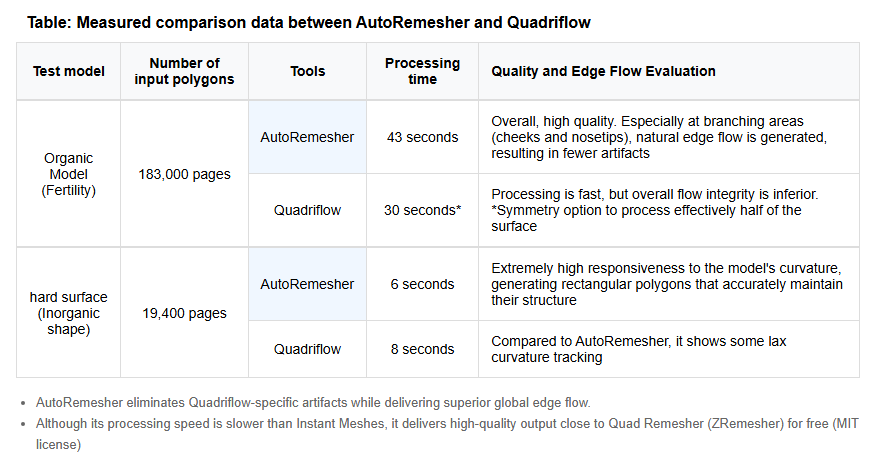
。 Compared to extremely fast tools like Instant Meshes, processing speed may take a certain amount of time, but in return, global topology consistency and edge continuity are maintained highly. In an actual case where a model with 183,000 faces was remeshed, it took about 43 seconds, but the quality of the output mesh was evaluated to behave similarly to that of very expensive commercial tools like ZRemesher and Quad Remesher (Exoside). Thus, the attempt to realize high-quality automatic retopology functionality—once dominated by expensive paid software—using open-source tools is an extremely ambitious and groundbreaking achievement.
Chapter 3: The Future of the 3DCG Industry and Future Highlights
Reducing production costs and promoting the utilization of scan data
The spread of AutoRemesher has the potential to further accelerate the use of 3D data throughout society. In recent years, dramatic advances in 3D printing and scanning technology have made it easier to digitize real-world objects and share and distribute them via the internet. However, raw data immediately after scanning is enormous and difficult to handle, which has always been a challenge. If AutoRemesher enables these data to be optimized automatically and at low cost, the digitization of design in manufacturing and barriers to individual digital manufacturing will be further lowered. On the other hand, the ease of duplicating and modifying 3D data also presents new challenges under intellectual property law. The harmony of legal systems and technological evolution—such as what rights arise for 3D data created on computers without blueprints, and how to reduce legal risks when using OSS—will become important points of discussion in the future digital society.
Development Roadmap and Further Evolution
Although AutoRemesher is currently positioned as an early stage of development (alpha), its future potential is highly regarded by many experts. Developer Jeremy HU plans to continue providing updates, with expectations for further refinement of the algorithm and improvements to the user interface. On the production floor, there is a strong desire for integration as an add-on to major 3DCG software like Blender, or for a guide feature that allows users to finely specify edge flow in specific areas. In the medium to long term, integration with learning-based retopology methods using neural networks (such as NeuFrameQ) is also considered a strong option for improving accuracy. By presenting a clear roadmap and flexibly incorporating feedback from communities around the world, AutoRemesher is expected to grow into one of the standard infrastructures for 3DCG production.
[#3DCG #AutoRemesher #オープンソース #リトポロジー #デジタルツイン #ソフトウェア開発 #3Dスキャン]


コメント