A significant performance gap has emerged among cloud-hosted AI models: processing times and response speeds for identical classes of tasks now vary by up to 5.6x to 7x depending on the underlying infrastructure and architecture. This discrepancy is driven primarily by memory bandwidth bottlenecks in traditional GPUs, as well as uneven adoption of next-generation technologies like data center power control and wafer-scale engines.
- Disparities in Processing Time and Latency Among Frontier Models
- Quantitative Comparison of Task Completion and Speed in Real-World Workflows
- GPU Memory Bottlenecks vs. the Rise of Wafer-Scale Engines
- Evolution of Data Center Power Control and Infrastructure Optimization
- Transforming Workflows Through Real-Time AI Agents
- Infrastructure Integration, Technical Challenges, and Key Trends
Disparities in Processing Time and Latency Among Frontier Models
Since August 2026, a pronounced disparity in processing times and generation speeds has surfaced across the latest frontier AI models deployed in the cloud. Historically, cloud AI services required users to endure wait times of several minutes or more for complex reasoning or extensive code generation. However, recent optimizations in inference infrastructure and model design have pushed output speeds up to 750 tokens per second. This represents a 5x to 11x leap in token generation speed and a 5.6x to 7x reduction in overall task completion time compared to conventional GPU setups. Beyond benchmark metrics, this performance gap directly impacts real-world API responsiveness and operational economics. Depending on the provider and model architecture, input and output API pricing can differ by up to 13.3x. Furthermore, even for the same model, execution speeds fluctuate dramatically based on the selected inference mode and underlying hardware stack. Consequently, enterprise evaluation criteria are shifting from pure reasoning accuracy toward throughput and task completion efficiency within strict time constraints.
Quantitative Comparison of Task Completion and Speed in Real-World Workflows
To evaluate the practical impact of these performance differences, data from GDP-Val—a benchmark measuring high-value knowledge work across legal, financial, and engineering domains—provides compelling quantitative evidence. Real-world testing conducted in July 2026 evaluated OpenAI’s flagship GPT-5.6 Sol model across different inference tiers. In standard mode, a complex task took an average of 7.7 minutes (approximately 462 seconds). When executed in ultrafast mode on optimized wafer-scale infrastructure, the exact same task finished in just 83 seconds. This represents an end-to-end speedup of 5.6x to 7x without any degradation in response quality.
Please refer to the figure below.
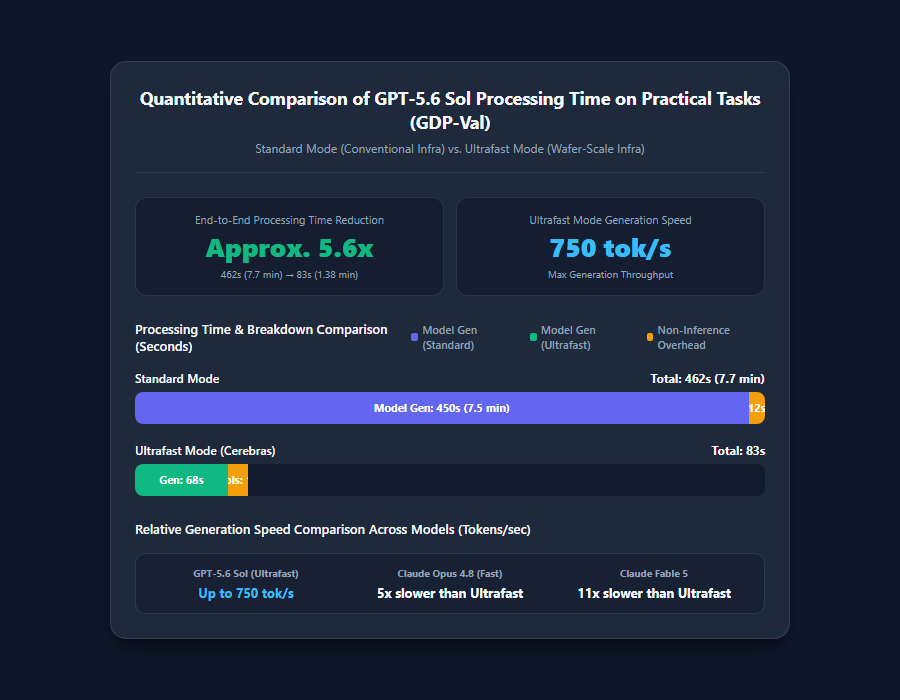
In standard processing mode, the vast majority of execution time is spent waiting for the model to stream tokens. In contrast, under the ultra-high-speed environment, model generation itself completed in merely 68 seconds, with the remaining 15 seconds consumed by non-inference overheads such as tool calling. Similar speed and completion rate discrepancies have been observed across other benchmarks, including DeepSWE v1.1 for software engineering and Terminal-Bench 4.0 for complex terminal-based execution. For enterprise users deploying autonomous agents to handle multi-step workflows, these timing variations represent the difference between seamless real-time operation and productivity-killing delays.
Technical Factors Driving the Performance Divide
GPU Memory Bottlenecks vs. the Rise of Wafer-Scale Engines
The primary technical driver behind these multi-fold speed differences lies in semiconductor memory architecture. In traditional general-purpose accelerators such as NVIDIA GPUs, generating every individual token requires repeatedly retrieving model weights from off-chip High Bandwidth Memory (HBM) into the compute cores. As model parameters grow, this data movement creates a massive bottleneck where generation speed is constrained not by raw compute capacity, but by memory bandwidth. Conversely, wafer-scale systems such as the Cerebras WSE-3, which gained widespread commercial adoption in 2026, integrate 44 GB of on-wafer SRAM directly onto a single massive silicon wafer. Keeping the entire model weights on-chip eliminates off-chip memory transfers, effectively removing data transfer latency during token generation. When paired with pipeline parallelism across multiple compute nodes, wafer-scale architectures achieve ultra-low-latency inference while maintaining frontier-class intelligence. This architectural divergence between on-chip SRAM and off-chip HBM is the core reason for the 7x latency gap across cloud providers.
Evolution of Data Center Power Control and Infrastructure Optimization
A second major factor shaping cloud processing speeds is the advancement of dynamic power management and capacity optimization at the data center scale. Power availability has become the single largest bottleneck for AI data centers. Historically, facilities allocated power statically based on peak consumption limits, leaving substantial power headroom unused during normal operation. In August 2026, NVIDIA demonstrated its DSX MaxLPS data center power control technology on a 5-rack, 19-node cluster equipped with NVIDIA HGX B200 systems. The technology successfully powered all 19 nodes within a power envelope previously capped at 16 nodes.
Please refer to the figure below.
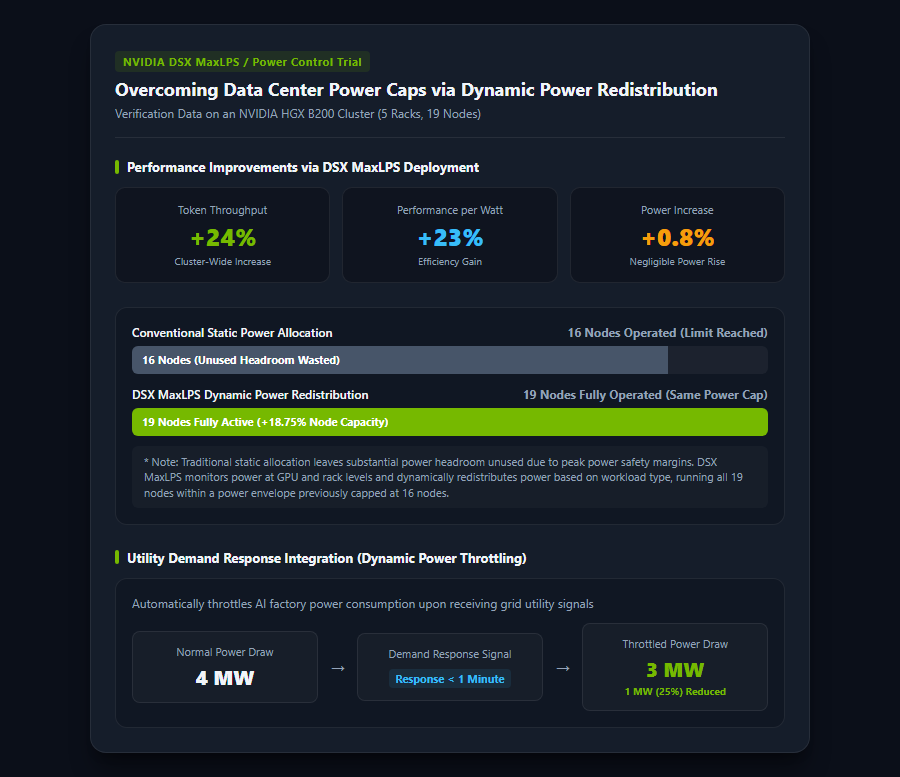
During the trial, the cluster achieved a 24% increase in total token throughput and a 23% improvement in performance-per-watt, while power consumption rose by a negligible 0.8%. Additionally, commercial demand-response systems now allow data centers to dynamically shed power—for instance, throttling consumption from 4 MW to 3 MW in less than 60 seconds in response to grid utility signals. Facilities capable of dynamically reallocating power and absorbing extra compute nodes within existing power budgets can deliver significantly higher aggregate throughput and faster API response times.
Enterprise Impact and Future Outlook
Transforming Workflows Through Real-Time AI Agents
The 7x reduction in AI processing times extends far beyond simple latency savings; it fundamentally alters human-AI collaboration. In slow-response environments, users waiting minutes for outputs inevitably switch browser tabs, fracturing focus and incurring heavy context-switching costs. Conversely, when output generation reaches hundreds of tokens per second and complex reasoning finishes in seconds, users can maintain continuous, real-time dialogue with AI agents. This immediacy is critical in time-sensitive operations, such as live incident response, cyberattack mitigation, and real-time pair programming. However, ultra-fast inference is not universally required. For batch processing, large-scale document indexing, or non-urgent background tasks, cost efficiency per token remains the primary metric. Enterprises are consequently adopting dual-tier operational strategies, pairing standard inference modes for bulk workloads with ultra-fast modes for mission-critical workflows.
Infrastructure Integration, Technical Challenges, and Key Trends
The battle over cloud AI processing speeds is rapidly reshaping the enterprise technology landscape. Leading frontier AI labs—including OpenAI, Anthropic, and Google—are treating latency reduction and infrastructure procurement as top strategic priorities alongside model accuracy. Organizations are diversifying away from exclusive reliance on single-vendor GPU clusters toward heterogeneous environments that combine wafer-scale chips, custom ASICs, and sovereign on-premises LLM infrastructure. As highlighted in verification reports by Japan’s Information-technology Promotion Agency (IPA), hybrid architectures leveraging existing CPU servers and air-gapped private networks offer greater control and predictability. Moving forward, navigating global semiconductor supply constraints—such as TSMC advanced packaging and HBM availability—while scaling gigawatt-class power and cooling infrastructure will determine market leadership. Enterprise decision-makers must evaluate AI foundations not solely on raw intelligence benchmarks, but on a holistic combination of execution speed, total cost of ownership, and infrastructure sovereignty.
References
- 【Cerebras: Accelerating GPT-5.6 Sol Ultrafast with OpenAI】https://www.cerebras.ai/blog/accelerating-gpt-5-6-sol-ultrafast-with-openai
- 【llama.cpp: Port of Facebook’s LLaMA model in C/C++】https://github.com/ggml-org/llama.cpp
- 【NIST FIPS 203: Module-Lattice-Based Key-Encapsulation Mechanism Standard】https://csrc.nist.gov/pubs/fips/203/final
【#CloudAI #AISpeed #GenerativeAI #DataCenter #Cerebras #NVIDIA #AIAgents】


コメント