Offers, an engineer career transition platform operated by overflow Inc., has added “Jev”—a novel AI model developed by US-based TypeSafe AI—to its registered skill profiles. This move comes against the backdrop of a rapid shift in the technical hiring landscape driven by generative AI, where evaluation criteria for software engineers are shifting from conventional code-writing speed to structured decision-making and adaptability to emerging technologies.
- Rapid Addition of “Jev” Just Five Days After Public Release
- “The Power to Question” and Skill Visualization Required for Next-Gen Engineers
- Next-Generation Recruitment and Scouting Strategies Connecting Enterprises with AI Talent
- The Core Design of “System One Models” That Omit Text Generation
- The RLCD Algorithm Enabling Ultra-Fast, Low-Cost Inferences
- Current Realities, Evaluation Trade-Offs, and Future Outlook
Rapid Addition of “Jev” Just Five Days After Public Release
On September 20, 2026, overflow Inc. announced the addition of “Jev”—an AI model released on September 15, 2026, by US startup TypeSafe AI—to the skill category options on its engineer job platform, Offers. Offers boasts a registered user base of approximately 40,000 job seekers nationwide and a track record of supporting recruitment across more than 1,000 companies. Through this swift platform update, forward-thinking AI talent and engineers who experiment with newly released technologies can immediately highlight their hands-on verification experience on their professional profiles. The image below illustrates the overview of this skill integration.
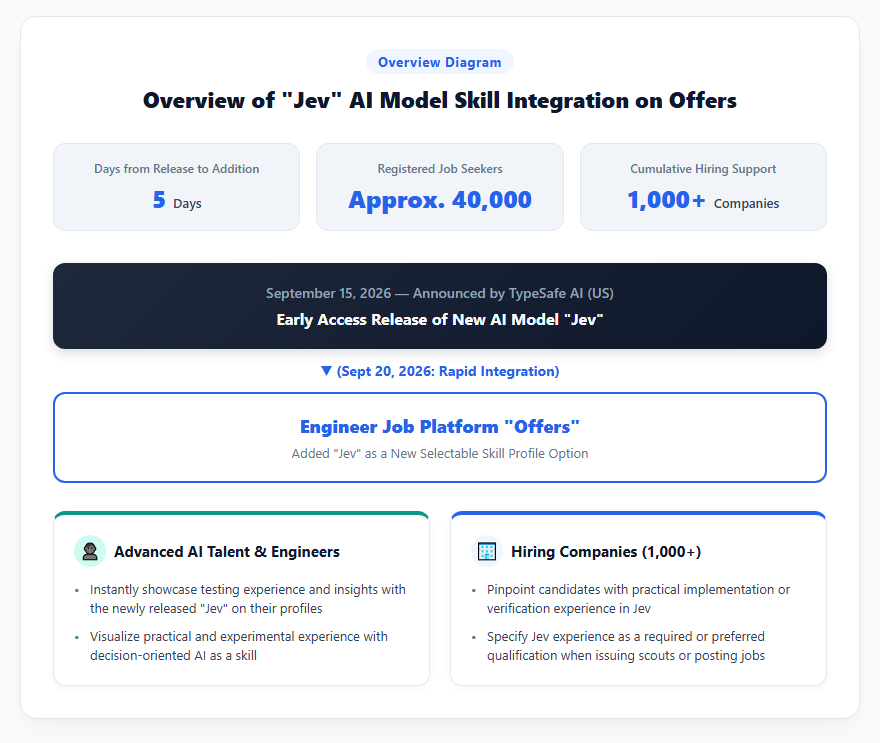
Simultaneously, hiring companies can now precisely filter and target candidates possessing real-world testing or integration experience with cutting-edge AI tools like Jev when issuing direct talent scouts or setting job requirements. In an era where technological innovation moves at breakneck speed, reflecting a brand-new model on a recruitment platform within five days represents a groundbreaking initiative aligned directly with industry needs.
“The Power to Question” and Skill Visualization Required for Next-Gen Engineers
In technical recruitment, the skill sets demanded of software engineers are undergoing a fundamental transformation due to the proliferation of generative AI. As AI assumes the burden of rapidly generating boilerplate code and written solutions, human engineers are increasingly evaluated on their ability to formulate strategic questions—determining why a given problem should be solved and designing overall system architectures. To adapt to this shifting paradigm, overflow Inc. has proactively championed the visualization of non-traditional skills on Offers that transcend conventional job titles. The platform has progressively introduced emerging roles and skill categories such as Forward Deployed Engineer (FDE), Go-To-Market (GTM) Engineer, Deployment Strategist (DS), and AI Builder. The addition of Jev fits squarely into this strategy, establishing an evaluation foundation that properly assesses an engineer’s capability to leverage decision-oriented AI models engineered for deterministic evaluation within software pipelines rather than text generation.
Next-Generation Recruitment and Scouting Strategies Connecting Enterprises with AI Talent
Integrating Jev into skill profiles delivers substantial enhancements to corporate scouting strategies and hiring precision. In traditional mid-career hiring, candidate evaluation heavily favored years of experience and past employers listed on resumes; however, in the AI era, adaptability to emerging tools and the velocity of practical technology verification have become critical metrics. Organizations can now define highly specific candidate profiles—such as professionals who have implemented automated ticket routing and verification using Jev, or architects who deployed lightweight decision models upstream of large language models to optimize computational costs. This enables highly targeted matching based on an applicant’s distinct technical interests and recent accomplishments, departing from generic mass-scout messaging. For employers, this approach minimizes hiring mismatches while accelerating the buildout of advanced AI development teams.
Technical Architecture of “Jev” and Its Broader Industrial Impact
The Core Design of “System One Models” That Omit Text Generation
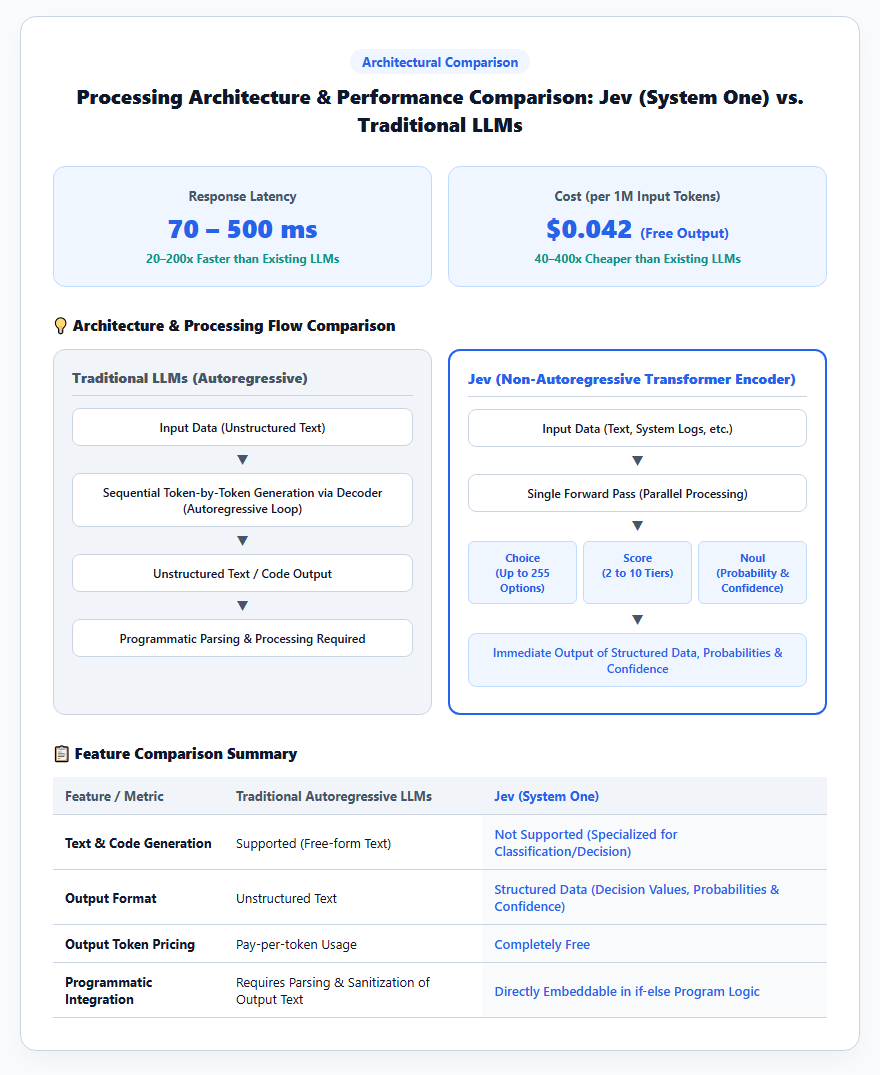
Developed by Diogo Almeida—a former OpenAI researcher involved in foundational ChatGPT research—and his team at US-based TypeSafe AI, Jev represents a new paradigm termed a “System One Model.” Its defining architectural feature is a deliberate, complete omission of text and code generation. While traditional autoregressive Large Language Models (LLMs) output text token-by-token sequentially, Jev entirely eliminates the decoder network, employing a non-autoregressive Transformer encoder architecture instead. By converting unstructured input text or system logs into semantic vectors and mapping them directly onto predefined classification heads, Jev outputs structured data—including categorical selections, numerical scores, probability distributions, and confidence metrics—in a single forward pass without output token generation. The concept of Jev’s parallel decision-making framework is displayed below.
The RLCD Algorithm Enabling Ultra-Fast, Low-Cost Inferences
Powering Jev’s remarkable efficiency is a proprietary training methodology called Reinforcement Learning for Calibrated Decisions (RLCD). To prevent the overconfidence bugs typical of standard cross-entropy loss functions, RLCD applies a composite reward function incorporating strictly proper scoring rules: bounded logarithmic score, spherical score, and ranked probability score (RPS). Furthermore, Jev supports three core primitives—Choice (selecting from up to 255 candidates), Score (evaluating across 2 to 10 rating tiers), and Noul (returning binary boolean probabilities)—which can be evaluated concurrently in a single API request. Demonstrating response latency of 70 to 500 milliseconds—20 to 200 times faster than standard LLMs—and pricing set at \$0.042 per million input tokens with zero output token fees, Jev operates 40 to 400 times cheaper than traditional generative models, outputting reliable values ready for direct inclusion in program logic.
Current Realities, Evaluation Trade-Offs, and Future Outlook
Despite its speed and cost efficiency, Jev maintains clear functional constraints: it cannot generate prose, converse, or articulate complex reasoning paths. Furthermore, academic and open-source communities have pointed out that Jev’s statistical calibration holds primarily across static, single-hop evaluation benchmarks, warning that confidence metrics may degrade across continuous, multi-step Markovian loops in autonomous agent architectures due to error propagation. Additionally, because its benchmark ground truth relies on ensemble averages from top-tier LLMs, third-party validation remains essential for specific enterprise domains. Moving forward, the industry is anticipated to embrace hybrid AI architectures combining System 2 LLMs for deep reasoning with System 1 models like Jev for instant routing and classification, requiring engineers to master the optimal composition of both paradigms.
Reference Pages
- [overflow Inc. Press Release] https://prtimes.jp/main/html/rd/p/000000346.000053307.html
- [TypeSafe AI Official Website] https://typesafe.ai/
- [Offers Official Website] https://offers.jp/
【#Offers #Jev #TypeSafeAI #TechHiring #GenerativeAI #HRTech】


コメント