
In July 2026, President Trump made his stance on AI regulation by minimizing government intervention while implementing minimum safeguards, prioritizing private-sector innovation. Behind this is the previous administration’s withdrawal of regulatory policies and a national strategy based on “techno-federalism” to secure an overwhelming advantage in the development race with China.
- The true meaning behind “avoiding intervention” in the CNBC interview
- 2025 AI Action Plan and Complete Rejection of Biden’s Direction
- The number one strategy in the market “beyond the internet”
- The Reality of Hardware Export Controls Centered on National Security
- A strong wave of regulatory demands rising from within the MAGA camp
- The shock of OpenAI’s ‘proposal to offer 5% of shares’ to the government
- The Golden Age of Data Center Expansion and Energy Infrastructure
The true meaning behind “avoiding intervention” in the CNBC interview
In an interview aired on July 2, 2026, U.S. President Trump discussed the nature of AI regulation in a CNBC interview. While acknowledging that some guardrails are necessary in the development of AI technology, the president expressed a desire to minimize government intervention as much as possible. Underlying this statement is the recognition that the AI market will surpass the scale of the internet in the past, and the competitive principle is that the number one player in this development race wins.
The president stated that malicious players would be dealt with quickly and effectively, citing export restrictions on Anthropic’s AI models “Claude Fable 5” and “Claude Mythos 5” implemented in June 2026 as a recent example. At that time, the regulation was “jailbreak,” which could bypass the model’s safety mechanisms and detect software vulnerabilities. However, with the confirmation of strengthened safety measures, the restrictions were lifted on June 30, 2026. In this way, the current Trump policy is characterized by “pinpoint interventions” that strictly address specific safety risks without slowing the overall pace of development.
2025 AI Action Plan and Complete Rejection of Biden’s Direction
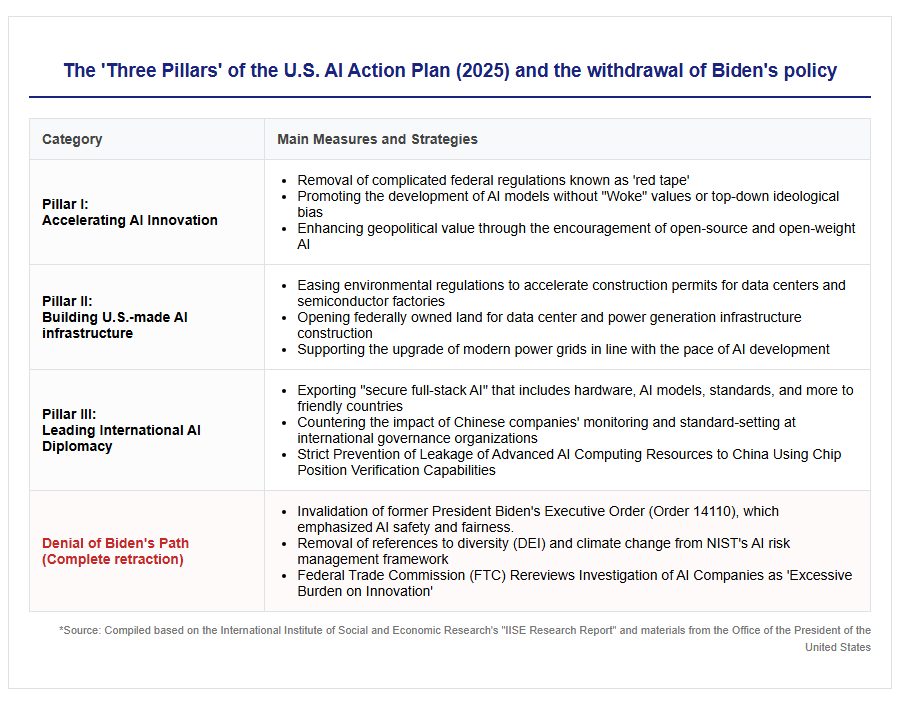
The Trump administration’s AI policy was determined by Executive Order 14179, “Removing Barriers to U.S. Leadership in AI,” issued shortly after taking office in January 2025. This order effectively revoked the executive order signed by former President Joe Biden in October 2023, which emphasized AI safety assessment and fairness. The Trump administration has defined the previous administration’s regulations as “an excessive and unnecessary burden on AI development,” criticizing them as undermining America’s global dominance.
Subsequently, the “Winning the AI Race: U.S. AI Action Plan,” announced on July 23, 2025, identified more than 90 specific measures. This action plan consists of three pillars: “Accelerating AI Innovation,” “Building U.S.-made AI Infrastructure,” and “Leading International AI Diplomacy.” The Federal Trade Commission (FTC) is also urging a review of all investigations into AI companies initiated under the previous administration, and to revise or nullify any investigations that place excessive strain on innovation. Please refer to the diagram below.
Countering China and the Rise of ‘Techno-Federalism’
The number one strategy in the market “beyond the internet”
President Trump positions the competition with China in AI development as a battle that will determine “a new golden age for human prosperity, economic competitiveness, and national security.” By making the export of U.S.-made AI a national priority, it seeks to prevent China’s growing influence by providing allies with “secure full-stack AI” packaged in hardware, AI models, software, and standards. As a result, countries in the Global South are forced to choose between American-made AI and Chinese-made AI.
In this competitive environment, the United States is transitioning to a new governance model known as “techno-federalism.” This is a paradigm that incorporates the traditional relationship between federal and state governments with the “market power” of giant tech companies as a third regulatory force. Rather than enforcing strict codes, governments are encouraging market discipline and industry self-governance, enabling flexible and dynamic responses to rapidly evolving AI technologies.
The Reality of Hardware Export Controls Centered on National Security
While the Trump administration has relaxed regulations on AI software, it has maintained extremely strong controls over the physical foundation of AI, especially in semiconductors. Based on the CHIPS Act enacted in 2022, we are leveraging $280 billion in federal subsidies to attract factories of major manufacturers such as Intel, Samsung, and TSMC to the U.S., promoting the de-China transformation of their supply chains. These subsidies are accompanied by “national security guardrails,” strictly limiting investment and technology transfer to China.
Furthermore, to block China’s access to advanced AI computing resources, there are plans to strengthen export controls utilizing the position verification function of semiconductor chips. This is a creative approach to ensure that chips do not exist in countries of concern, aiming to close loopholes in existing export regulations. Thus, the Trump administration’s policy of “minimal intervention” is primarily aimed at promoting innovation within the U.S., and in terms of managing hardware and infrastructure from hostile countries, it has taken an unprecedentedly tough approach.
Future developments and new uncertainties surrounding the AI industry
A strong wave of regulatory demands rising from within the MAGA camp
Ironically, in response to President Trump’s “non-regulating” stance, there are calls for strong regulation from within the current support base, the “MAGA (Make America Great Again)” camp. In May 2026, more than 60 MAGA leaders, including former Chief Strategist Steve Bannon, sent a letter to the White House demanding mandatory government inspection and approval before powerful AI models are released. They warn of the risks of AI assisting in the design of biological weapons, intrusion into core infrastructure, and manipulation of financial markets as a “serious threat.”
Conservative activists argue that elites from unchosen tech companies should not be allowed to conduct experiments on the public without safety measures or accountability. This also reflects the wariness unique to Trump’s supporters, who see tech giants as part of the “shadow government.” The White House has so far pursued policies to invalidate state-level regulations, but it is difficult to completely ignore regulatory demands from the core power base of the MAGA camp, casting a subtle shadow over future policy decisions [4,517; 5,524].
The shock of OpenAI’s ‘proposal to offer 5% of shares’ to the government
Amid growing regulatory uncertainty, it has been reported that OpenAI, the largest company in the industry, is making an extremely unusual proposal to the government. According to reports from July 2026, the company’s CEO, Sam Altman, has begun negotiations to transfer 5% of the company’s shares (worth approximately $42.6 billion) to a U.S. government public investment vehicle, on the condition that political and regulatory hurdles are cleared. Analysts analyze that while this proposal claims to share the benefits of AI with the public, in reality it is a “buyout of regulatory certainty through equity.”
Altman has already been in contact with President Trump and Commerce Secretary Lutonic and is reportedly proposing the creation of public funds like the Alaska Perpetual Fund, where other major AI companies would also contribute 5% of their stakes. If this plan is realized, governments and AI companies will become a shared destiny, leading to regulatory relaxation and accelerated IPOs (initial public offerings), but new legislation from Congress is essential for implementation. This move by private companies offering shares directly to the government to circumvent regulation could bring about a historic shift in public-private relations in the United States.
The Golden Age of Data Center Expansion and Energy Infrastructure
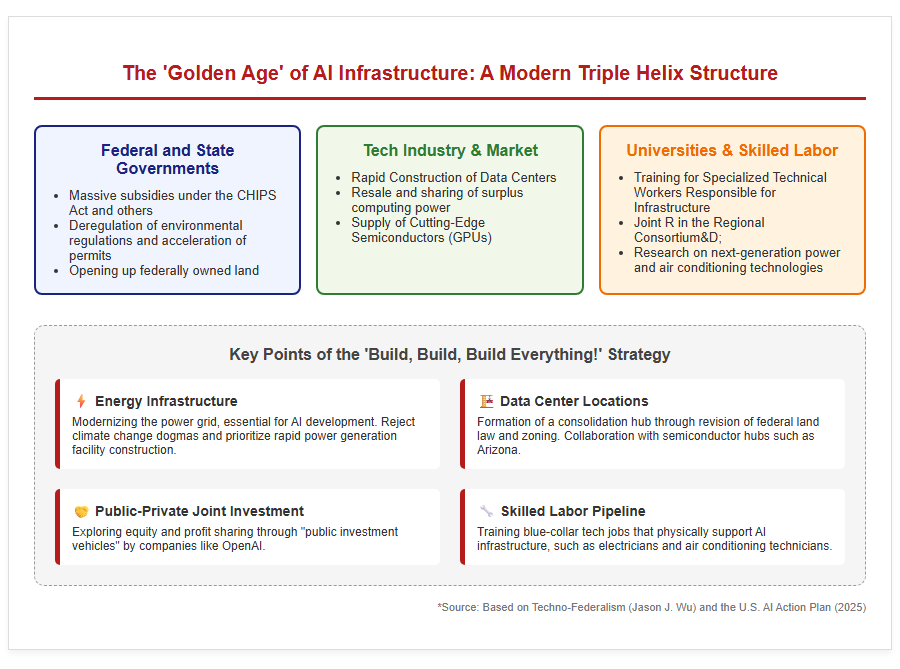
The Trump administration’s top priority as the cornerstone of the “golden age” is the rapid expansion of data centers and energy infrastructure, which are the “physical tools” of AI. The July 2025 action plan calls for dramatic deregulation, such as easing cumbersome environmental regulations and making federal land available for data center construction. The motto is “Stand, Stand, Stand!” clearly rejecting bureaucratic bureaucracy and dogmatism on climate change.
Along with this, upgrading the power grid to operate data centers and securing new energy sources have become urgent priorities. Meta’s start selling surplus computing power externally is also seen as a strategic move to increase infrastructure asset turnover and recover massive capital investments. Going forward, with federal government funding as a backdrop, attention will be focused on whether semiconductor hubs like Arizona and data center sites in each state will collaborate with universities and industry to form a “modern triple helix,” establishing the infrastructure that supports U.S. AI dominance. Please refer to the diagram below.
[#トランプ大統領 #AI規制 #国家安全保障 #米中競争 #テクノ連邦主義 #OpenAI #インフラ投資]


コメント