Since around August 2026, second-hand bookstores across Japan have experienced a series of “mysterious bulk orders” for specialized books and other titles, driven by a global buying frenzy for physical books aimed at securing training data for generative AI. As cyberspace becomes increasingly contaminated with AI-generated text, clean second-hand books published in 2022 or earlier have become the target of a fierce scramble as a new “resource of knowledge.”
- An abnormal sales volume of 100 books a day and a shared shipping destination
- Tracking Record of 50 Tons of Japanese Books That Crossed to the U.S.
- Technical Reasons for Seeking “Uncontaminated Data” from Before 2022
- “Project Panama” and the Reality of Destructive Scanning
- Differences in the Debate Surrounding US Court Rulings and Japan’s Copyright Law
- Revaluation of Analog Assets and Future Outlook
An abnormal sales volume of 100 books a day and a shared shipping destination
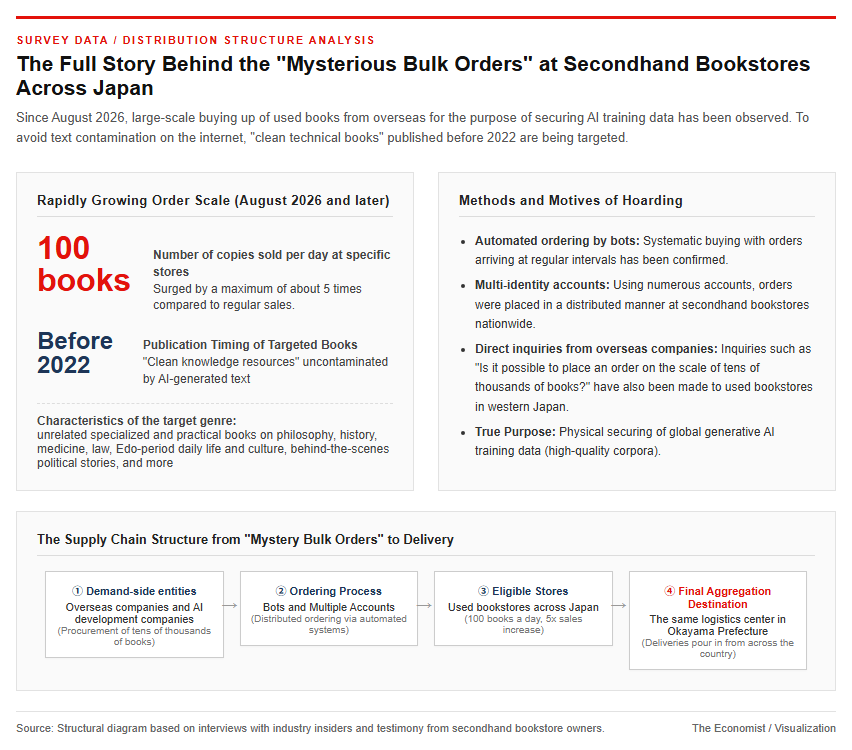
Since around August 2026, online used bookstores and major book websites across Japan have been hit by a wave of unprecedented, large-scale book orders. According to a Tokyo-based used bookstore owner interviewed for this story, while comics and novels are typically what sells, this time a disparate mix of academic and practical books—such as philosophy, history, medicine, law, as well as “behind-the-scenes political gossip from 30 years ago” and “the lifestyle and culture of the Edo period”—are being bought up all at once. At certain stores, more than 100 books have been sold in a single day, with some days seeing sales surge to five times their usual levels.
A secondhand bookstore owner in the Kanto region (a man in his 50s) suspects that purchases are being made using a mechanical automated system (bot program) because orders arrive at regular intervals. Furthermore, an investigation by industry insiders revealed a strange commonality: while orders are being placed at various stores from accounts under multiple names, the shipping destinations for all the items are concentrated at the exact same logistics center in Okayama Prefecture. Another secondhand bookstore in western Japan has also received a direct inquiry email from an overseas company asking, “Is it possible to place an order on the scale of tens of thousands of books?”, leading to a rapidly growing view within the industry that the purpose may be to collect training data for generative AI. The following figure illustrates this series of transactions.
Tracking Record of 50 Tons of Japanese Books That Crossed to the U.S.
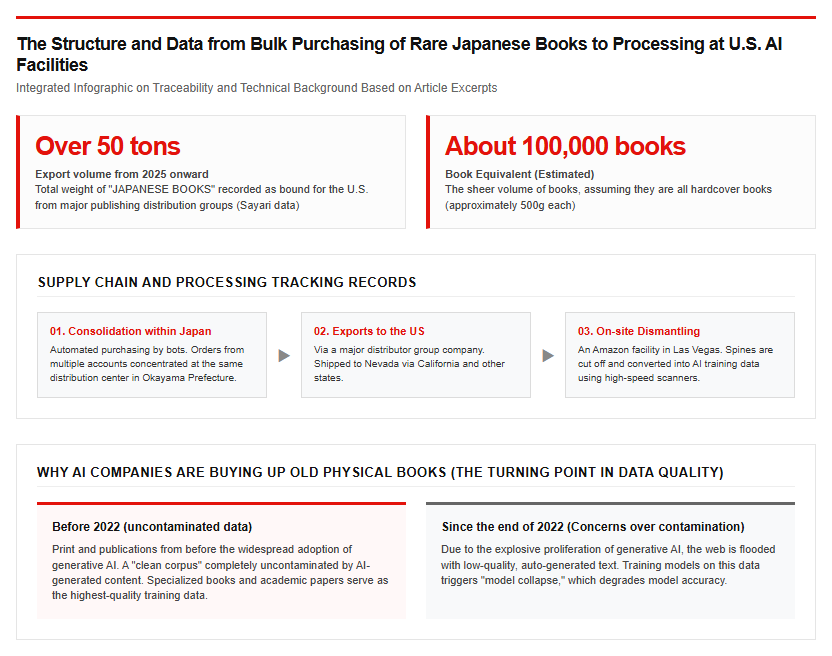
An investigative follow-up on the background of mysterious mass purchases at used bookstores has revealed the reality that large quantities of Japanese paper books are being exported overseas. Through an investigation using “Sayari,” a tool for analyzing trade and import/export data, records were confirmed showing that a total of over 50 tons of “JAPANESE BOOKS” were exported from a group company of a major Japanese publishing distributor to the United States in 2025 alone. Assuming all of these are heavy hardcover books (weighing about 500 grams each), this calculates to a massive amount of books—equivalent to roughly 100,000 volumes—crossing the ocean.
Specific examples of where such physical books end up have been brought to light through an investigation by the US investigative journalism media outlet “404 Media.” When the outlet placed tracking devices (AirTags) inside 1,000 used books to track their transport routes, the packages passed through California and other locations before arriving at a massive Amazon fulfillment center in Las Vegas, Nevada. Inside the facility, workers reportedly scanned the books, with the pages—dismantled by cutting off their spines—fed into high-speed scanners. An interviewed employee testified, “All we do here is scan books,” strongly suggesting that books exported from Japan are being processed in the same way as AI training data.
Why AI Companies Are Buying Up and Destroying Old Paper Books
Technical Reasons for Seeking “Uncontaminated Data” from Before 2022
The primary reason advanced AI development companies are bulk-purchasing physical books from used bookstores around the world lies in the “preservation of data quality” for training generative AI models. Ever since the explosive spread of generative AI, including ChatGPT, at the end of 2022, the web space on the internet has become flooded with massive amounts of inaccurate text and low-quality automatically generated content created by AI itself. Incorporating such AI-generated text back into AI training data gives rise to a serious technical challenge known as “model collapse” (data self-contamination), in which the model’s accuracy deteriorates and its outputs collapse.
In contrast, printed books and used books printed or published in 2022 and earlier—before the widespread adoption of generative AI—hold extremely high value as “pure text data (clean corpora)” completely unpolluted by AI-generated content. In particular, specialized books, academic papers, and historical documents written by humans based on specialized knowledge and published after going through editors and proofreaders serve as “high-quality training data” for building the logical reasoning abilities and deep knowledge base of large language models. For major tech companies that have exhausted the text available on the web, undigitized old books are the highest-quality intellectual resources remaining, and they have become an indispensable battleground for improving AI performance. The overall picture of the technical background is summarized in the figure below.
“Project Panama” and the Reality of Destructive Scanning
In the overseas antiquarian book industry, including in the United States, similar unusual bulk purchasing had been observed several months earlier than in Japan. At secondhand bookstores in the UK, Ireland, Australia, and elsewhere, mysterious buyers appeared one after another, purchasing antiquarian books across a diverse range of unrelated genres at full price without any discount negotiations. It has been revealed that a massive volume of books was collected via logistics warehouses near London’s Heathrow Airport and bases in Canada.
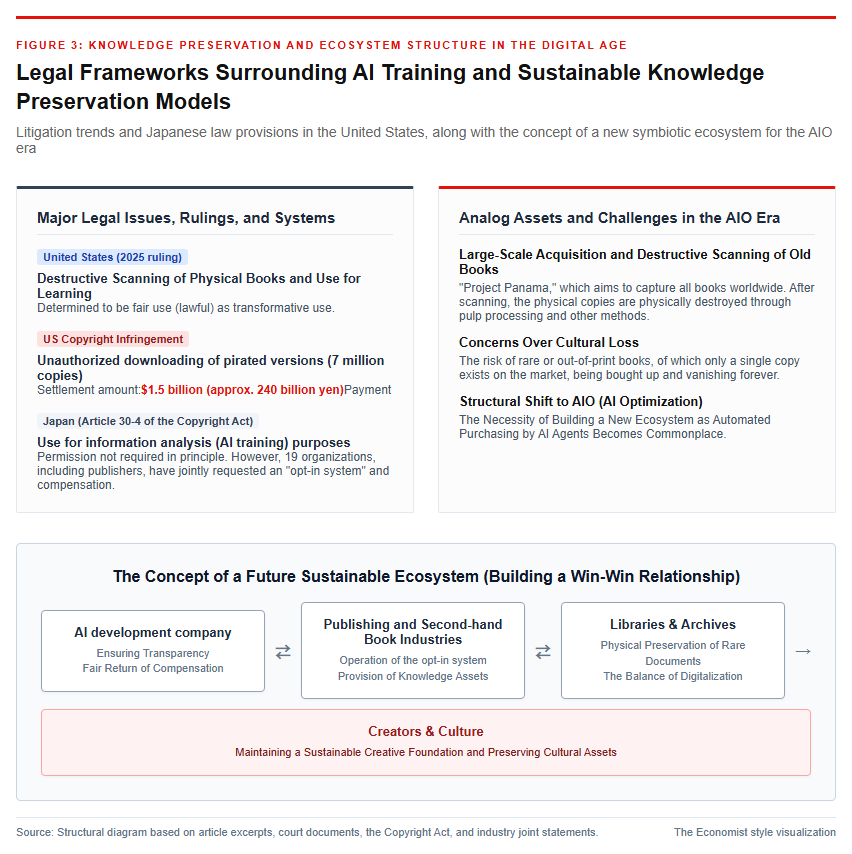
The full picture of this initiative became even clearer with the unsealing of court documents related to a lawsuit involving U.S. AI giant Anthropic. In the company’s internal communications, the plan to ingest antiquarian and used books was called “Project Panama,” and its purpose was explicitly stated as “destructively scanning every book in the world.” Destructive scanning is a method in which books are cut using industrial hydraulic cutters to slice off the spines, and the separated pages are read all at once by high-speed scanners to digitize the entire text. After scanning is complete, the paper is disposed of through pulp processing or similar methods. To prevent data from leaking back into the market to be repeatedly used for training, and to maintain a one-to-one archive as an internal library, physical books are systematically destroyed after scanning.
Legal Challenges and Knowledge Preservation in the Digital Age
Differences in the Debate Surrounding US Court Rulings and Japan’s Copyright Law
Regarding the legal basis for purchasing physical books, cutting and scanning them, and using them for AI training, there are significant institutional differences between countries. In 2025, in a copyright lawsuit filed against Anthropic by authors, a federal district judge ruled that “destructively scanning legally purchased physical books and using them for training purposes” constitutes transformative use and falls under fair use (lawfully permissible) under copyright law. On the other hand, the act of downloading data for over 7 million books without authorization from pirate e-book sites was clearly recognized as copyright infringement, resulting in the company paying a record-breaking settlement of $1.5 billion (approximately 240 billion yen).
Under Article 30-4 of Japan’s Copyright Act, the use of copyrighted works for “information analysis (AI training)” not intended for the enjoyment of thoughts and emotions is, in principle, permitted without the consent of the right holder. However, 19 organizations, including publishers such as Kodansha and KADOKAWA as well as the Japan Cartoonists Association, have issued a joint statement calling for right holders’ consent, the enforcement of transparency, and the introduction of an opt-in system. Self-reproduction for training purposes is a separate issue from providing data to third parties or public transmission, and concerns and discussions continue both domestically and internationally over how the unauthorized use of content threatens the foundation of creation without adequate compensation being returned to authors.
Revaluation of Analog Assets and Future Outlook
The successive “mysterious bulk orders” at secondhand bookstores have vividly highlighted the ironic reality that AI technology, operating at the cutting edge of the digital society, still depends on the analog intellectual medium of paper. While mismatched used books that had slumbered on shelves for years are being unexpectedly purchased and bringing in profits, there are also strong concerns within and outside the used book industry regarding the cultural loss of rare and out-of-print books—of which perhaps only a single copy exists in the market—being bought up, scanned, and then permanently destroyed and lost forever.
Moving forward, it is expected that a structural shift will accelerate from conventional human-targeted web searches (SEO) to “AIO (AI Optimization),” in which AI agents directly read structured data and APIs to conduct purchases and gather information. As automated purchasing by AI agents becomes a daily occurrence, a major focus will be how to maintain a balance between the digital archiving of valuable literature and the preservation of physical copies. Rather than relying solely on legal interpretations, the key to preserving knowledge in the coming digital society will be how AI development companies, the publishing industry, libraries, and the antiquarian book industry can collaborate to build a sustainable mechanism (a win-win relationship) that ensures fair compensation is returned to creators and cultural assets. The concept of the future ecosystem is shown in the figure below.
Reference Page
- 【National Diet Library (NDL) Legal Deposit System】https://www.ndl.go.jp/collect/deposit
- National Diet Library News – Regarding Cooperation on Text Provision to NII
- 【404 Media – Amazon AI Training Facility Investigation】https://www.404media.co/we-tracked-a-shipment-of-rare-books-it-ended-at-an-amazon-ai-training-facility/
- [U.S. Copyright Office – Mandatory Deposit] https://www.copyright.gov/help/faq/mandatory_deposit.html
- 【Capgemini – What matters to today’s consumer 2026】https://www.capgemini.com/wp-content/uploads/2026/01/Final-Web-Version-Report-Consumer-Trends-2026.pdf
【#BulkUsedBookOrders #GenerativeAITrainingData #ProjectPanama #CopyrightLaw #AIO】
コメント