
South Korean memory chip giant SK Hynix is in preliminary talks with Intel to manufacture memory semiconductors in the U.S. for the first time by utilizing Intel’s Ohio fabrication site. The move is driven by a severe global memory shortage stemming from surging AI demand, alongside intense U.S. government pressure and threats of high tariffs.
- Framework for Collaboration Utilizing Intel’s Ohio Fab
- Cloud Giants Join In as AI Memory Demand Surges
- Intel’s Financial Pressures and Strategic Lifeline
- Tariff Threats and Washington’s Demand for Onshoring
- Seoul’s Technology Protection Scrutiny and Geopolitical Dilemmas
- Overcoming High Structural Costs and the Future of the Chip Supply Chain
Framework for Collaboration Utilizing Intel’s Ohio Fab
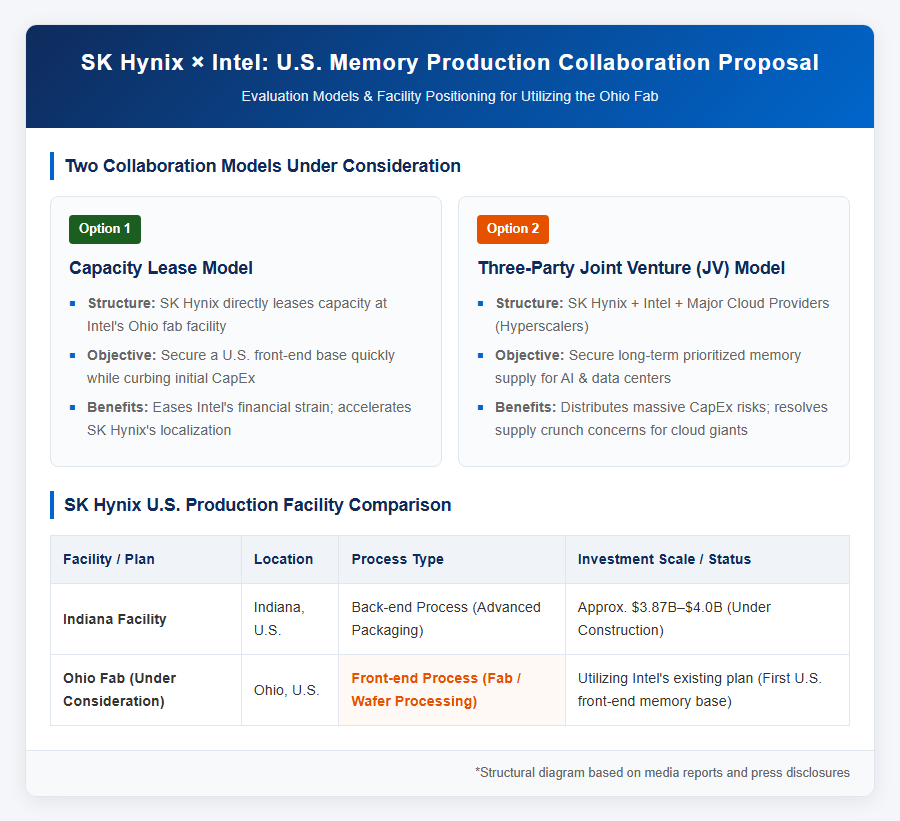
In September 2026, reports emerged that South Korean semiconductor giant SK Hynix is in discussions with U.S. chipmaker Intel regarding what could become its first-ever memory chip production on U.S. soil. According to industry sources, while talks remain in an early, exploratory phase, two primary frameworks are under consideration. The first scenario involves SK Hynix directly leasing part of the production capacity at Intel’s semiconductor manufacturing complex under construction in Ohio to produce memory chips locally. The second, more ambitious concept involves establishing a joint venture (JV) between SK Hynix, Intel, and major cloud service providers eager to secure a stable memory supply.
SK Hynix currently supplies DRAM for servers and smartphones, NAND flash memory for long-term storage, and High Bandwidth Memory (HBM) essential for artificial intelligence (AI) processing, holding the world’s top market share in HBM. In July 2026, the company completed a secondary listing on the U.S. Nasdaq exchange and is currently building an advanced packaging (back-end) facility in Indiana valued at \$3.87 billion (approx. 630 billion yen) to \$4.0 billion. However, it currently possesses no front-end wafer fabrication (fab) facilities in the United States. If realized, this collaboration would secure SK Hynix’s first U.S. front-end memory manufacturing base. Please refer to the diagram below.
Cloud Giants Join In as AI Memory Demand Surges
In the proposed joint venture model, the involvement of major cloud service providers—commonly referred to as hyperscalers—has drawn particular attention. Globally, investments in AI model development and data center infrastructure are expanding rapidly, pushing state-of-the-art memory chips into severe shortage. Cloud providers are urgently seeking to secure long-term, prioritized memory supplies to ensure the stable operation of their AI infrastructure.
Financial markets responded immediately to the news. In U.S. after-hours trading, shares of both Intel and SK Hynix rose by over 2%. In Seoul, SK Hynix’s stock surged by approximately 4.0% compared to the previous day, reaching 1,757,000 won. This significantly outperformed the Kospi’s gain of 1.37% to 1.4%, signaling strong market enthusiasm for the proposal.
While the specific memory types to be produced at the Ohio site have not been finalized, cutting-edge products such as DRAM and HBM are primary candidates. Key drivers behind this initiative include:
– Intense demand for High Bandwidth Memory (HBM) used in AI accelerators
– The imperative for major data center operators to secure long-term supply contracts
– Efforts to diversify the global semiconductor supply chain
Strategic Motivations of Both Companies and Intense U.S. Government Pressure
Intel’s Financial Pressures and Strategic Lifeline
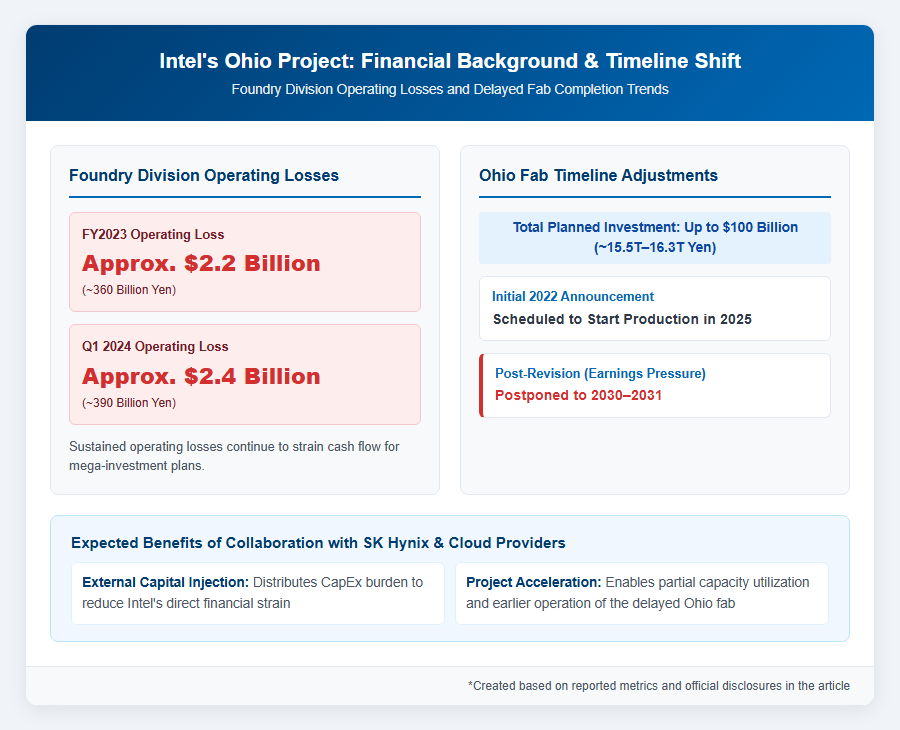
For Intel, discussions with SK Hynix could serve as a welcome lifeline to relieve its heavy financial burden. In 2022, Intel announced plans to invest up to \$100 billion (approx. 15.5 trillion to 16.3 trillion yen) to build a massive semiconductor mega-site in Ohio, with initial production slated for 2025. However, due to mounting losses in its foundry (contract manufacturing) division—reporting an operating loss of approximately \$2.2 billion in 2023 and another \$2.4 billion in Q1 2024—alongside broader earnings headwinds, the completion dates for two fabs in Ohio were postponed significantly to 2030–2031.
With massive capital expenditures straining liquidity, bringing in external capital from SK Hynix and cloud providers would allow Intel to distribute its heavy cash flow burden while preventing the Ohio project from stalling. For Intel, in which the U.S. government holds a stake, leasing fab capacity or forming a joint venture represents a pragmatic avenue to get the Ohio project back on track. Please refer to the diagram below.
Tariff Threats and Washington’s Demand for Onshoring
Political pressure from the U.S. government serves as another decisive catalyst accelerating these negotiations. U.S. Commerce Secretary Howard Lutnick has demanded that foreign chipmakers, including those from South Korea and Taiwan, swiftly commit to expanding production within the United States, openly warning that failure to comply could result in tariffs of up to 100%.
In response to these threats, SK Group Chairman Chey Tae-won acknowledged the necessity of domestic U.S. manufacturing in July 2026, stating, “I believe we need to build a plant in the U.S. If possible, we should do so.” SK Hynix recently raised approximately \$26.5 billion (approx. 4.3 trillion yen) through an American Depositary Receipt (ADR) issuance, exploring options to satisfy U.S. demands. For Washington, having a South Korean memory powerhouse manufacture advanced chips on U.S. soil would mark a signature victory in the Trump administration’s policy push to onshore semiconductor manufacturing.
Formidable Hurdles and Future Outlook
Seoul’s Technology Protection Scrutiny and Geopolitical Dilemmas
The most significant obstacle facing these negotiations is the stringent stance of the South Korean government. Advanced memory manufacturing technologies for HBM and DRAM are designated as “National Core Technologies” in South Korea. While the Ministry of Trade, Industry and Energy noted that corporate decisions remain at the discretion of the company, it emphasized that any transfer involving National Core Technology is subject to strict review under the Industrial Technology Protection Act to prevent technology leakage abroad.
Furthermore, SK Hynix is caught in a delicate geopolitical tug-of-war between Washington and Seoul. The South Korean government seeks to leverage domestic companies’ U.S. investment commitments as bargaining chips in bilateral trade negotiations (such as determining the allocation of the unassigned \$200 billion out of a promised \$350 billion U.S. investment package). At the same time, authorities in Seoul are urging SK Hynix and rival Samsung Electronics to accelerate plans for a new semiconductor manufacturing cluster in southwestern South Korea. Balancing domestic infrastructure commitments with Washington’s demand for rapid U.S. expansion places SK Hynix in a complex dilemma.
Overcoming High Structural Costs and the Future of the Chip Supply Chain
Manufacturing semiconductors in the U.S. involves inherent structural challenges, including significantly higher labor and construction expenses, as well as increased logistics costs due to distance from the primary semiconductor supply chain concentrated in Asia. Given that manufacturing in the U.S. is substantially more expensive than in South Korea, utilizing Intel’s existing facility serves as an effective method to curb initial capital expenditure.
In response to inquiries from media outlets including Reuters, SK Hynix stated: “We are evaluating various measures, including establishing additional production bases, to strengthen the competitiveness of our memory business, but nothing has been finalized at this stage.” Whether this collaboration culminates in a formal agreement will depend on several critical factors:
– Managing cost increases associated with U.S. construction and ensuring profitability
– Securing export regulatory approval from the South Korean government regarding National Core Technology
– Establishing a joint investment structure and securing long-term off-take agreements with major cloud providers
As political and commercial interests between the U.S. and South Korea remain tightly intertwined, the global semiconductor industry is watching closely to see how these negotiations shape the future of the AI supply chain.
References
- 【SK Hynix in Talks with Intel on U.S. Memory Production, Reuters Reports】https://jp.investing.com/news/stock-market-news/article-1681844
【#SKHynix #Intel #Semiconductors #AIMemory #HBM #Ohio #USKoreaRelations】

コメント