On September 22, 2026, the National Bank of Hungary decided to hold its key policy rate unchanged at 5.50% at its monetary policy meeting. The move comes amid heightened global geopolitical risks, energy price uncertainty, and concerns over exchange rate volatility.
- Rate Hold Decision and Pause in Recent Easing Cycle
- Introduction of New Inflation Target from 2028 and Stepping Stone to Euro Adoption
- Oil Price Surges from Middle East Tensions and Forint Volatility
- Stagnant Economic Growth and S&P Outlook Downgrade
- EU Fund Freezes and Fiscal Deficit Risks Ahead of 2026 General Election
- Future Monetary Policy Outlook and Inflation Trends in Focus
Rate Hold Decision and Pause in Recent Easing Cycle
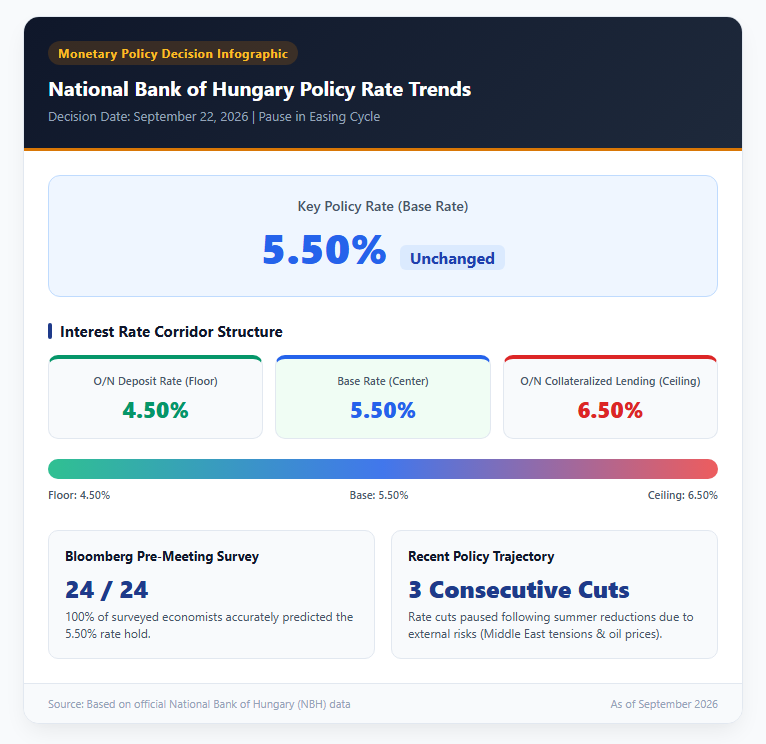
The National Bank of Hungary (NBH) announced at its monthly monetary policy meeting on September 22, 2026, that it would maintain its key policy rate, the base rate, at 5.50%. Concurrently, the overnight deposit rate was held at 4.50% and the overnight collateralized lending rate at 6.50%. Having delivered three consecutive rate cuts during the summer of 2026, this decision temporarily pauses the central bank’s modest monetary easing cycle. In a pre-meeting survey conducted by Bloomberg, all 24 participating economists correctly anticipated the rate pause, aligning the outcome fully with market expectations. In the post-meeting press conference, Governor Mihály Varga maintained a hawkish tone while emphasizing a data-driven approach, noting that future decisions would depend on incoming macroeconomic data. The decision to hold rates is viewed not as mere passivity, but as a deliberate choice following a careful assessment of the inflation outlook and external conditions. The NBH indicated that liquidity management remains a top priority, keeping monetary conditions sufficiently restrictive to anchor the disinflation process. For details on the policy rate trajectory and decision background, please refer to the diagram below.
Introduction of New Inflation Target from 2028 and Stepping Stone to Euro Adoption
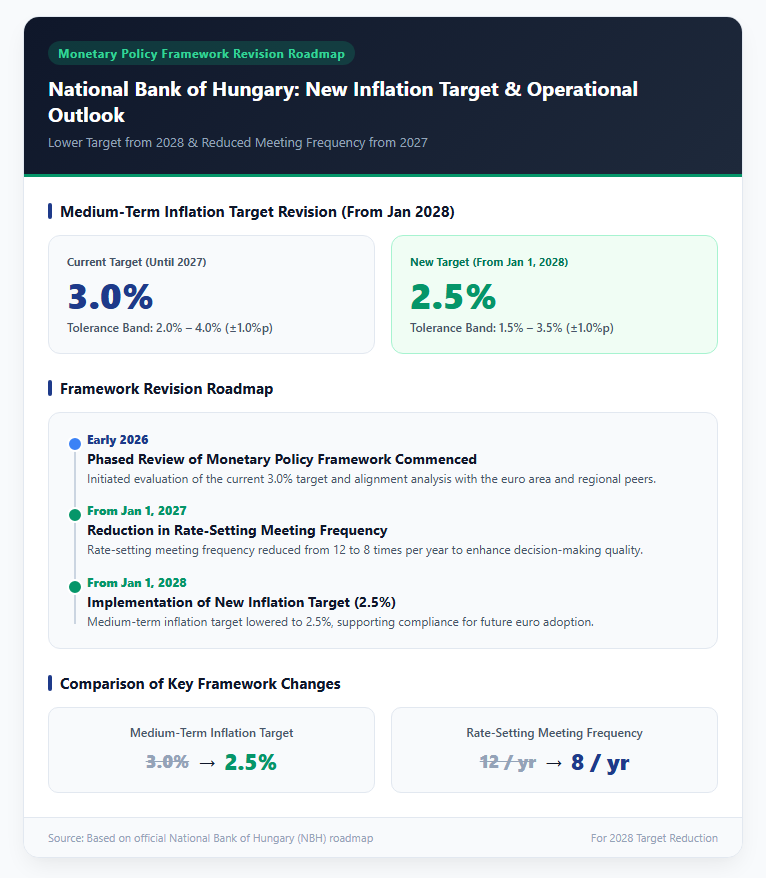
Alongside the rate decision, the Monetary Council approved key changes to its medium-term monetary policy framework. The NBH announced plans to lower its medium-term inflation target from 3.0% to 2.5%, effective January 1, 2028. The tolerance band of ±1.0 percentage point around the target will remain unchanged. A phased review of the framework initiated in early 2026 highlighted that the current 3.0% target was set higher than those of the euro area and neighboring economies. Ongoing convergence across nominal and real economic indicators supports this reduction, which is also intended to facilitate Hungary’s future compliance with euro adoption criteria. To enhance decision-making efficiency, the central bank also decided to reduce the frequency of its rate-setting meetings from 12 to 8 times per year starting in 2027. While household perceived inflation and inflation expectations have shown improvement, central bank analysis indicates that policy alignment with currency stability remains crucial to securing medium-term price stability. For the roadmap regarding the new inflation target, please refer to the diagram below.
Macroeconomic Headwinds and Geopolitical Risks
Oil Price Surges from Middle East Tensions and Forint Volatility
A primary driver behind the central bank’s decision to halt rate cuts is the rapidly worsening external risk environment. Heightened geopolitical tensions in the Middle East—specifically escalating conflict involving the United States and Iran, alongside fears of a blockade in the Strait of Hormuz—have elevated the risk of global energy price spikes. For Hungary, which relies heavily on energy imports, rising crude oil prices represent a direct inflationary threat. At the same time, stabilizing the exchange rate of the Hungarian forint is a top priority to contain inflation expectations. The euro-forint exchange rate (EUR/HUF) is particularly sensitive to energy market fluctuations, while the Federal Reserve’s monetary stance and a strong US dollar continue to exert broad downward pressure on emerging market currencies. The NBH aims to curb excessive forint volatility and maintain the currency within a stable range to prevent imported inflation from resurfacing. Market participants warn that should energy prices surge again, the central bank might even price in future rate hikes, making risk premium dynamics a key constraint on future policy decisions.
Stagnant Economic Growth and S&P Outlook Downgrade
Hungary’s real economy continues to suffer from prolonged stagnation amid weakening external demand and depressed domestic investment. In the first quarter of 2025, real GDP growth contracted by 0.4% year-on-year and 0.2% quarter-on-quarter, marking the seventh quarter of negative growth over the past three years. Following a technical recession in the second and third quarters of 2024, a robust recovery has failed to materialize, with manufacturing and construction experiencing particularly severe contractions. In light of these conditions, rating agency S&P Global Ratings downgraded Hungary’s credit rating outlook from “Stable” to “Negative” in April 2025. S&P cited rising global trade protectionism, economic softness in Germany—Hungary’s principal trading partner—high debt servicing costs, and reduced EU fund inflows as key factors undermining fiscal and external stability. Furthermore, the Hungarian government significantly revised down its 2025 real GDP growth forecast from an initial 3.0% to 1.5%, rendering its medium-term target of 3.0%–6.0% increasingly out of reach.
Fiscal Structural Risks and Future Monetary Policy Outlook
EU Fund Freezes and Fiscal Deficit Risks Ahead of 2026 General Election
At the heart of Hungary’s structural economic vulnerabilities are ongoing fiscal deficits and a persistent dispute with the European Union over the rule of law. Citing insufficient anticorruption and judicial reforms, the European Commission triggered its conditionality mechanism, resulting in the permanent loss of €1 billion (approximately \$1.03 billion) in EU funding for Hungary in January 2025. This marked the first time in EU history that such a penalty was enforced, while roughly €19 billion in recovery and cohesion funds remain frozen. The suspension of funds has delayed public investment projects and placed significant strain on state finances. Hungary’s general government deficit stood at 4.9% of GDP in 2024 and is projected to remain elevated at around 4.5% in 2025. Furthermore, ahead of the parliamentary general election scheduled for spring 2026, increased pre-election spending by the Orbán administration—including expanded housing subsidies and tax relief measures—has amplified concerns over fiscal discipline. High government debt (73.5% of GDP) and interest payments exceeding 4% of GDP severely limit the government’s fiscal maneuverability.
Future Monetary Policy Outlook and Inflation Trends in Focus
While the latest decision has paused the short-term easing cycle, market experts broadly agree that the medium-term rate-cutting path is not entirely over. According to an analysis by ING, if geopolitical tensions ease and energy prices stabilize over the next six months, additional rate cuts remain plausible. Market projections indicate that the policy rate could decline to 5.25% by the end of 2026, before gradually easing to between 4.25% and 4.50% by the end of 2027. However, future policy actions will remain strictly data-dependent; a renewed spike in oil prices or sharp currency fluctuations could prompt the central bank to extend the pause or even pivot back toward monetary tightening. As pre-election fiscal expansion pressures collide with the central bank’s mandate to maintain price stability ahead of the April 2026 general election, the alignment between fiscal and monetary policy will be the critical element to watch. Market participants are closely watching the release of the full Inflation Report on September 24, alongside upcoming revisions to GDP and CPI forecasts.
References
- [National Bank of Hungary Press Release (Xinhua Report)] https://english.news.cn/europe/20260922/2b24e05eeadb4f37bae3f89ab6ea09c9/c.html
【#Hungary #NationalBankOfHungary #PolicyRate #InflationTarget #EuropeanEconomy #ExchangeRateRisk】


コメント