OpenAI has reportedly acquired tens of thousands of Macs to bolster its AI agent training. This massive procurement is driven by the soaring demand for computer-use AI that directly operates user interfaces, coupled with strict macOS licensing terms that make virtualization on non-Apple hardware legally impossible.
- The Core Event: OpenAI’s Massive Purchase of Mac Hardware
- The Architectural Superiority of Unified Memory
- Computer-Use AI and the Demands of Reinforcement Learning
- How Apple’s Licensing Terms Force Physical Hardware Purchases
- Skyrocketing Hardware Demand and the Surge in Memory Prices
- Future Outlook: The Transition to Infrastructure Optimization
The Core Event: OpenAI’s Massive Purchase of Mac Hardware
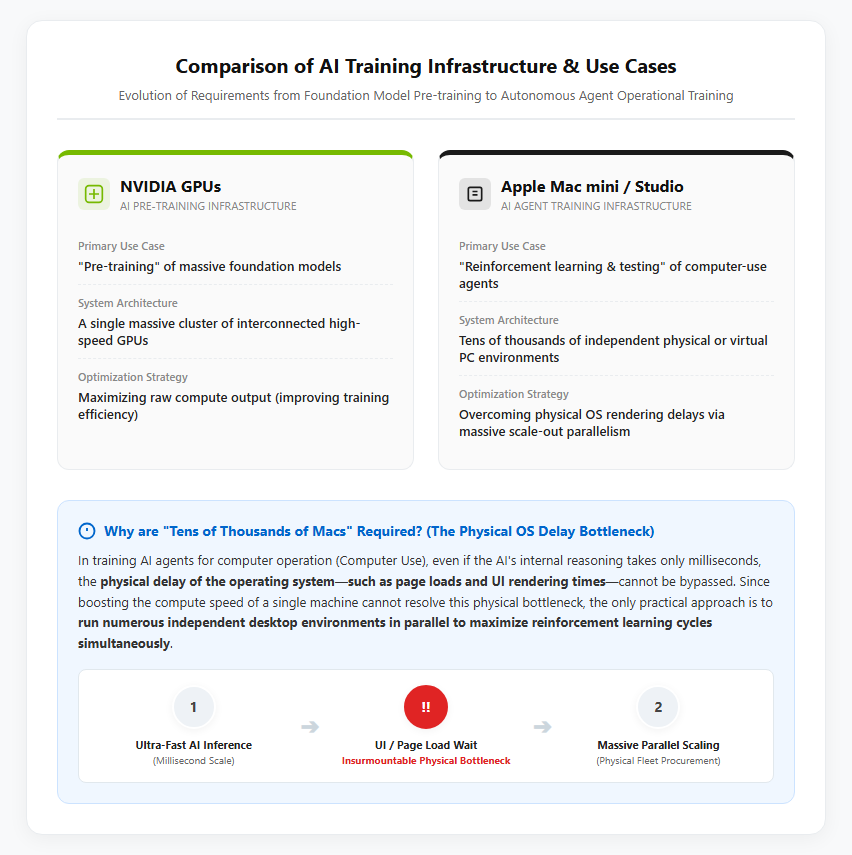
According to a report by the tech media outlet The Information on August 30, 2026, OpenAI has quietly purchased tens of thousands of Mac mini and Mac Studio desktop computers over the past few months. Its chief rival, Anthropic, has similarly leased a vast fleet of Mac mini instances via Amazon Web Services (AWS). These consumer-grade machines are not destined for employees’ desks as standard office PCs. Instead, they are being deployed as dedicated training infrastructure to help next-generation AI models learn how to autonomously navigate and operate personal computers. Unlike traditional large language models (LLMs) that are pre-trained from scratch on massive clusters of NVIDIA GPUs, these Macs serve a very different purpose. They are being utilized for reinforcement learning and testing computer-use agents that interact directly with operating systems. Refer to the diagram below for a structural overview.
The Architectural Superiority of Unified Memory
A primary reason AI developers are choosing Apple Silicon over traditional server hardware lies in its unique Unified Memory Architecture (UMA). In a conventional Windows PC or server equipped with high-performance discrete GPUs, the system RAM and the GPU’s video memory (VRAM) are physically separated. When an AI model’s size exceeds the available VRAM, data must constantly travel back and forth across the slow PCIe bus, creating a severe performance bottleneck. In contrast, Apple Silicon shares a single, high-speed memory pool between the CPU and the GPU, allowing massive models to reside entirely in memory without costly data copies. Furthermore, starting with the M5 chip generation released in October 2025, Apple integrated dedicated matrix multiplication accelerators directly into the GPU cores, drastically boosting local AI processing. This setup allows compact desktop machines to handle local inference of exceptionally large models with remarkable efficiency.
The Rise of AI Agents and the Licensing Hurdle
Computer-Use AI and the Demands of Reinforcement Learning
The evolution of artificial intelligence is rapidly shifting from text generation to autonomous computer-use agents that can execute tasks on behalf of humans, such as filing expense reports or booking travel. To accomplish this, these agents must visually perceive user interfaces and simulate keyboard and mouse inputs. Training an AI to master these workflows requires reinforcement learning, where the model operates inside a real OS environment and refines its strategy through millions of trials. While the AI’s internal reasoning takes only milliseconds, the physical speed of the operating system—such as page loads and UI rendering times—cannot be bypassed. Consequently, scaling a single machine’s processing power does nothing to speed up this step. To accelerate development, AI labs must run thousands of independent desktop sessions in parallel, making a physical fleet of computers the only practical way to multiply training cycles.
How Apple’s Licensing Terms Force Physical Hardware Purchases
In a typical datacenter environment, engineers would avoid buying thousands of physical desktops by running virtual machines (VMs) on enterprise servers. However, when dealing with macOS, Apple’s rigid Software License Agreement (SLA) presents an insurmountable barrier. The macOS licensing terms strictly prohibit running the operating system on non-Apple hardware. Even on genuine Apple hardware, standard terms limit users to a maximum of two virtualized instances of macOS per physical machine. This means that no matter how powerful a custom server cluster an AI company builds, they cannot legally virtualize and scale macOS environments at will. Similarly, AWS EC2 Mac instances require a dedicated host with a minimum 24-hour allocation period under bare-metal configurations to comply with these terms. Faced with these legal constraints, OpenAI had no choice but to physically procure tens of thousands of individual Mac mini and Mac Studio units to build its training pipelines.
Market Ripple Effects and the Future of AI Infrastructure
Skyrocketing Hardware Demand and the Surge in Memory Prices
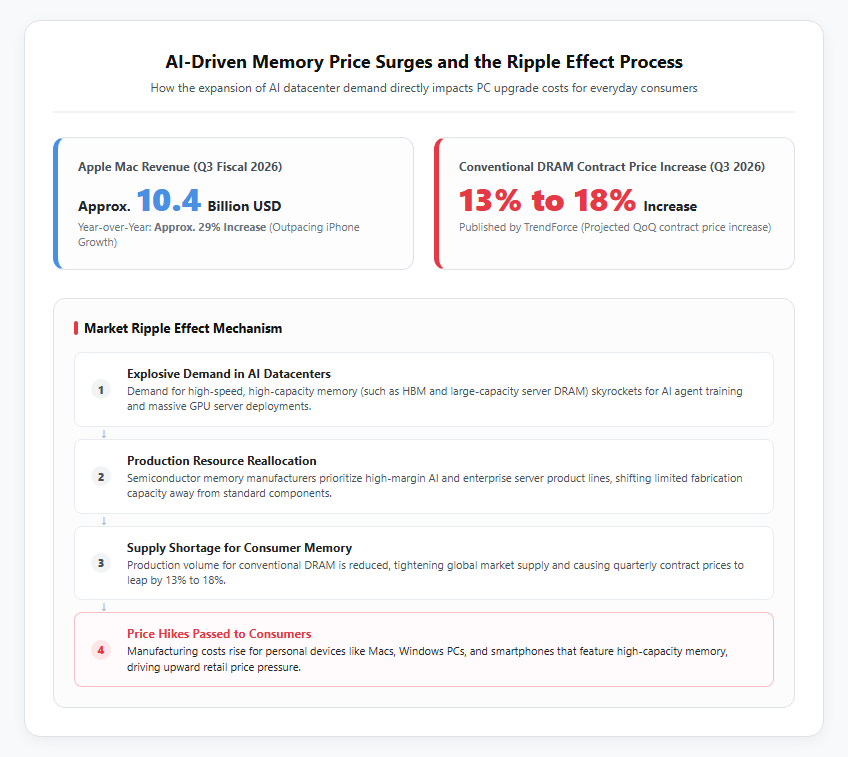
The sudden rush of AI companies buying up Macs has sent shockwaves through the hardware market. According to Apple’s third-quarter fiscal 2026 earnings report, Mac revenue surged by approximately 29% year-over-year to reach \$10.4 billion, outpacing iPhone growth and representing the fastest-growing sector in Apple’s hardware business. However, this enterprise AI demand has also created challenges for average consumers. With semiconductor manufacturers heavily prioritizing high-margin AI chips and High Bandwidth Memory (HBM) for datacenters, standard memory components are facing severe supply shortages. According to the market research firm TrendForce, contract prices for conventional DRAM are projected to rise by 13% to 18% in the third quarter of 2026. This shortage is exerting upward price pressure on consumer electronics, including Macs and PCs configured with large memory capacities. Even everyday consumers who do not use AI are beginning to feel the financial impact of this hardware arms race when upgrading their personal computers. Refer to the flow diagram below for a visual breakdown of this process.
Future Outlook: The Transition to Infrastructure Optimization
Looking ahead to a future where millions of autonomous AI agents operate simultaneously, relying on physical arrays of desktop PCs will become cost-prohibitive. For instance, running 100 million active agents would require an astronomical 1.7 exabytes (EB) of logical memory. To scale sustainably, the industry must develop advanced virtualization technologies that can temporarily hibernate inactive agents, saving their states from DRAM to enterprise NAND flash storage and restoring them instantly when needed. By 2030, this runtime NAND demand alone is projected to reach approximately 3.2 exabytes. Concurrently, AI infrastructure will move toward intelligent orchestration. Rather than executing an entire workflow on macOS, orchestrators will delegate over 90% of generic tasks—such as code generation and data processing—to cheaper, highly virtualized Linux containers, routing only the absolute necessary iOS or macOS-specific steps to physical Macs. The future of AI infrastructure will belong to platforms that can most efficiently slice, share, and schedule computational resources.
References
- 【GitHub – microsoft/WindowsAgentArena】https://github.com/microsoft/WindowsAgentArena
- 【GitHub – anthropics/claude-quickstarts】https://github.com/anthropics/claude-quickstarts/blob/main/computer-use-demo/Dockerfile
- 【Apple – macOS Sequoia SLA】https://www.apple.com/legal/sla/docs/macOSSequoia.pdf
- 【AWS Documentation – EC2 Mac Instances】https://docs.aws.amazon.com/AWSEC2/latest/UserGuide/ec2-mac-instances.html
【#AIAgents #OpenAI #MacProcurement #UnifiedMemory #ReinforcementLearning #SemiconductorMemory #Apple】

コメント