Minoru Kiuchi, Minister of State for Economic and Fiscal Policy, declared that the phase of reflationary policy—centered on monetary easing and flexible fiscal stimulus—has come to an end. This shift is driven by macro-environmental changes, including moderate inflation and rising interest rates, alongside a broader redefinition of fiscal and monetary policy aimed at sustainable economic growth.
- Key Takeaways: Economic Minister Kiuchi Declares End of the “Reflation Phase”
- Background: Structural Shift to Moderate Inflation and Rising Interest Rates
- Policy Architecture: How “Responsible Proactive Fiscal Policy” Differs from Abenomics
- Market Reactions and Concerns: Long-Term Yield Spikes and Fiscal Discipline
- Equity Market Impact: The “Takaichi Trade” and Japan Stock Outlook
- Future Outlook and Key Watchpoints: Strategic Growth and Real Wages
Key Takeaways: Economic Minister Kiuchi Declares End of the “Reflation Phase”
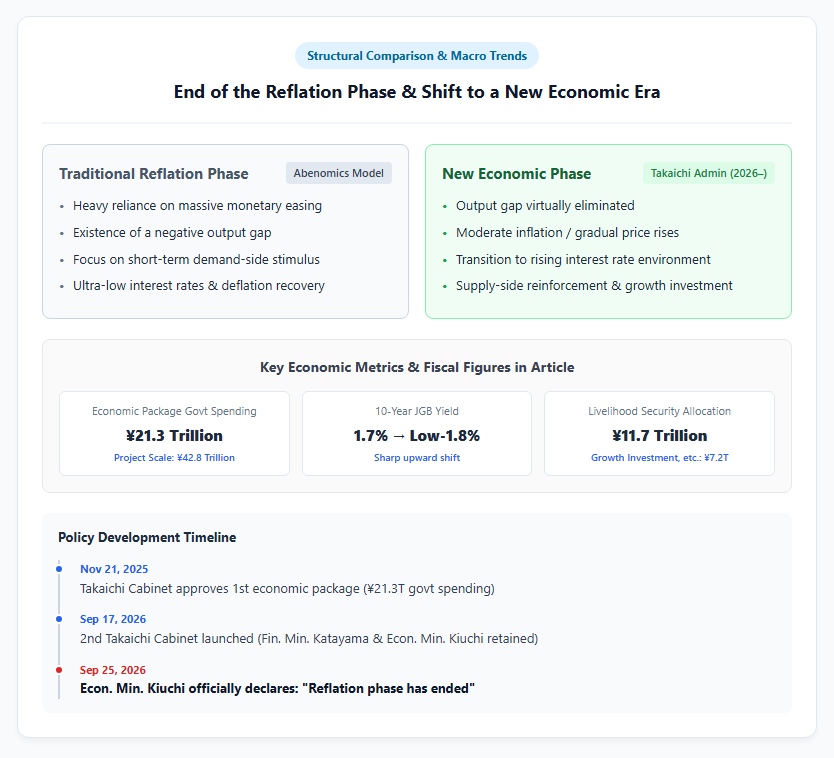
On September 25, 2026, Minoru Kiuchi, Minister of State for Economic and Fiscal Policy, stated at a post-cabinet news conference that Japan has exited the phase of reflationary policy—the Abenomics-style combination of monetary easing and proactive fiscal spending. Minister Kiuchi emphasized that the economic management under Prime Minister Takaichi’s administration is no longer a simple reflation policy. Regarding current economic and inflation trends, he explained that the era of massive monetary stimulus has passed, and Japan has entered a new phase characterized by moderate inflation accompanied by rising interest rates. In the Second Takaichi Cabinet reshuffle launched on September 17, 2026, key economic ministers including Finance Minister Satsuki Katayama and Minister for Growth Strategy (and Economic Policy) Minoru Kiuchi retained their posts, ensuring policy continuity. This statement marks an official acknowledgment by top administration officials of the altered macroeconomic reality, representing a pivotal turning point away from an economic model reliant on unconventional monetary easing. The diagram below illustrates recent policy shifts and macroeconomic trends.
Background: Structural Shift to Moderate Inflation and Rising Interest Rates
Minister Kiuchi’s remarks reflect the fundamental transformation of Japan’s macroeconomic structure, moving from deflation recovery to persistent inflation and rising interest rates. On November 21, 2025, the Takaichi cabinet approved its first comprehensive economic package, featuring 21.3 trillion yen in central government expenditure and a total project scale of 42.8 trillion yen. However, as analyses from Meiji Yasuda Research Institute highlighted, the negative output gap in the Japanese economy had virtually disappeared by then. Continuing pure demand-side stimulus in a supply-constrained environment risked accelerating inflation and driving up import costs rather than fostering sustainable expansion. Furthermore, upward pressure on interest rates became prominent in financial markets, with Japan’s 10-year benchmark bond yield surging from around 1.7% to the low-1.8% range. With Bank of Japan Governor Kazuo Ueda advancing rate hike discussions and normalizing policy interest rates, the limitations of relying on monetary stimulus to drive growth became increasingly clear.
Takaichi’s “Responsible Proactive Fiscal Policy” and Market Reactions
Policy Architecture: How “Responsible Proactive Fiscal Policy” Differs from Abenomics
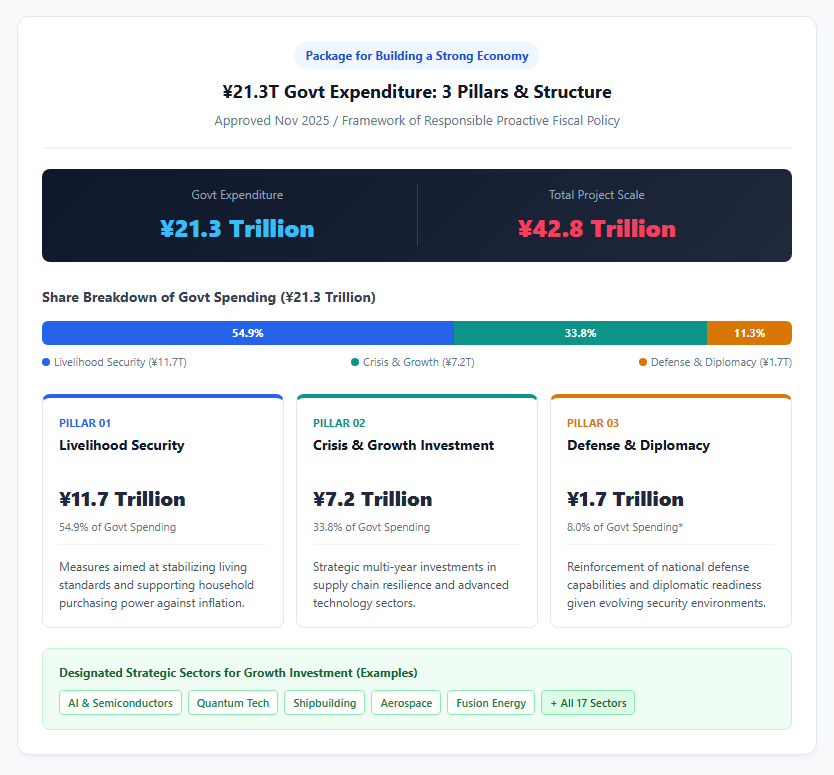
The Takaichi administration characterizes its economic policy framework as “Responsible Proactive Fiscal Policy.” Unlike Abenomics, which prioritized large-scale monetary easing and short-term demand creation, this approach focuses on strengthening the supply side and channeling investments into strategic growth sectors. In the “Comprehensive Economic Package for Building a Strong Economy” approved in November 2025, the 21.3 trillion yen in government spending was allocated across three main pillars: 11.7 trillion yen for livelihood security (including inflation relief), 7.2 trillion yen for crisis management and growth investment, and 1.7 trillion yen for strengthening defense and diplomatic capabilities. Growth investments target 17 strategic sectors—such as AI, semiconductors, quantum technology, shipbuilding, aerospace, and fusion energy—under multi-year budgetary commitments. The Takaichi policy distinguishes itself by aiming to raise potential growth rates and rebuild Japan’s industrial base. The diagram below illustrates the three pillars and budget breakdown of the economic package.
Market Reactions and Concerns: Long-Term Yield Spikes and Fiscal Discipline
Financial markets have reacted with heightened sensitivity to fiscal expansion under the Takaichi administration. During the formulation of the November 2025 economic package, concerns over expanded Japanese Government Bond (JGB) issuance pushed 10-year yields sharply higher from ~1.7% to the low-1.8% range, underscoring the challenge of preserving market trust. Prime Minister Takaichi stressed that “market confidence is indispensable for responsible fiscal policy,” pledging to lower the debt-to-GDP ratio. Nevertheless, market participants remain skeptical, noting that fiscal consolidation plans rely heavily on natural tax revenue growth. While tax relief measures—such as repealing the provisional gasoline tax rate and raising income tax thresholds—support household budgets, they create an estimated 1.5 trillion yen revenue shortfall across national and local budgets without clearly defined offset sources. With Finance Minister Satsuki Katayama signaling readiness to take decisive action against excessive yen depreciation, effective communication with markets remains critical to the administration’s political standing.
Equity Market Impacts, Challenges, and Future Outlook
Equity Market Impact: The “Takaichi Trade” and Japan Stock Outlook
Following the launch of the Takaichi administration and its consolidation of political stability, equity markets experienced a rally dubbed the “Takaichi Trade.” In January 2026, speculation over a lower house dissolution sent the Nikkei 225 surging by 1,600 points in a single session, breaking above the 53,000 mark for the first time in history. The Liberal Democratic Party’s (LDP) decisive victory in the general election on February 8 further drove re-evaluation of Japanese equities by foreign investors. In February 2026, Nomura Securities strategists upgraded their year-end 2026 Nikkei 225 forecast to 60,000 (and TOPIX to 4,000), citing earnings upside and political stability. According to Nomura’s analysis, Japanese equities are transitioning from a liquidity-driven market powered by monetary easing to an earnings-driven market reflecting corporate performance. While nominal GDP growth exceeding nominal long-term yields and record share buybacks continue to support equity valuations, the focus is now shifting to concrete execution and underlying corporate profit growth.
Future Outlook and Key Watchpoints: Strategic Growth and Real Wages
The ultimate success of the Japanese economy and the Takaichi administration hinges on whether targeted growth investments across the 17 strategic sectors translate into tangible productivity gains and sustained real wage growth. While inflation relief measures like gasoline tax cuts and cash payouts provide temporary support, a truly resilient economy cannot be built without wage gains that outpace inflation. Because long-term real wage growth is fundamentally anchored in labor productivity, structural industrial reform is essential beyond temporary tax incentives. On the monetary policy front, as Minister Kiuchi explicitly signaled a shift toward a higher interest rate environment, maintaining alignment between the Bank of Japan’s rate normalization and the government’s growth strategy will be paramount. Heading into the late-2026 extraordinary parliamentary session, key focus areas include policy coordination and funding agreements within the ruling coalition, alongside managing inflation and rising interest rates while preserving market confidence.
References
- [Economic Minister Kiuchi: “Reflation Phase Has Ended” – Newsdas Policy Overview] https://newsdas.mopita.com/Article/MyNews/NewsDetail/Genre/968778
[#MinoruKiuchi #TakaichiAdministration #ReflationPolicy #JapaneseEconomy #MonetaryPolicy #InflationRelief #StockMarket]

コメント