In Japan’s first 26GHz band wave auction conducted by the Ministry of Internal Affairs and Communications, NTT Docomo won the nationwide slot for 6.288 billion yen. Behind this historic institutional change lies an important strategy of ensuring transparency in radio wave allocation and the full-scale launch of the 5G millimeter wave market. Based on the research findings, we will explain the background and impact.
- The competition among the three companies for the national slot and Docomo’s victory
- Regional Category Winning Results and the Rise of Infrastructure Sharing
- Why did the beauty vote shift to an auction?
- Docomo’s shift in favor of Rakuten Mobile
- The Future of the 5G Millimeter Wave Market Pioneered by the 26GHz Band
- Improved communication quality and future highlights
The competition among the three companies for the national slot and Docomo’s victory
On June 30, 2026, the Ministry of Internal Affairs and Communications announced a historic turning point in Japan’s telecommunications industry. Japan’s first radio auction (price competition) aimed at spreading 5G in the 26GHz band was held, and the results have been revealed. The most anticipated nationwide slot (25.8~26.2GHz) saw three existing major mobile carriers—NTT Docomo, KDDI/Okinawa Cellular Telephone, and SoftBank—participate in the bidding. After four rounds of bidding, NTT Docomo offered the highest bid of 6,288,000,000 yen and was selected as the successful bidder. The minimum winning bid price set in advance by the Ministry of Internal Affairs and Communications was 3.93 billion yen, but the final winning bid far exceeded that amount. Please refer to the diagram below.
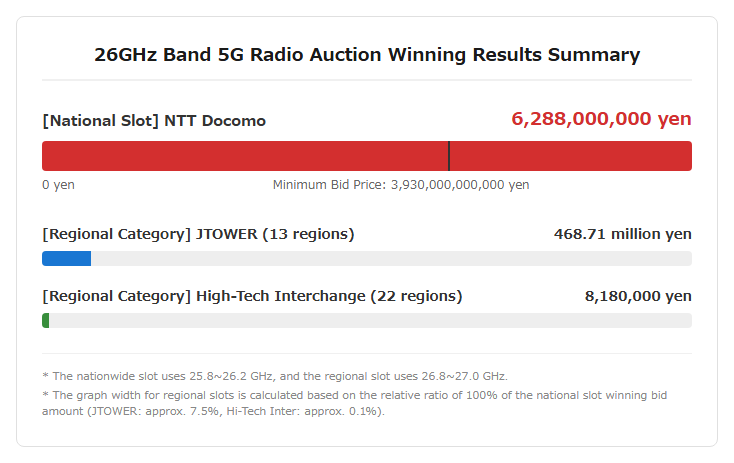
The certification period for this nationwide quota is set at 10 years, during which Docomo has secured a strong frequency base to expand its extensive 5G millimeter wave service across Japan. In response, Docomo plans to obtain certification for establishing specified high-frequency radio stations and begin full-scale infrastructure development, including building backbone lines utilizing existing IP networks.
Regional Category Winning Results and the Rise of Infrastructure Sharing
The results regarding regional frameworks were also very interesting. The regional slots (26.8~27.0GHz) are finely divided at the municipal level and are dedicated slots to encourage new and regional businesses to enter. In this auction, two companies participated: JTOWER, which handles infrastructure sharing, and Hi-Tech Inter, a network equipment vendor. JTOWER won bids in 13 regions, mainly in urban areas including Tokyo’s special wards (23 wards), Yokohama, Nagoya, Osaka, Fukuoka, and Chiba, with a total winning bid amount reaching 468.71 million yen. On the other hand, Hi-Tech Inter won bids for 8,184,000 yen in a total of 22 areas, including Nakafurano Town in Sorachi District, Hokkaido, Fujiyoshida City in Yamanashi Prefecture, and Yonaguni Town in Okinawa Prefecture. The competition that attracted particular market attention was in Chitose City, Hokkaido. In this region alone, JTOWER and Hi-Tech Inter fiercely competed, resulting in an unusually long battle spanning 35 rounds. The lowest winning bid in Chitose City, initially set at 1.3 million yen, ultimately soared to 10.14 million yen, 7.8 times higher, and JTOWER persistently won the bid. This result is a highly significant example of how the economic value of telecommunications infrastructure in a specific region has become visible.
Background of the New System Introduction and Changes in the Industry Landscape
Why did the beauty vote shift to an auction?
The long-standing system for radio wave allocation in Japan was called the comparative review method. This method involves the Ministry of Internal Affairs and Communications scoring the plans submitted by operators such as the number of base stations opened, coverage rate, and support measures for budget smartphones (MVNOs), and assigning signals to those with higher scores. Within the industry, this format has also been jokingly called a beauty contest. The reason was that the screening criteria were sometimes vague, and there was a persistent suspicion that the Ministry of Internal Affairs and Communications was arbitrarily operating to favor certain businesses at its discretion. In fact, when Docomo, which excelled in area planning, was eliminated in the 2020 1.7GHz band allocation and Rakuten Mobile was selected, criticism of Rakuten favoring smoldered within the industry. To address this lack of transparency, the Radio Law was amended in April 2025, and in October 2025, an auction format was legally permitted in October 2025, where eligible operators can bid for band usage rights for a fee, and the highest bidder wins. This auction in the 26GHz band is the first implementation under this new law, and serves as the first step in a fair process to determine the previously opaque value of radio waves based on market principles.
Docomo’s shift in favor of Rakuten Mobile
During the introduction of this new system, serious conflicts among mobile carriers became apparent. Motoyuki Ii, president of NTT Docomo, the largest company, surprised the industry by expressing support for the introduction of auctions in November 2021. Until then, Docomo had also taken a cautious stance, but they strongly opposed the opaque results of the 1.7GHz band and made a rebellious decision, arguing that a transparent auction that settles the matter with financial power was better than government-led beauty votes. In response, Rakuten Mobile Chairman Hiroshi Mikitani was furious, openly opposing the idea, calling it a foolish move to revive the monopoly of companies that are making excessive profits on his social media. Mikitani argued that if the three existing companies with ample funds raise prices, operators like Rakuten Mobile, which are latecomers rushing to invest in equipment, will lose the signal and hinder competition. SoftBank President Junichi Miyagawa also expressed concerns about the current situation where profits are being squeezed due to requests for communication fee reductions, saying he wants not only the whip but also candy, and expressed concern about the further management burden caused by auction costs. Please refer to the diagram below.
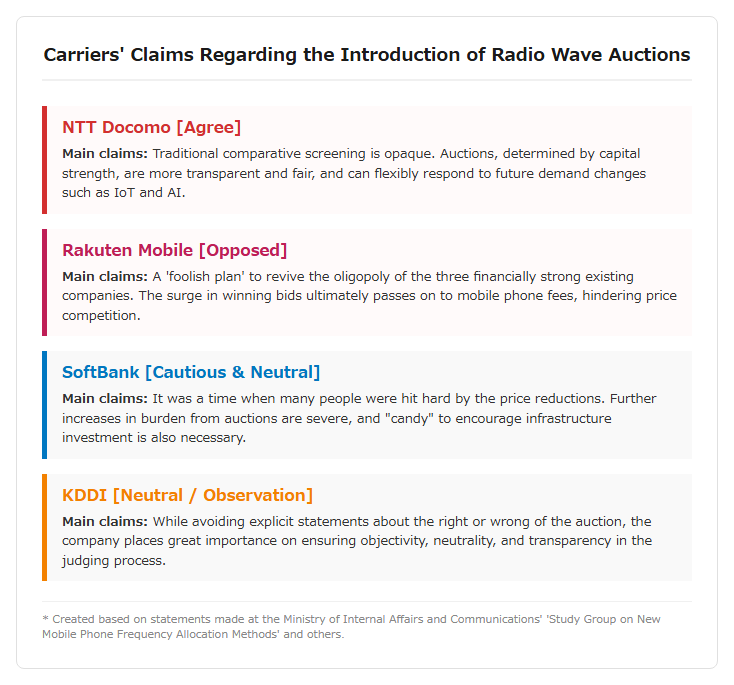
After sparking a divisive debate across the industry, the fact that Docomo won a high-value bid this time is a historic event that fundamentally changed the nature of telecommunications competition in Japan.
Potential and future developments of the millimeter-wave market
The Future of the 5G Millimeter Wave Market Pioneered by the 26GHz Band
The 26GHz band targeted in this auction belongs to the ultra-high frequency band known as 5G millimeter wave. 5G is broadly divided into Sub-6 bands and millimeter wave bands, but millimeter wave has the characteristics of dramatically fast communication speeds, ultra-low latency, and the ability to transmit large amounts of data. On the other hand, radio waves have a very strong straight-line nature and are easily blocked by obstacles like buildings or walls, or have extremely short radio transmission distances, which are physical weaknesses. Therefore, rather than aiming for area-specific coverage, a strategy is required to install densely and precisely concentrated base stations in specific ultra-high-traffic areas such as stations, stadiums, and commercial facilities with high concentrations. According to market forecasts, the market size for 5G millimeter wave technology is expected to reach USD 18.32 billion by 2036, up from USD 3.9 billion in 2025, with an extremely high compound annual growth rate of 15.1%. Going forward, it is expected to be used not only in smartphones but also in industrial applications where vast amounts of data are exchanged in real time, such as autonomous vehicles, sensors within smart cities, and even remote operations in medical settings. Docomo’s winning bid can be seen as a long-term upfront investment to anticipate these next-generation data communication demands and maintain competitiveness.
Improved communication quality and future highlights
Following the results of this auction, Japan’s telecommunications infrastructure is entering a new phase. For the three winning bidders—NTT Docomo, JTOWER, and Hi-Tech Inter—the Ministry of Internal Affairs and Communications is scheduled to sequentially grant approval for the establishment of radio stations. Each company will be required to provide innovative services utilizing the frequency bands they win over the next decade, with particular focus on expanding infrastructure sharing. JTOWER’s decision to win the frequency bid as the first domestic sharing operator suggests a future where multiple operators share a single facility and expand the millimeter wave area efficiently and cost-effectively, rather than having a single carrier operate alone. On the other hand, concerns remain about the impact on consumers. Although the approximately 6.3 billion yen won bid cost by Docomo has been kept under control compared to other developed countries, future attention will be focused on whether this will ultimately be passed on to service fees or if excessive investment burdens will lead to delays in network development. As of June 2026, the fact that Japanese radio waves have shifted from being chosen to being bought will bring to our daily lives and how effective communication evolution will be closely monitored.
[#5G #NTTドコモ #電波オークション #総務省 #通信業界 #経済 #ビジネス #ミリ波]


コメント