On October 9, 2026, U.S.-based Cloudflare announced that the entire development team of the JavaScript and TypeScript runtime environment Deno has joined the company. This move is driven by the consolidation and integration of development resources to advance the in-house operation of its serverless platform, Workers, and stateful architecture, Durable Objects.
- Key Points of the Acquisition and Integration of the Development Team
- Migration Roadmap for Existing Products and Services
- The Decentralization of Durable Objects and the Challenges of workerd
- A New Self-Hosted Paradigm Brought by the Single Binary “celld”
- Runtime Consolidation and Developer Community Response
- Future Developments in Serverless Edge Computing
Key Points of the Acquisition and Integration of the Development Team
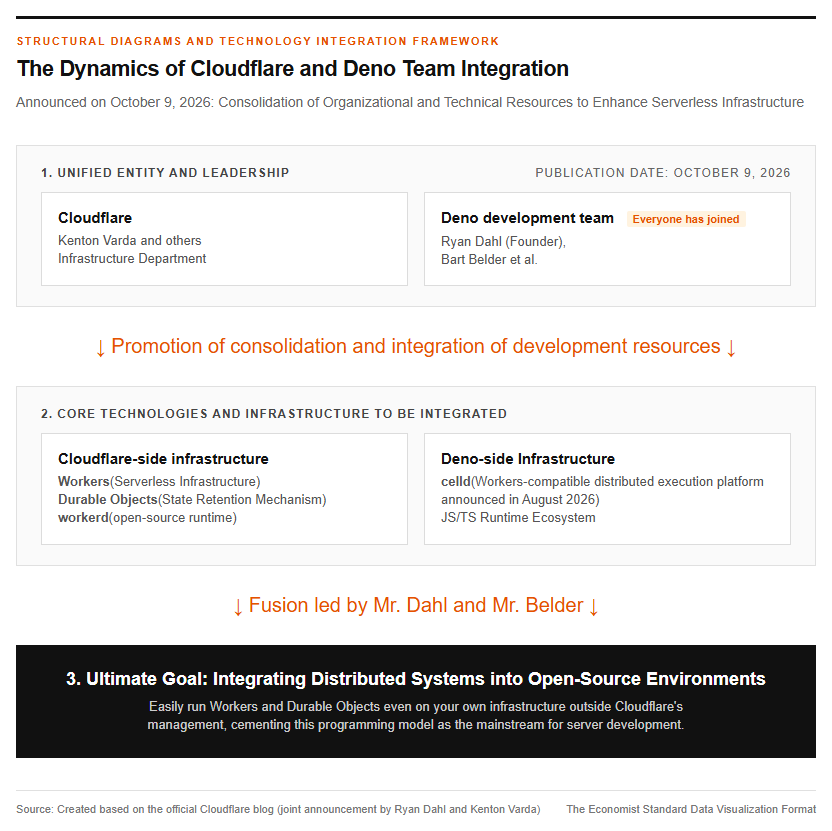
On October 9, 2026, major US cloud computing company Cloudflare announced in an official blog post that the entire team behind Deno, the open-source runtime for JavaScript and TypeScript, is joining the company. The announcement was jointly published by Ryan Dahl, creator of Node.js and founder of Deno, and Kenton Varda of Cloudflare. The purpose of this integration is to build a unified infrastructure that makes it easy to run Cloudflare’s serverless platform, Workers, and its stateful distributed processing mechanism, Durable Objects, on self-hosted infrastructure outside of Cloudflare’s management. Specifically, Ryan Dahl and Bert Belder will lead the effort to integrate celld, a Workers-compatible distributed execution infrastructure announced by the Deno team in August 2026, with workerd, the open-source runtime published by Cloudflare. Dahl has indicated his intention to concentrate resources on making the Workers programming model the mainstream for server development, with a policy of expanding the advanced abstraction of distributed systems into the open-source environment. Please refer to the diagram below for the structure of the development team’s integration.
Migration Roadmap for Existing Products and Services
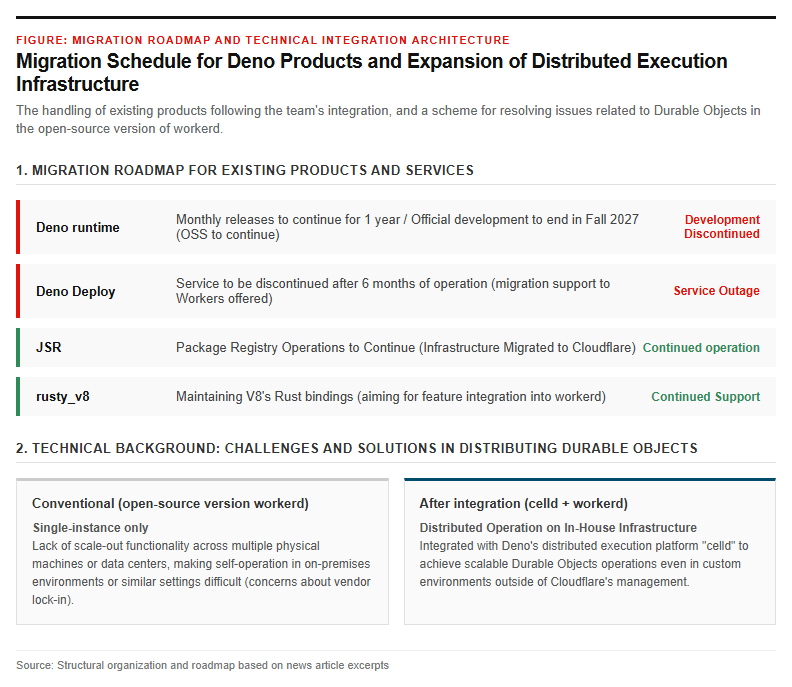
Following the team integration, a phased migration schedule for the existing products and services previously provided by Deno was clearly outlined.
- Deno runtime: Bug fixes and security updates will continue to be provided through monthly releases for one year, but official development will end in the fall of 2027. The code will remain open source, and the continuation of community-led development is welcome.
- Deno Deploy: As a hosting service, Deno Deploy will shut down after operating for six months. Migration support to Cloudflare Workers will be provided for paid plan customers.
- JSR: JSR, a package registry, has been confirmed to continue its operations, and its infrastructure will be migrated to Cloudflare.
- rusty_v8: Support for rusty_v8, the Rust bindings for V8, will also continue, with the goal of integrating its features into workerd.
For developers who have been running their products on Deno, this represents a major strategic shift, and they will need to evaluate future migration options and architectural changes within the one-year grace period.
Technical Background and the Role of the Compatibility Infrastructure “celld”
The Decentralization of Durable Objects and the Challenges of workerd
Cloudflare open-sourced its Workers runtime, workerd, in 2022, but significant technical challenges existed regarding self-hosting. This was because Durable Objects support in open-source workerd was limited to a single instance and did not include the ability to scale out across multiple physical machines and data centers. Cloudflare’s internal Durable Objects routing mechanism relied on a massive infrastructure that centrally managed hundreds of locations, and was not structured in a way that developers could easily self-host on-premises or in their own cloud environments. Due to this architectural limitation, concerns regarding vendor lock-in—the idea that “using Cloudflare Workers makes it impossible to migrate to other platforms”—remained deeply rooted in the developer community. While explaining that providing an escape route through open-sourcing is justified from a business perspective as well, Varda has disclosed that realizing scalable Durable Objects that support self-hosting has been a long-standing issue. Please refer to the following figure for an illustration of scaling from a single location to a distributed environment.
A New Self-Hosted Paradigm Brought by the Single Binary “celld”
Appearing as a direct solution to this workerd challenge is celld, announced by the Deno team in August 2026. Written in Rust as a single binary, celld is a distributed execution platform that narrows down external dependencies to just a single object storage bucket.
- Integration of Distributed Processing: Computation, the SQLite relational database, message queues, and WebSockets are built directly into the programming model.
- Stateful Singleton: Each Durable Object functions as an individually addressable small server with built-in SQLite.
- Application to AI Agent Platforms: Because it integrates serverless execution, persistent state, and real-time communication, it is exceptionally well-suited as an execution infrastructure for AI agents (agent harness).
By integrating workerd with celld—which crystallizes the Deno team’s insights into distributed cloud complexity, cultivated through operating Deno Deploy, into a single binary—a new ecosystem is established that allows anyone to easily self-host a Workers environment.
Impact on the Developer Community and Future Outlook
Runtime Consolidation and Developer Community Response
Behind this merger lies the background that when Deno announced “celld” in August 2026, it offered low prices that significantly undercut Cloudflare Workers’ pricing structure, bringing price competition and discussions between the two to the surface. Additionally, at the end of 2025, Oven, the developer of the JavaScript runtime Bun, was acquired by the AI company Anthropic, accelerating a trend in which independent runtime development companies are being absorbed into major platform companies. While Bun’s acquisition was aimed at strengthening Anthropic’s own AI infrastructure, Deno’s merger differs in nature as its main objectives are the expansion of Cloudflare Workers’ existing ecosystem and the unification of the programming model. Although there are voices within the community lamenting the reduction of choices as Deno as an independent runtime effectively comes to an end, Deno itself will be maintained as an open-source license, leaving the path open for forks by volunteers and community-led maintenance activities.
Future Developments in Serverless Edge Computing
Going forward, as a result of the integration between workerd and celld, running applications using the Workers programming model will become even easier, not only on Cloudflare’s network, but also in private cloud and on-premises environments.
- Achieving Multi-Cloud Operations: Because it operates with only a single binary and a storage bucket, portability is ensured regardless of the cloud provider.
- Continuity of Web Standards and Ecosystems: Maintaining the infrastructure of JSR and rusty_v8 ensures the interoperability of existing JavaScript and TypeScript assets.
- Standardization of distributed application development: A development approach that delegates scalability to the programming model—without requiring developers to worry about building databases or communication layers—is becoming widespread.
The era of competition among independent runtimes that has continued since the introduction of Node.js in 2009 has reached a major turning point, and a transition is expected toward a next-generation server development paradigm that seamlessly integrates computation and data state at the edge and across internal infrastructure.
Reference Page
- 【Deno is joining Cloudflare – Cloudflare Blog】https://blog.cloudflare.com/deno-joins-cloudflare/
- 【Deno is joining Cloudflare – Deno Blog】https://deno.com/blog/cloudflare
- [workerd – Open source Workers runtime (GitHub)] https://github.com/cloudflare/workerd
- 【celld – Distributed Execution Engine】https://celld.dev/
【#Cloudflare #Deno #JavaScript #TypeScript #EdgeComputing #Serverless #ITNews】

コメント