
The Chinese government is considering restrictions on overseas access to its state-of-the-art artificial intelligence (AI) models and has begun discussions with major tech companies such as Alibaba and ByteDance. Behind this is the U.S. resistance to advanced technology regulations and strong caution over technology leakage, positioning AI as a strategic “weapon” for nations.
- Contents of the top-secret meeting and discussions between authorities and tech giants
- The capabilities of regulated AI models and Chinese-made AI
- “Countermeasures” Against U.S. Technology Containment
- “Singapore washing” and stopping talent drain
- Serious Impact on Companies’ Overseas Transactions and Investments
- Building a Unique Ecosystem and an “Investment Firewall”
Contents of the top-secret meeting and discussions between authorities and tech giants
From June to July 2026, an important meeting was held, led by China’s Ministry of Commerce and attended by officials from the National Development and Reform Commission. This meeting brings together executives from leading Chinese tech companies such as Alibaba, ByteDance, and the emerging Zhipu AI (Z.ai). The main agenda item of the consultation was how to restrict overseas access to China’s cutting-edge AI models.
The proposed regulation under consideration clarifies the legal basis for punishing the leakage or theft of a company’s proprietary technology externally as a violation of the National Security Law. Furthermore, new measures have emerged to restrict the entities that can invest in domestic AI startups. Chinese authorities regard domestically produced AI technology as a vital national asset and appear to have firmly strengthened its management. The diagram below illustrates the concept of regulation that China is advancing to build.
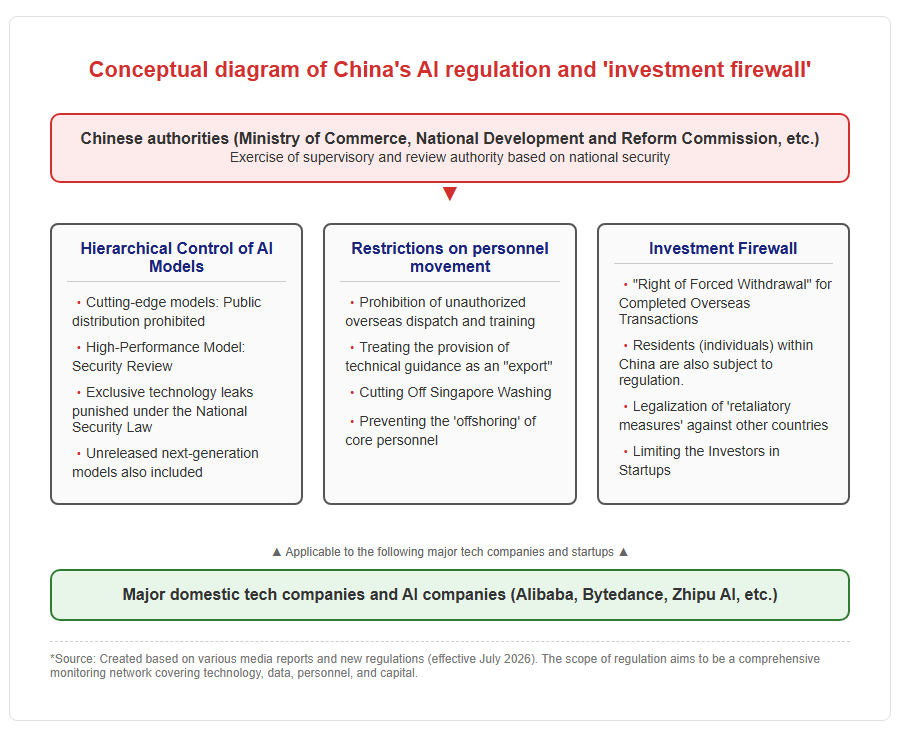
These discussions go beyond mere ideas and are progressing as part of strengthening controls over all overseas transactions involving technology, data, and national security. Although the actual implementation date and specific scope have not yet been determined, potential restrictive measures are likely to be prioritized for next-generation models to be unveiled soon.
The capabilities of regulated AI models and Chinese-made AI
The focus of this regulation is not only on closed-source models already widely used in China, but also on models offered in relatively open formats. Specifically, Alibaba’s “Qwen,” Bytedance’s “Doubao,” and the latest model developed by Zhipu AI are being cited as examples.
In particular, Zhipu AI’s release of “GLM-5.2” in June 2026 shocked AI professionals worldwide. This model approaches the “Claude Opus 4.8” provided by Anthropic in the United States in coding and agent work, earning the highest reputation as an open-source model ever. Notably, despite being subject to U.S. export restrictions on advanced chips, it does not use any GPU made by Nvidia and instead uses Huawei’s “Ascend 910B” The fact is that we completed the training with a cluster of 100,000 units.
In this way, Chinese-made AI is gaining a strong presence in the global market, armed with its “low cost and high performance,” and Chinese authorities view the leakage of this advanced intelligence overseas as a risk equivalent to the proliferation of “cyber nuclear weapons.” Therefore, going forward, it is considered helpful to consider phased regulation plans that restrict the release of higher-performance models after security reviews or restrict their use within China.
Background of Tightening Regulations and Strong Concerns About ‘Technology Leakage’
“Countermeasures” Against U.S. Technology Containment
China’s recent move strongly reflects a direct countermeasure against AI regulations that the United States has already implemented. In the United States, in June 2026, the Department of Commerce imposed export restrictions, halting access to top models such as Anthropic’s “Claude Fable 5” and “Mythos 5” worldwide for foreign users. Additionally, OpenAI’s new model “GPT-5.6” is restricted from being offered due to government approval procedures.
The Chinese side is calmly analyzing this U.S. “containment” strategy and judges that since AI technology has the ability to analyze software weaknesses and generate attack methods, it could pose a serious national security threat. The founder of China’s security giant 360 refers to the U.S. advanced model as a “cyber nuclear weapon” and warns that China will be unable to effectively respond to cyberattacks unless it secures and protects its own technological capabilities.
Therefore, the “investment firewall” that the Chinese government is trying to build is a crucial part of the economic security framework to counter the export control system established by the United States. The new rules issued in June 2026 also include legal grounds to prevent unrelated overseas companies from taking over Chinese companies in retaliation if other countries impose sanctions on Chinese companies.
“Singapore washing” and stopping talent drain
What the Chinese government is most concerned about is no longer the outflow of funds, but the outflow of technology, data, and even “human resources” themselves. Until now, many Chinese tech companies and entrepreneurs have shifted their bases overseas to places like Singapore to avoid strict domestic regulations and geopolitical risks, thereby attracting investment from Western capital. This is called “Singapore washing.”
A decisive example that put the brakes on this movement was Meta’s blocking of Meta’s acquisition of the AI startup “Manus” in April 2026. Manas was registered in Singapore, but its core technology and talent originated from mainland China, and Chinese authorities forcibly scrapped the approximately $2 billion acquisition for national security reasons.
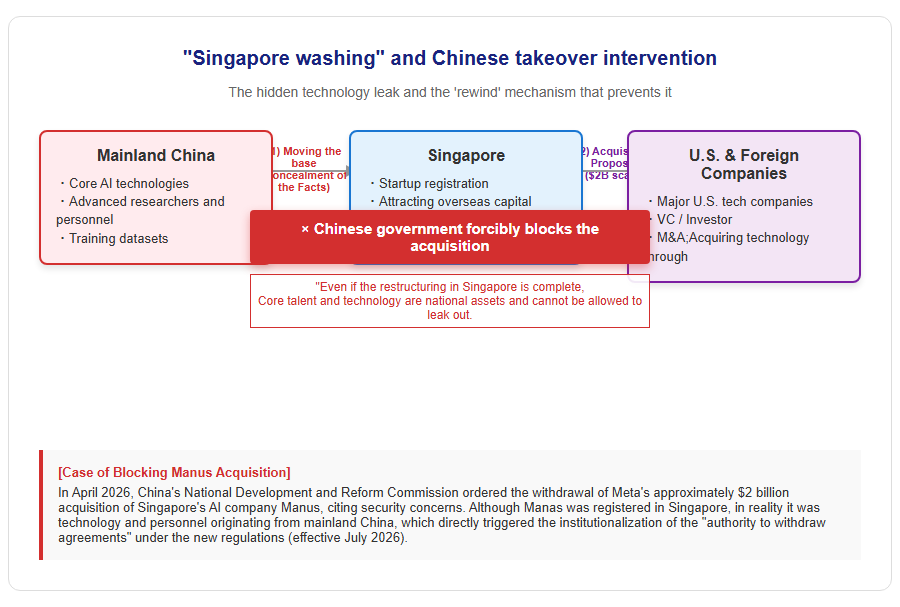
Under the new regulations effective from July 1, 2026, unauthorized overseas dispatch of engineers, technical guidance, and even cross-border training are considered “technology exports” and subject to licensing or prohibition. Recognizing that the essence of IT and AI is “code” and “humans,” the Chinese government has begun to put strong brakes on “human movements.”
Future Developments and Key Points: Acceleration of Global AI Decoupling
Serious Impact on Companies’ Overseas Transactions and Investments
This regulatory tightening is expected to completely transform the business environment of the technology industry. The biggest feature of the “State Council Regulations on Outbound Investment,” promulgated on June 1, 2026, is the explicitly stated “rollback mechanism,” which forcibly revokes (cancellation) of overseas transactions at the government’s discretion, even if already completed. As a result, investors and companies constantly face a huge geopolitical risk, such as transactions being invalidated by government decisions several years later.
Specific penalties have also been strengthened, with illegal investments subject to fines ranging from 0.5% to 1% of the investment amount, and there is a possibility of banning foreign investment activities for a certain period. Additionally, since “individual residents within China” have been explicitly included in regulation for the first time, overseas asset purchases by wealthy individuals and the establishment of offshore companies will also come under scrutiny.
This is also relevant for Japanese companies. Efforts to utilize inexpensive, high-performance Chinese-made open-source AI have also begun within Japan, but going forward, it is necessary to consider the risks of these models suddenly being discontinued or the developers’ capital relationships being changed by government order. The importance of having a universal technology foundation in-house that is not dependent on any specific platform is being recognized.
Building a Unique Ecosystem and an “Investment Firewall”
From a long-term perspective, the “decoupling” of the AI supply chain, where the AI supply chain is completely fragmented between the Western countries centered on the U.S. and the ecosystem centered on China, will accelerate even further. The Chinese government positions AI at the core of future competition alongside semiconductors, quantum computing, and biotechnology, clearly positioning it not just as a private technology but as a “national asset.”
The “investment firewall” China is building is evolving into a comprehensive surveillance network comparable to the once strictest U.S. Committee on Foreign Investment in the United States (CFIUS). Beijing aims to gain complete control over capital, data, supply chains, and the flow of talent.
The future focus will be on how the “enclosure (regulation)” by the U.S. and the “enclosure (protection)” by China will affect AI adoption in third countries. While the U.S. is restricting exports of its latest models, there are also concerns that if China strategically opens up semi-frontier-level models, Chinese players could dominate the majority of AI used in global settings. The battle for technological supremacy has transformed into a survival contest between nations over who writes the rules and who guards the data.
[#AI規制 #経済安全保障 #米中対立 #技術流出 #シンガポールウォッシング #国家安全法]
コメント