Major Japanese automakers, including Nissan Motor and Honda, have announced plans to equip and introduce advanced automated driving systems incorporating AI technology in commercial vehicles starting in fiscal 2027 and beyond. The background to this includes the rise of AI-based methods that significantly reduce development man-hours and the agreement on Level 4 international standards at the UN WP29, as momentum truly builds toward the societal implementation of hands-free driving on ordinary roads and driverless mobility services.
- Major automakers to introduce AI-powered autonomous driving by fiscal 2027
- A radical shift in development methodology from rule-based to AI-based
- Agreement on Level 4 International Standards at UN WP29 and Preliminary Review
- Attribution of Accident Liability, Compensation for Damages, and Legal Frameworks in Japan
- Deployment of Mobility Services in Collaboration with Local Governments and Vehicle Cost Reduction
- Challenges and Outlook for Full-Scale Adoption from Fiscal 2027 Onward
Major automakers to introduce AI-powered autonomous driving by fiscal 2027
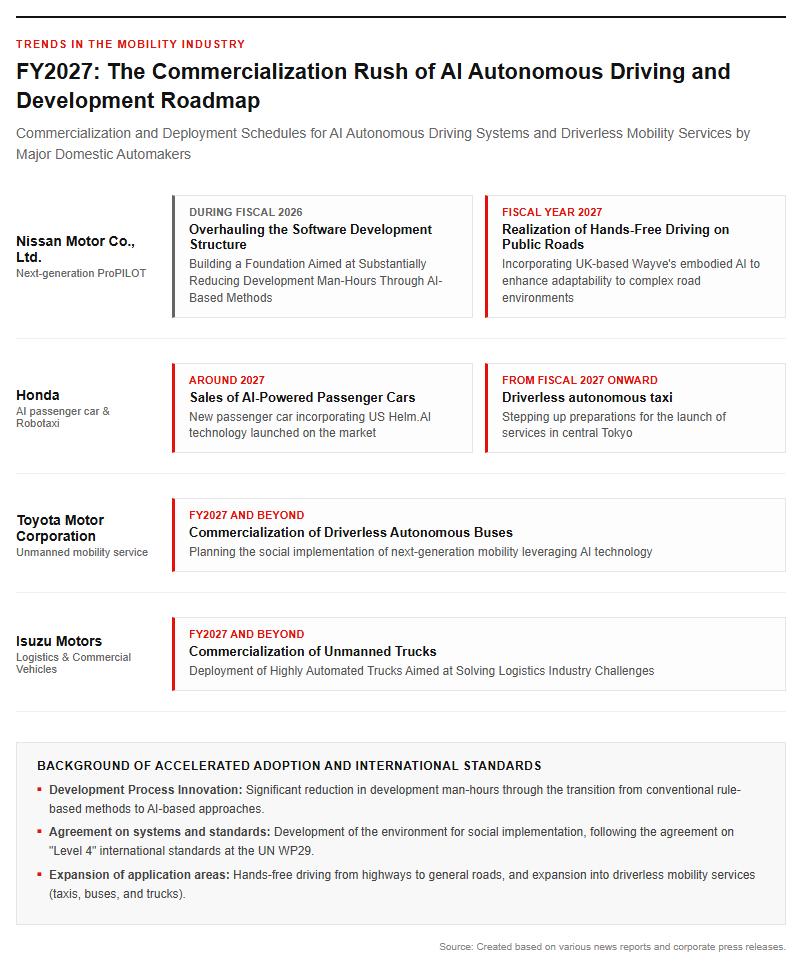
Major Japanese automakers, including Nissan Motor and Honda, have clarified their plans to roll out AI-powered autonomous driving technologies in commercial vehicles and mobility services successively from fiscal 2027 onward. Nissan Motor plans to overhaul its software development structure during fiscal 2026 and aims to introduce a next-generation ProPILOT to the market in fiscal 2027, enabling hands-free driving not only on highways but also on ordinary roads. Furthermore, by incorporating embodied AI technology from the UK-based company Wayve, Nissan intends to dramatically enhance its adaptability to complex road environments. Meanwhile, Honda plans to sell passenger cars equipped with AI technology from the US-based company Helm AI around 2027, while also proceeding with preparations to launch an unmanned autonomous taxi service in central Tokyo. In addition, Toyota Motor and Isuzu Motors are planning to commercialize unmanned autonomous buses and trucks with fiscal 2027 as a milestone, rapidly accelerating efforts across the entire automotive industry toward mass production from fiscal 2027 onward. The following diagram shows an overview of each company’s key deployment plans and schedules.
A radical shift in development methodology from rule-based to AI-based
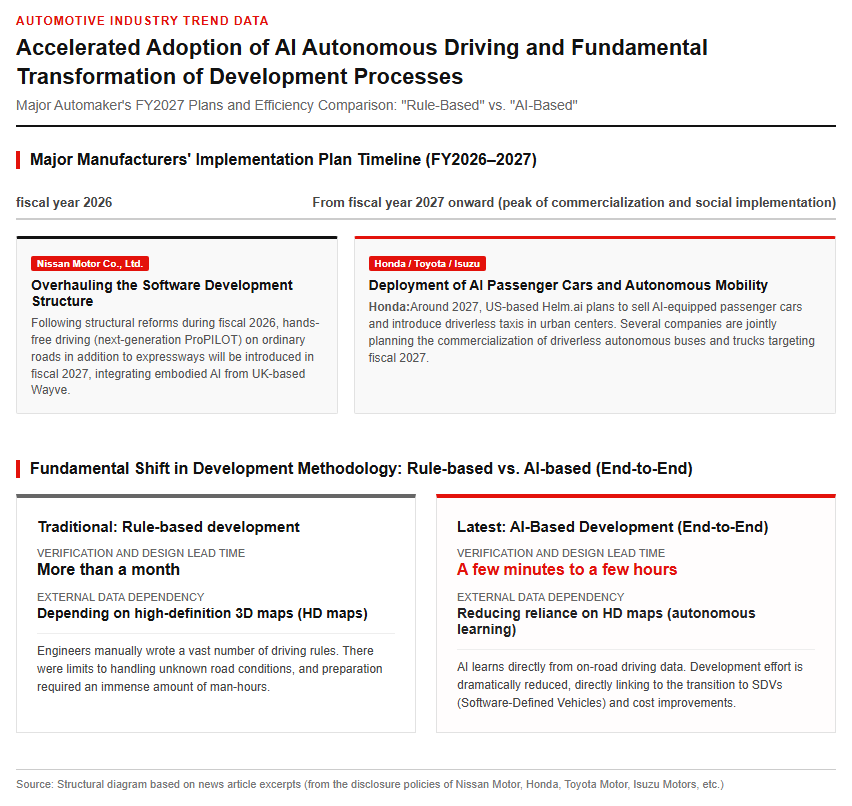
Traditionally, rule-based development—in which engineers manually write vast numbers of driving rules—has been the mainstream for autonomous driving control programs. However, there have been limitations in handling complex scenarios such as unknown road conditions and passing vehicles in narrow alleys, along with the challenge that creating high-precision three-dimensional maps (HD maps) in advance required a massive amount of time. In contrast, with the latest AI-based development (End-to-End), the speed and accuracy of programming improve dramatically as AI directly learns driving operations from on-road driving data. In the case of Nissan Motor, verification and design work that previously took engineers over a month is expected to be reduced to just a few minutes to a few hours through the full-scale introduction of AI. This reduction in development lead time accelerates the transition to Software-Defined Vehicles (SDVs) and directly leads to a fundamental improvement in development costs. AI-based control reduces reliance on HD maps, making it possible to build highly versatile autonomous driving systems.
Establishment of International Safety Standards and Development of Domestic Legal Systems
Agreement on Level 4 International Standards at UN WP29 and Preliminary Review
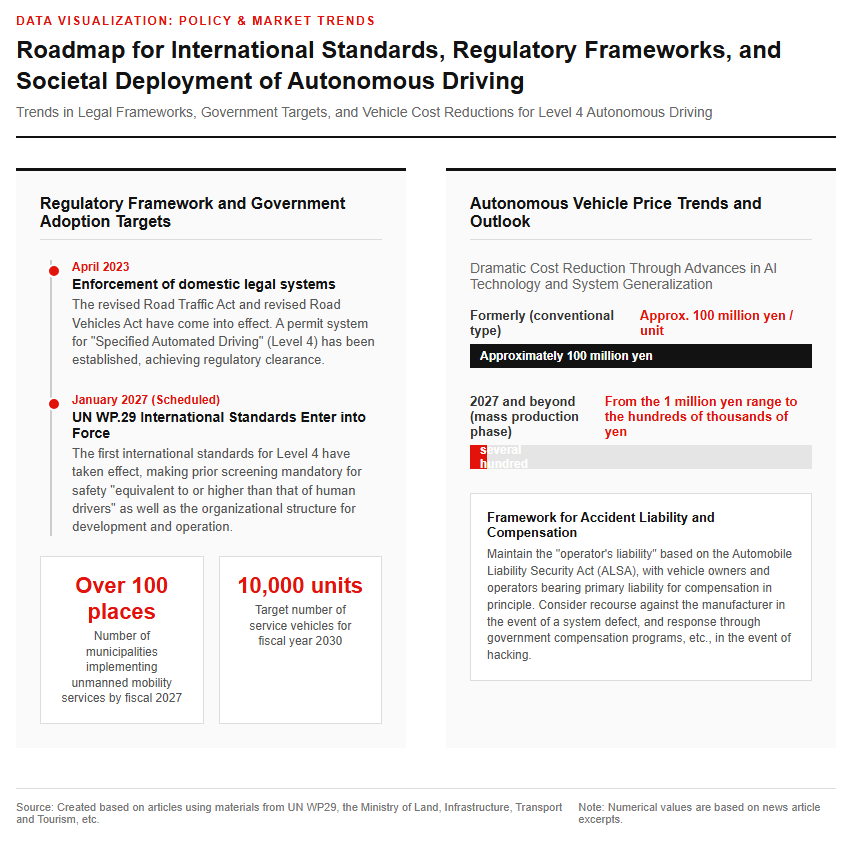
Ensuring objective safety and harmonizing international standards are essential for the commercialization and widespread deployment of autonomous driving vehicles and services. The United Nations World Forum for Harmonization of Vehicle Regulations (WP29) has agreed to adopt the first international standards for Level 4—which refers to fully autonomous driving under specific conditions—with an expected entry into force in January 2027. The new standards explicitly require autonomous driving systems to provide “safety equivalent to or greater than that of a competent and attentive human driver.” Manufacturers, including automakers, will be mandated to undergo rigorous prior screening not only regarding the safety of vehicle performance—such as appropriate behavior in response to traffic conditions, occupant information systems, and cybersecurity measures—but also regarding their development and operational organizational structures for maintaining safety. Additionally, even after market launch, they will be required to continuously monitor operating states and persistently implement defect remediation. Japan has led discussions by serving as the co-chair of the expert panel in formulating these new standards, and the establishment of these international standards is helping to bolster the efficient global development efforts of domestic manufacturers.
Attribution of Accident Liability, Compensation for Damages, and Legal Frameworks in Japan
With the practical application of autonomous driving, concrete discussions are progressing regarding where responsibility lies and how insurance systems should be structured in the unlikely event of an accident. In Japan, the revised Road Traffic Act and the revised Road Vehicles Act were enforced in April 2023, establishing a permit system for “Specified Automated Driving”—which allows vehicles to operate without a driver under certain conditions—and achieving the institutional deregulation of Level 4. Regarding civil liability for damages, the Ministry of Land, Infrastructure, Transport and Tourism’s “Guidelines for Institutional Development related to Autonomous Driving” and other documents indicate a policy to maintain the concept of “operator liability” based on the existing Automobile Liability Security Act. This maintains a framework where, even in accidents occurring while the system is engaged, the vehicle owner or operator bears primary liability in principle, ensuring the prompt relief of victims. If a system defect is the cause, insurance companies are expected to seek compensation from the manufacturer, and for accidents caused by unauthorized hacking, responses such as government compensation programs are being considered. To clarify the circumstances at the time of an accident, the installation of operational status recording devices is mandatory, and the development of legal frameworks and technological verification are being promoted in parallel.
Expansion of Social Implementation and Future Challenges / Prospects
Deployment of Mobility Services in Collaboration with Local Governments and Vehicle Cost Reduction
The social implementation of autonomous driving is generating high expectations as a means to resolve regional issues such as maintaining local bus routes and alleviating driver shortages in rural areas. The government has set numerical targets to realize unmanned autonomous mobility services in over 100 locations nationwide by fiscal 2027, and to expand the number of service vehicles to 10,000 by fiscal 2030. Through the “Autonomous Driving Social Implementation Promotion Project,” the Ministry of Land, Infrastructure, Transport and Tourism is providing robust financial support to local governments and consortiums aiming to implement Level 4 autonomous driving by fiscal 2027 at the latest. By subsidizing initial investments and operating expenses, initiatives to enhance the sustainability of regional public transportation are spreading across the country. Furthermore, thanks to advances in AI technology and the standardization of systems, the price of autonomous vehicles—once as high as approximately 100 million yen per vehicle—has dropped dramatically. In the mass production phase expected from 2027 onward, prices are projected to fall to the 1 million yen range, or several hundred thousand yen as a driving assistance option for commercial vehicles, making the reduction of implementation costs—historically the greatest hurdle to adoption—a realistic prospect.
Challenges and Outlook for Full-Scale Adoption from Fiscal 2027 Onward
Looking ahead to the full-scale adoption period from fiscal 2027 onward, critical focal points will include not only technical aspects but also improving social acceptance and establishing remote monitoring systems. While past demonstration experiments have centered on low-speed small carts and buses in specific regions, moving forward, the full-scale entry of major domestic manufacturers will shift operations to higher speeds and more complex traffic environments. The introduction of “1-to-N” operation systems, in which a single operator remotely monitors multiple Level 4 vehicles, is expected to reduce operating costs and provide a fundamental solution to labor shortages. At the same time, to foster understanding among local residents and ensure transparency in administrative procedures, community-centric support environments are being developed—such as the establishment of “Level 4 Mobility Regional Committees” uniting local municipalities, business operators, and relevant administrative agencies. Given that approximately 96% of traffic accidents are reportedly caused by drivers violating traffic laws, the practical application and expansion of AI autonomous driving are projected to play an exceptionally vital role in reducing accidents and preserving local mobility options.
Reference page
- [Ministry of Land, Infrastructure, Transport and Tourism] Initiatives for the Promotion and Expansion of Automated Driving
自動車:自動運転における損害賠償責任に関する研究会 - 国土交通省国土交通省のウェブサイトです。政策、報道発表資料、統計情報、各種申請手続きに関する情報などを掲載しています。www.mlit.go.jp - [Ministry of Land, Infrastructure, Transport and Tourism] Guidelines for the Social Implementation and Commercialization of Automated Driving Mobility Services
https://www.mlit.go.jp/jidosha/content/001901763.pdf

【#AutonomousDriving #AI #Level4 #MinistryOfLandInfrastructureTransportAndTourism #ProPILOT #Mobility】


コメント