Plans are progressing for the construction and development of a large-scale data center on the site of a former Sharp factory in Yaita City, Tochigi Prefecture. Through its designation as a GX (Green Transformation) strategic region by the Ministry of Economy, Trade and Industry and collaboration with Tokyo Electric Power Company, the project is expected to drive regional revitalization and realize a decarbonized society by leveraging abundant power infrastructure.
- Overview of the Large-Scale Clustering Plan Utilizing Vacated Sites
- Power Reception Infrastructure Capable of Supplying Over 1 Gigawatt and the Strengths of Transmission Lines
- The Impact of the Ministry of Economy, Trade and Industry’s Designation of DC-Integrated Regions
- Collaboration with Tokyo Electric Power Company Holdings and Infrastructure Development
- Surge in Electricity Demand and Responses to Cooling Water and Environmental Issues
- Future Focus and Prospects for Sustainable Regional Development
Overview of the Large-Scale Clustering Plan Utilizing Vacated Sites
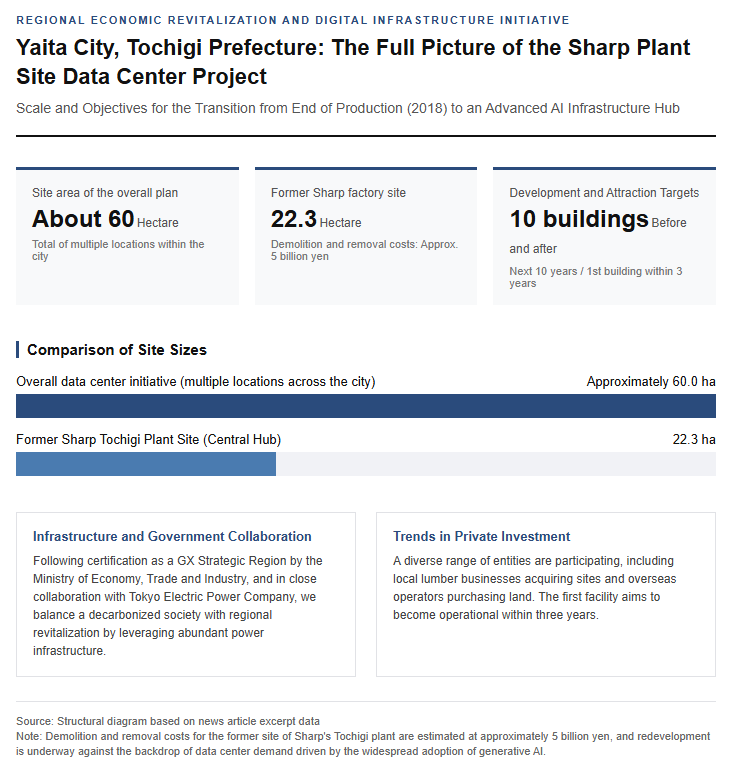
The former Sharp Tochigi Plant in Yaita City, Tochigi Prefecture, which once supported the local economy as a flat-screen TV production base for major electronics manufacturer Sharp, had faced a major challenge in utilizing its vast land since production ended in 2018. Demolition and removal costs for the approximately 22.3 hectares of unused land were estimated to require at least about 5 billion yen, and efforts to explore the utilization of the site had continued for many years. Amid this background, driven by the surge in data center demand accompanying the rapid spread of generative AI, plans to redevelop the former site into an advanced data center hub have entered full swing. A vision has been put forward to attract and develop around 10 data centers over the next 10 years across a total site area of approximately 60 hectares combining multiple locations within the city. The first building aims to be operational within three years, attracting diverse private investment such as the acquisition of the site by a local lumber business and land purchases by overseas operators. The long-stagnant former factory site is now poised to be reborn as a cutting-edge digital infrastructure hub.
Power Reception Infrastructure Capable of Supplying Over 1 Gigawatt and the Strengths of Transmission Lines
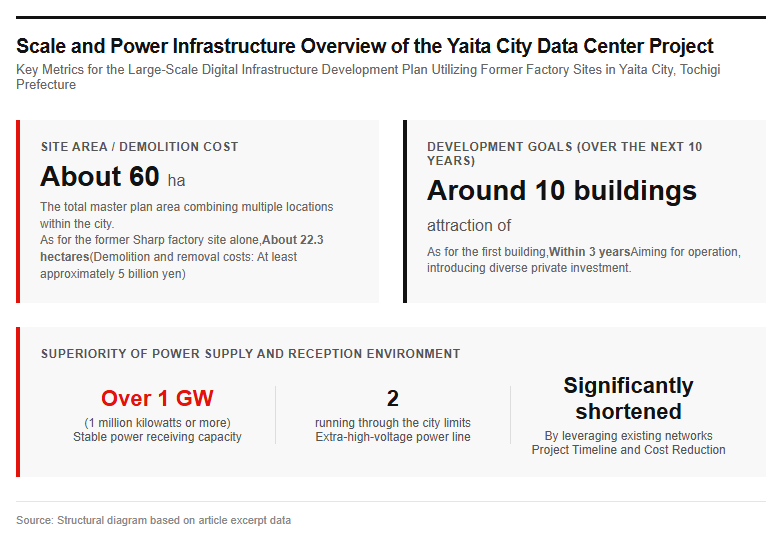
The biggest bottleneck in data center construction is securing the massive amount of power required to keep facilities operating stably. The primary reason Yaita City holds a strong competitive advantage as a location for data centers is the presence of two extra-high-voltage power lines running through the city. By utilizing this existing, superior power grid, the city is equipped to smoothly supply over 1 gigawatt (1 million kilowatts) of electricity. Normally, building a new, large-scale data center in the hundreds-of-megawatts class requires anywhere from several years to over a decade, along with enormous infrastructure development costs, to newly construct substations or lay backbone power lines. However, because Yaita City allows for power reception utilizing the existing extra-high-voltage grid, it offers the major advantage of significantly reducing both the construction period and implementation costs required for power intake. This abundant transmission capacity margin and high reliability of power supply make it an extremely attractive location for domestic and international AI data center operators aiming for rapid business expansion.
Designation of GX Strategic Regions as a National Strategy and Public-Private Partnerships
The Impact of the Ministry of Economy, Trade and Industry’s Designation of DC-Integrated Regions
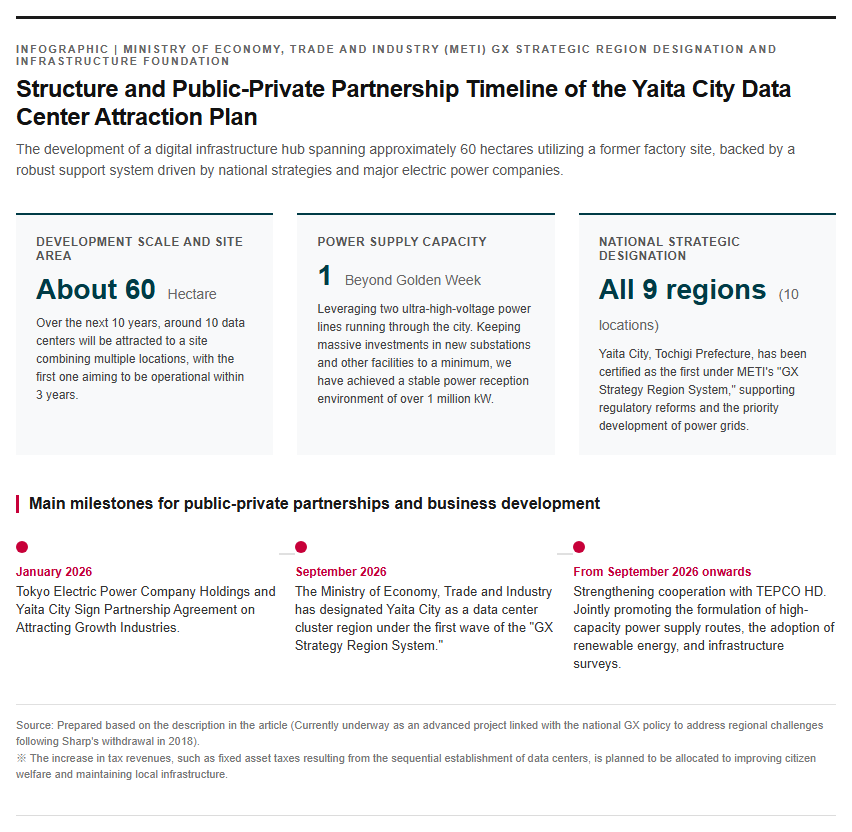
In September 2026, the Ministry of Economy, Trade and Industry (METI) certified Yaita City, Tochigi Prefecture, as a data center cluster region under the first round of the “GX (Green Transformation) Strategic Region System.” This initiative, which selected 9 regions and 10 locations nationwide, aims to integrally promote regional decarbonization and the development of new industrial clusters. By receiving the strategic region designation from the national government, Yaita City has secured strong government support, including direct assistance for capital investment, prioritized early development of power grids, and various regulatory exemptions. Yaita City Mayor Takeyoshi Morishima noted that a significant increase in property tax revenue is expected as data centers are established sequentially, and indicated his intention to use the resulting financial resources to improve public welfare and maintain regional infrastructure. To tackle regional issues such as industrial contraction and population decline that worsened following Sharp’s withdrawal in 2018, advanced industry attraction tied to national GX policies is beginning to take off as a powerful solution.
Collaboration with Tokyo Electric Power Company Holdings and Infrastructure Development
To achieve stable operation and rapid construction of data centers, a close cooperative framework with major electric power companies responsible for power infrastructure is indispensable. Tokyo Electric Power Company Holdings officially concluded a “Partnership Agreement on Attracting Growth Industries” with Yaita City in January 2026, and has repeatedly discussed power receiving systems and infrastructure development. Furthermore, following its designation as a GX Strategic Region by the Ministry of Economy, Trade and Industry, it announced in September 2026 that it would further strengthen cooperation between the two parties. Based on this partnership agreement, the TEPCO Group is integrally promoting initiatives including the formulation of stable supply routes for the large-capacity electricity required by data center clusters, the promotion of renewable energy adoption such as solar and woody biomass, and infrastructure surveys of power and telecommunications networks in the surrounding areas. By sharing plans from the initial stages between high-power consuming businesses and the supply side, it becomes possible to minimize risks such as grid connection delays and power shortages, and the foundation for realizing sustainable industrial agglomeration is falling into place.
Data Center Challenges and Community Coexistence Amid the Rapid Expansion of Generative AI
Surge in Electricity Demand and Responses to Cooling Water and Environmental Issues
The global surge in data center construction is highlighting not only the strain on power systems, but also new challenges in terms of local communities and the environment. In particular, the high-density server clusters supporting the latest generative AI generate immense heat, making the implementation of efficient cooling systems essential. In precedent cases in the U.S. and Europe, concerns have been raised regarding the massive consumption of water resources associated with cooling processes, the noise and exhaust heat from emergency generators lining the sites, and the visual oppression posed by windowless giant buildings on the landscape. This has led to a succession of opposition movements and friction with local residents. Similar troubles have occurred near residential areas in urban parts of Japan as well, creating a strong demand for environmental consideration and highly transparent consensus-building. In the development of data centers in Yaita City, building upon these domestic and international precedents, guidelines that operators must observe are being formulated and thorough explanations are being provided to residents, while ongoing efforts continue to seek local coexistence through the adoption of water-saving and highly efficient cooling technologies.
Future Focus and Prospects for Sustainable Regional Development
For Yaita City’s data center cluster initiative to result in true regional revitalization, the future focal points lie in the official announcement of companies whose entry has been decided and the reliable commencement of operations for the first building, which marks the first step of the plan. The data center industry brings massive economic ripple effects during the construction phase; however, due to its industrial characteristics, once operations begin, it is highly automated, resulting in limited direct job creation compared to factories and similar facilities. Therefore, rather than simply attracting server buildings, the key to long-term success will be how to attract related companies responsible for facility maintenance, telecommunications carriers, and the surrounding agglomeration of advanced IT industries. It is essential to steadily reinvest the increased property tax revenues into enriching citizens’ lives and regional welfare, and to promote measures that allow residents to experience the benefits firsthand. Yaita City’s challenge of transforming the negative legacy of Sharp’s abandoned site into a digital infrastructure hub is garnering high expectations as a model case for the resurgence of local governments.
Reference page
- [Tokyo Electric Power Company Holdings Press Release] [suspicious link removed]
- [The Institute of Energy Economics, Japan Report] [suspicious link removed]
【#YaitaCity #DataCenter #GXStrategicArea #FormerSharpSite #TokyoElectricPower #EnergyEfficientCooling #IndustrialPromotion】


コメント