In the Tone River system, water intake restrictions began on some rivers starting May 2026, and even in late June, dam storage volumes remain significantly below average. This is due to a dual factor of record snowfall shortages and insufficient rainfall since last summer.
- 10% limit on the Kanna River and the decline in dam storage rates
- Reservoir Status of Nine Dams Upstream of the Tone River and the Role of Yamba Dam
- The crisis of drought control looming in the Kinugawa River system
- The impact of record-breaking snowfall and premature snowmelt
- Prolonged trend of low rainfall and worsening weather conditions
- Risks to Industrial and Economic Activities and Water-Conservation Requests
- Timeline operation by the Drought Countermeasures Liaison Council
- Future Policies and Direction of Water Intake Restrictions Presented by the Extraordinary Session
- Typhoon Path and Outlook for Cessation Based on the Three-Month Forecast
10% limit on the Kanna River and the decline in dam storage rates
Starting at 9:00 a.m. on May 26, 2026, a 10% water intake restriction was implemented on the Kanna River, a tributary of the Tone River system, targeting agricultural and industrial water. This measure was announced by the Kanto Regional Development Bureau’s Takasaki River and National Highway Office and others, and is directly caused by the drop in water capacity at Shimokubo Dam, located in the Kanna River basin, to a critical level. According to data as of June 18, 2026, Shimokubo Dam has an effective capacity of 120 million cubic meters, but the storage capacity is about 38.98 million cubic meters, with a storage rate of only 32%.
Shimokubo Dam is located in an area where water storage recovery is not expected due to snowmelt and runoff, and its water storage status is greatly affected by rainfall. Looking back at the situation in 2026, rainfall from August to October 2025 was below average, increasing downstream replenishment and significantly reducing water storage levels. From December to January, there was hardly any rainfall around the dam, and the water level did not fully recover into early summer. Although there was a slight recovery due to Typhoon No. 6 in June, the water volume was not sufficient to lift the water intake restrictions, and the current situation has continued. The following image shows the current situation around the Kanna River, where water intake restrictions are in place.
Reservoir Status of Nine Dams Upstream of the Tone River and the Role of Yamba Dam
Currently, there are no water intake restrictions on the main Tone River, but the overall water storage status of the nine upstream dams remains unpredictable. As of June 18, 2026, the total storage capacity of the nine dams is approximately 278.88 million cubic meters, with a storage rate of 51%. This represents about 77% of the historical average from 1992 to 2025, indicating that water is decreasing at a pace well below normal. Notably, the decline is particularly noticeable at major dams such as Yagisawa Dam (storage rate 51%) and Sonohara Dam (44%).
A notable point in this drought is the presence of Yamba Dam, which began full-scale operation in 2020. As of June 18, 2026, the storage rate of Yamba Dam is 46%, helping to raise the overall storage capacity of the Tone River system. If the Yamba Dam had not existed, it is presumed that the total water storage of the entire water system would have been even lower. However, the fact that even operations including Yamba Dam are below average suggests that the current water shortage is widespread and severe. For information on the reservoir trends of the dam group, please refer to the graph below.
The crisis of drought control looming in the Kinugawa River system
Even in the Kinugawa River, a major tributary of the Tone River system, the risk of drought is rapidly increasing. As of June 18, 2026, the total storage capacity of the four upstream dams of the Kinugawa River—Igori Dam, Kawamata Dam, Kawaji Dam, and Yunishigawa Dam—has reached 112.66 million cubic meters, with a storage rate reduced to 55%. This means that water intake restrictions have decreased to levels comparable to those in 2013 and 2016. As of April, the storage rate was 89%, which was good, but in just two months, the storage volume decreased by about 114 million cubic meters, which is a faster rate of decline than the main Tone River.
In response to these circumstances, on June 18, 2026, extraordinary meetings were held for the “Kinugawa Water Resources Coordination Coordination Liaison Committee” and the “Kinugawa Upstream Water Utilization Coordination Liaison Committee.” In 2024 (Reiwa 6), the Kinugawa River also implemented water intake restrictions of up to 10% from July to September. Depending on future rainfall conditions in 2026, there is a very high possibility that drought control will be implemented on the Kinugawa River alone ahead of the main Tone River. In particular, the Kawaji Dam and Yunishigawa Dam serve both water utilization purposes for the entire Tone River system, so a drop in storage here could affect the overall water supply-demand balance in the Tokyo metropolitan area.
Background to the severe water shortage in summer 2026
The impact of record-breaking snowfall and premature snowmelt
The biggest natural factor causing the drought in 2026 is the extreme “snowfall” in winter and the resulting “premature snowmelt.” The dam groups in the upper reaches of the Tone River typically restore the dams to nearly full capacity through spring snowmelt (snowmelt outflow), and supply this water during the peak agricultural water demand from May to June. However, in 2026, the snowmelt will end about a month earlier than usual, resulting in a significant shortage of meltwater supply.
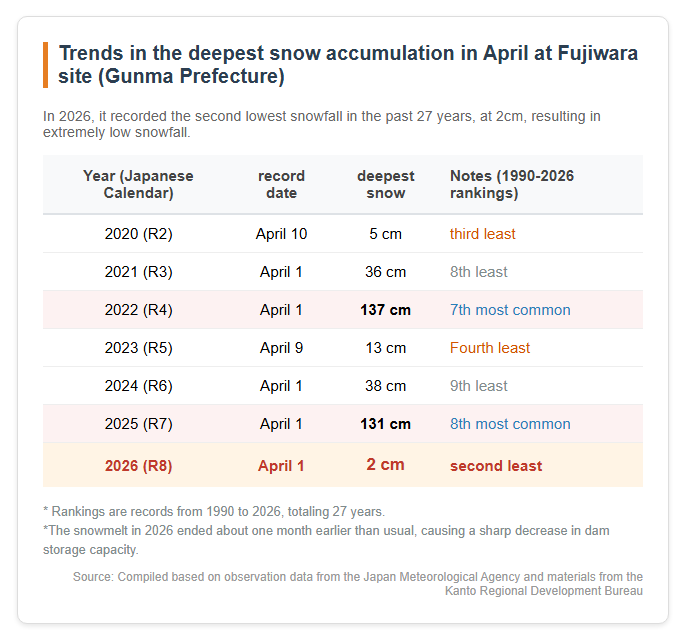
Looking at specific observational data, the deepest snow depth at Fujiwara site in Gunma Prefecture on April 1, 2026, was only 2 centimeters. This is the second lowest record over the past 27 years, from 1990 to 2026, after 2020. Compared to the same period in 2025, when there was 131 centimeters of snowfall, you can see how little snow was recorded in 2026. As a result, it was no longer necessary to break down the dam’s storage to replenish downstream water, which would normally be covered by snowmelt, resulting in a sharp drop in storage rates just before summer. The following figure shows recent comparative data on snow depth in April.
Prolonged trend of low rainfall and worsening weather conditions
In addition to the lack of snowfall, the ongoing rainfall shortage since the latter half of 2025 is casting a serious shadow. The average precipitation in the upper reaches of the Kurihashi point on the Tone River has been below historical averages for many months since June 2025. This trend is especially pronounced even after entering 2026, with January receiving about 50% (21 millimeters) of the average, and February 26th being about 40% (19 millimeters) of the average.
Also, around June 20, 2026, the rainy season was confirmed nationwide, but the concentrated rainfall from the rainy season front has not been sufficiently brought to the upper reaches of the dam. Under drought conditions, continuous rainfall across the entire dam catchment area is needed rather than localized thunderstorms, but for now, the 2026 rainy season is close to an empty rainy season. Regarding temperature, the forecast for the next month shows a 50% probability of being ‘high,’ raising concerns that increased water demand due to rising temperatures could further squeeze storage capacity.
Social Impact and Future Measures
Risks to Industrial and Economic Activities and Water-Conservation Requests
The continuation and strengthening of water intake restrictions will have a significant impact on local industries and economic activities. Especially in manufacturing and semiconductor industries, which use large amounts of industrial water, water supply instability poses a direct risk of reduced operations and deterioration of product quality. Past surveys have shown that when water intake limits exceed 20%, there is a sharp increase in businesses facing impacts on products and equipment or being forced to halt operations, raising concerns about the current 10% limit being further strengthened.
In agriculture as well, water shortages during critical periods after rice planting can lead to poor crop growth and reduced yields. Referring to a past emergency survey conducted by the Toyohashi Chamber of Commerce and Industry, about 35.8% of responding businesses require water as a core part of their business activities, and if water conservation is prolonged, about half of these sites are expected to experience some form of management impact. The government is urging citizens to voluntarily save water in daily life, and is at the stage of reducing the burden on society as a whole, such as stopping watering at public facilities and limiting pool usage.
Timeline operation by the Drought Countermeasures Liaison Council
In response to the worsening drought, the Ministry of Land, Infrastructure, Transport and Tourism is urgently coordinating with relevant prefectures through the ‘Tone River System Drought Countermeasures Liaison Council.’ This council is composed of the Kanto Regional Development Bureau of the Ministry of Land, Infrastructure, Transport and Tourism, the Ministry of Economy, Trade and Industry, the Ministry of Agriculture, Forestry and Fisheries, and Tokyo Metropolis (one metropolis and six other prefectures), and is responsible for sharing information and coordinating among water users. Currently, concrete actions are being taken based on the “Drought Response Timeline,” which sets out measures tailored to the situation from the initial stages to the worsening of droughts.
Specifically, flexible dam operations and flexible use of dams and necessary access from other water systems will be considered to prevent the water storage status from shifting from Category 1 (start of water intake restrictions) to Category 2 (significant impact on socioeconomic activities). Additionally, manuals have been developed to request cooperation from power generation operators to convert dedicated dam capacity for water supply to prepare for abnormal droughts. An extraordinary executive meeting is scheduled for June 24, 2026, where the main focus is whether water intake restrictions will be raised and new measures will be presented.
Future Outlook and Key Points
Future Policies and Direction of Water Intake Restrictions Presented by the Extraordinary Session
The results of the “Tone River System Drought Countermeasure Liaison Council Executive Committee (Extraordinary),” scheduled to be announced on June 24, 2026, will have a decisive impact on water use in the Tokyo metropolitan area this summer. At this meeting, the latest storage data and weather forecasts will be compared to discuss whether to continue the current 10% intake limit or to expand the target areas and restriction rates. Especially if the storage rate of Shimokubo Dam does not recover, it cannot be ruled out that intake restrictions may be introduced in the main river basin other than the Kanna River.
Additionally, the decision made by this executive committee will be drawn to the start of drought control measures in the Kinugawa River system. At the council, the council discusses how to maintain a balance of demand for each water user—agricultural water, industrial water, and tap water—while taking the situation of the Tone River and Kinugawa River as an integrated approach. For citizens and businesses, based on the outlook presented at this conference, further revisions of water-saving measures and operational plans may be necessary.
Typhoon Path and Outlook for Cessation Based on the Three-Month Forecast
The biggest uncertainty affecting future conditions is the occurrence and path of the typhoon. Typhoon No. 7, which formed on June 20, 2026, is approaching Okinawa, and the amount of rainfall this typhoon and the subsequent tropical cyclone will bring to the upper reaches of the dam will be key. In recent years, even in years with little snow, there have been cases where rainfall caused by typhoons from August dramatically restored water levels, helping to avoid severe droughts.
However, according to the three-month forecast released by the Meteorological Agency for March to May 2026 (and subsequent long-term outlook), the probability of rainfall in the coming months exceeding 70% is either “low” or “average,” making a natural recovery far from the point of optimism. With temperatures expected to remain high, it is necessary to prepare for the risk of prolonged water intake restrictions heading into August, when increased evaporation and peak water demand coincide. This summer will be a time when we closely monitor government announcements and real-time water source information, and cooperation across the entire region will be required.
[#利根川水系 #取水制限 #渇水 #水不足 #ダム貯水率 #節水 #八ッ場ダム #鬼怒川]

コメント