
With the rapid surge in AI data centers, large-scale development of power infrastructure and the transformation of power supply models are progressing in African countries. While utilizing massive electricity demand as a stable customer base is expected to improve power grid efficiency and reduce costs, managing grid integration and investment risks has emerged as a new challenge.
- Africa’s AI Infrastructure Entering the Gigawatt Era
- Breaking Away from Power Outage Losses and Costly On-Site Power Generation
- Large-Scale “Anchor Demand” Drives Power Grid Cost Distribution
- Two Infrastructure Strategies Using Geothermal, Solar, and Natural Gas
- The Structural Risks of Off-Grid Transitions and Asset Stranding
- Future Outlook for Power Integration and the Development of Policies and Regulations
Africa’s AI Infrastructure Entering the Gigawatt Era
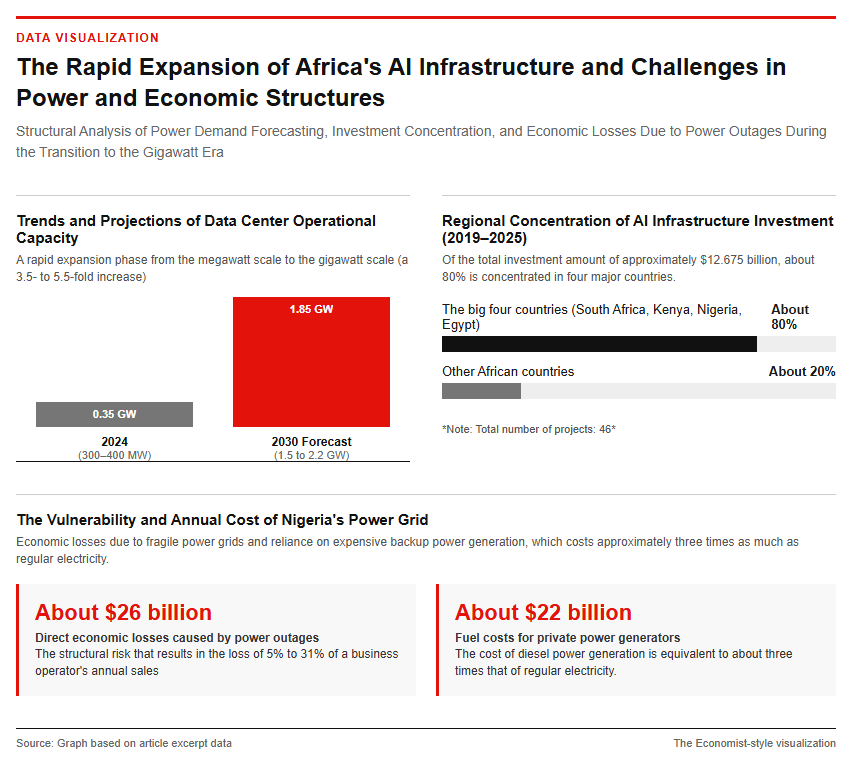
With the rapid advancement of artificial intelligence (AI), the power demand of global data centers is surging. While operational data center capacity in Africa stands at only about 300 to 400 megawatts as of 2024, it is projected to expand approximately 3.5 to 5.5 times to a scale of 1.5 to 2.2 gigawatts by 2030. Power infrastructure that was previously planned on a megawatt scale is now being forced to transition to large-scale facilities in the 100-to-200-megawatt class, as well as gigawatt-scale hyperscale campuses. From 2019 to 2025, a total of approximately $12.675 billion in investments was announced across 46 AI-related infrastructure projects throughout Africa. Approximately 80% of these investments are concentrated in four major countries—South Africa, Kenya, Nigeria, and Egypt—where foundational development for the growth of the digital economy is progressing rapidly. Because computing resources supporting AI training and real-time inference require 24/7 continuous operation and high-voltage power supply, expanding grid capacity and improving stability have become top priorities.
Breaking Away from Power Outage Losses and Costly On-Site Power Generation
In many African countries, chronic power shortages and grid instability have been major barriers to economic growth. According to business surveys, African enterprises are estimated to lose anywhere from about 5% to as much as 31% of their annual revenue due to power outages. For example, in Nigeria, direct economic losses from blackouts reach approximately $26 billion annually, while about $22 billion is spent each year on fuel for private generators. Because the cost of self-generation using diesel generators is equivalent to about three times the electricity rates procured from the conventional power grid, it significantly drives up costs across all industries. Mission-critical AI data centers require an uptime of 99.99% or higher, meaning they cannot rely on traditionally fragile power grids. Hitherto, excess generation capacity in Africa’s power sector has been viewed as a financial inefficiency, but with the advent of AI demand, surplus capacity is being re-evaluated as a crucial buffer to enhance grid stability and reduce outages. The entry of data centers serves as an opportunity to break away from the conventional, high-cost self-generation structure and build a reliable power infrastructure.
The Mechanism of Electricity Price Reduction and Energy Selection
Large-Scale “Anchor Demand” Drives Power Grid Cost Distribution
The key to AI data centers potentially lowering regional electricity bills lies in their role as “anchor demand.” Because data centers continuously consume large amounts of electricity year-round, they provide power companies with extremely predictable revenue streams. By entering into long-term Power Purchase Agreements (PPAs), operators ensure the reliable recovery of the massive capital investments required to build and reinforce power plants and high-voltage transmission grids. As a result of fixed grid and maintenance costs being broadly distributed among ultra-large consumers, there is an anticipated effect of suppressing unit prices (tariffs) for electricity supplied to households and small-to-medium enterprises. Furthermore, with the approval of approximately 174 megawatts of hyperscale facilities in Cape Town, South Africa, they are serving as a catalyst to encourage power market reform and private sector participation. As shown in the figure below, the grid connection of large data centers serves as the driving force that circulates regional energy investments.
However, this is premised on designing a highly transparent pricing structure that appropriately requires large-scale consumers to bear the costs of power grid reinforcement.
Two Infrastructure Strategies Using Geothermal, Solar, and Natural Gas
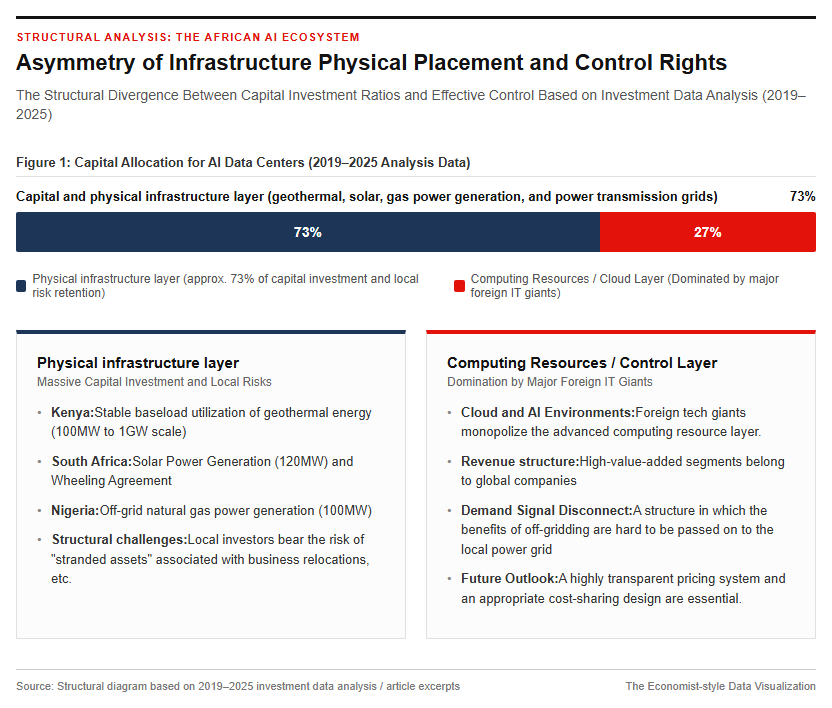
There are two main approaches to power source development for data centers deployed in Africa: leveraging renewable energy and a self-sustained natural gas-based approach. A prime example of renewable energy utilization is Kenya. Kenya’s power grid is composed of approximately 90% renewable energy, with geothermal power accounting for about 48%. Because geothermal energy can provide stable output (baseload) unaffected by the weather, Microsoft and G42 have decided to invest in a 100-megawatt-scale data center (expandable to 1 gigawatt in the future) in the Naivasha geothermal region. In South Africa, Teraco has constructed a 120-megawatt solar power plant and utilizes a “wheeling agreement” to wheel power across Eskom’s grid. Meanwhile, in Nigeria, Tetracore Energy Group has adopted a model to build a 100-megawatt on-site natural gas power plant for a 20-megawatt data center. To cope with underdeveloped existing power grids, an increasing number of cases are choosing off-grid configurations that are completely independent of the power grid.
Challenges and Future Outlook: A Sustainable Power and AI Ecosystem
The Structural Risks of Off-Grid Transitions and Asset Stranding
Attracting data centers does not necessarily translate automatically to lower local electricity rates, and structural challenges also exist. The fully off-grid natural gas power generation model seen in Nigeria and elsewhere helps operators avoid blackout risks, but it generates no electricity sales revenue for the power utility (grid). Because demand signals are not fed back into the grid, there is a risk that grid upgrades and the transition to renewable energy for the general public may be delayed. In addition, since hyperscale companies may relocate to other regions in search of cheaper power or more favorable regulatory environments, African investors shoulder the risk that massive gas-fired power facilities could become stranded assets in the future. Furthermore, according to investment data analysis from 2019 to 2025, while approximately 73% of capital has been poured into the capital and physical infrastructure layers, the compute resource layer managing cloud and GPU environments is dominated by foreign major tech companies. As illustrated in the diagram below, it is crucial to understand the asymmetry between the physical placement of infrastructure and its de facto control.
Future Outlook for Power Integration and the Development of Policies and Regulations
To achieve the coexistence of AI data centers and power demand, transitioning from megawatt-scale localized thinking to a gigawatt-scale, region-wide energy and digital integration strategy is essential. In policy discussions such as the Africa Energy Conference (AEWC), the importance of aligning data center development with Integrated Resource Plans (IRPs) has been emphasized. The introduction of mechanisms that leverage private capital to distribute grid risks—such as the Independent Transmission Producer (ITP) framework advancing in South Africa—is required. Furthermore, key factors include the legalization of cost-sharing rules for grid reinforcement expenses for large-scale consumers and wheeling frameworks that utilize surplus renewable energy. Integrating regional power pools (such as SAPP and EAPP) through the African Continental Free Trade Area (AfCFTA) and aggregating wide-area demand by leveraging data embassy initiatives are also effective measures. By closely linking energy policy and digital sovereignty policy, the creation of a comprehensive ecosystem is anticipated that connects AI demand to the modernization of power grids and the long-term reduction of electricity costs.
Reference Page
- [arXiv] https://arxiv.org/abs/2605.00000
- 【World Bank / IFC】https://openknowledge.worldbank.org/
[#AIDataCenters #AfricaPowerDemand #RenewableEnergy #GeothermalPower #DigitalInfrastructure]
コメント