On June 11, 2026, Efinix announced a new FPGA family called “Titanium Edge,” targeting edge AI applications. This new product aims to redefine the norms for power efficiency and performance in edge computing by leveraging its proprietary architecture.
- Announcement of the new family, ‘Titanium Edge’
- The New Role of AI SoCs as ‘Preprocessing’
- XLR cells that switch logic and wiring
- Achieving advanced power efficiency and reliability
- Integration of RISC-V and MIPI interfaces
- Supply system to fill the gap in general-purpose FPGAs
- Contribution to AI-driven industries and expansion of product lines
Announcement of the new family, ‘Titanium Edge’
Efinix, an innovative programmable logic company based in Cupertino, California, officially announced its new family, Titanium Edge, on June 11, 2026. This device is designed for the rapidly expanding edge AI market, specifically for environments that demand optimized power consumption and high processing power. Bob Beathenler, Senior Vice President of Marketing and Corporate Development at the company, stated that this family has overwhelming advantages over traditional FPGAs in terms of power efficiency and die area. The background to this announcement is the strong market demand to achieve more advanced intelligent processing with low power consumption in fields such as industrial automation, vision systems, and edge servers. Efinex has previously offered products such as “Trion” and “Titanium,” but with the addition of “Titanium Edge,” it has established a system capable of providing optimal solutions specialized in edge AI.
The New Role of AI SoCs as ‘Preprocessing’
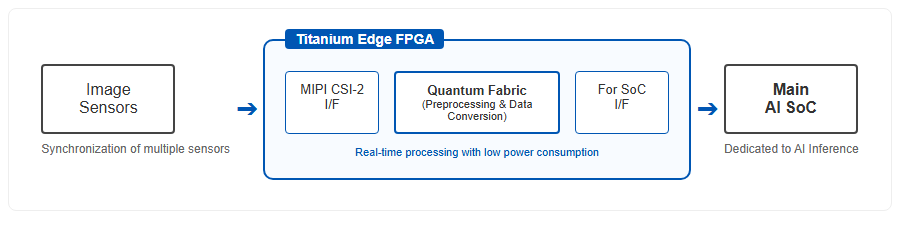
The “Titanium Edge” aims to serve as the “front end” for an AI-powered SoC (System on Chip). In recent edge AI systems, SoCs handle advanced computations, but the “preprocessing” of organizing and converting massive data input from sensors has increased the load and power consumption on the SoC. Efinix proposes to flexibly and efficiently execute this preprocessing process on FPGAs. Specifically, the system converts image data from image sensors and signals from various sensors into formats suitable for AI inference, removes unnecessary data, and passes it to the main SoC. This allows the SoC side to focus on more advanced tasks while maximizing overall system power efficiency. This role as a “front end” is especially crucial in complex applications such as robotics, where multiple sensors need to be synchronized and processed. The diagram below shows how the FPGA functions as a sensor interface.
Innovative Quantum Architecture and Technical Specifications
XLR cells that switch logic and wiring
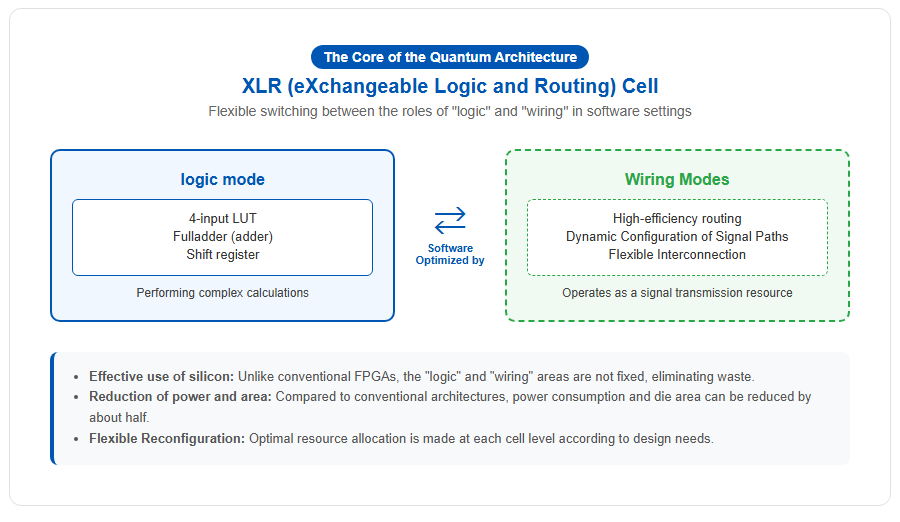
Supporting the outstanding performance of “Titanium Edge” is its patented proprietary “Quantum” architecture. Traditional FPGAs have the areas that execute logic and the wiring areas are fixed on silicon, which can sometimes waste one area or limit performance due to wiring constraints depending on the design. In contrast, Efinix’s “XLR (eXchangeable Logic and Routing) Cell” adopts a hybrid type that can function both as logic and wiring through software settings. This flexibility allows the necessary resources to be packed into the minimum silicon size, achieving both chip miniaturization and cost reduction simultaneously. According to Beachler, this technology can reduce power consumption and die area to about half of conventional levels while maintaining performance equivalent to top-class FPGAs. The diagram below shows the internal structure of XLR cells.
Achieving advanced power efficiency and reliability
The manufacturing process uses TSMC’s 16nm process, which achieves both high speed and low power consumption. In particular, the static power supply, which is a challenge for edge devices, has been further improved compared to the previous Titanium family. Additionally, considering the harsh conditions of industrial sites and communication infrastructure, we are focusing on improving reliability. One example is strengthening measures against single event upset (SEU) to prevent malfunctions caused by radiation. We are considering adoption in environments such as outer space and high-precision medical devices, where even a momentary malfunction is unacceptable. Furthermore, in terms of security, it features RSA-4096 authentication and AES-256-bit encryption for bitstream protection, safeguarding the system from intellectual property leaks and device tampering. Regarding stable supply, the use of standard CMOS processes makes fab transfer easier, guaranteeing long-term supply until 2045, which provides significant reassurance for industrial equipment manufacturers with long lifecycles.
Integration of RISC-V and MIPI interfaces
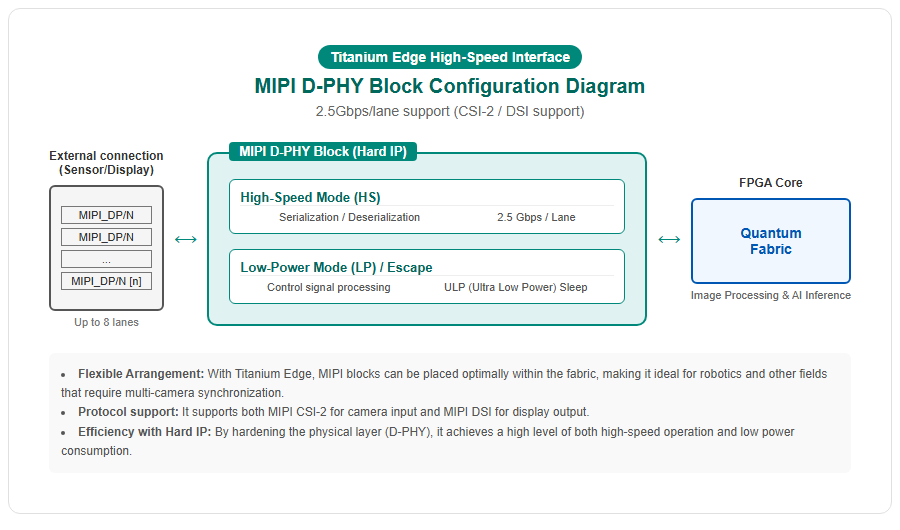
“Titanium Edge” is optimized on both hardware and software sides to enable advanced processing. Internally, it integrates RISC-V cores as the “Sapphire SoC,” enabling users to flexibly design systems by combining high-performance FPGA fabric with general-purpose processors. Additionally, to strengthen connectivity with image sensors, which serve as the “eyes” of edge AI, it supports up to 8 lanes of 2.5Gbps MIPI D-PHY (CSI/DSI support). The design allows for flexible placement of MIPI blocks, which were previously fixed as hard macros, greatly improving design freedom for stereo vision and robot arms that use multiple cameras. Additionally, it features a built-in LPDDR4/4x memory controller that supports high-speed data access required for AI inference. The diagram below shows the block diagram of the MIPI interface.
Market Strategy and Future Outlook
Supply system to fill the gap in general-purpose FPGAs
At the core of Efinix’s growth strategy is filling the “general-purpose and mid-range market gap” created by major FPGA manufacturers shifting to the high-end market. The company’s CEO, Sammy Chan, points out that there is no vendor in the edge domain that can provide a balanced combination of “high performance, low power consumption, and low cost.” To realize this strategy in the Japanese market, we are advancing a partnership with OKI (Oki Electric Industry). OKI has launched an EMS (Electronic Equipment Contract Manufacturing) service that provides a one-stop service from design to mass production using Efinix’s FPGAs, establishing a system to quickly deliver highly reliable FPGA solutions to customers in Japan. They actively respond to replacement demand from existing major manufacturers’ products, making them a strong alternative option for engineers struggling with supply instability and rising costs.
Contribution to AI-driven industries and expansion of product lines
Going forward, Efinex plans to further strengthen its contribution to the AI-driven industrial automation market. The company’s FPGAs have already captured a high market share in AI-powered industrial machine vision systems, and the launch of the “Titanium Edge” will accelerate that momentum. In September 2025, it announced plans to double its titanium product line, offering 20 configurations including large-scale devices with up to 2 million logic elements (LE). This enables AI applications of all scales, from small handheld devices to large-scale edge servers. Additionally, by providing the development tool “Efinity IDE” free of charge and enhancing software development environments utilizing RISC-V, we are accelerating the formation of an ecosystem where even software engineers with limited FPGA expertise can easily build AI accelerators. As edge AI permeates every corner of society, Efinix aims to become a key player supporting next-generation infrastructure, leveraging the flexibility of reconfigurable logic.
[#科学 #技術 #FPGA #エッジAI #半導体 #Efinix #RISC-V]


コメント