Due to stubbornly high global inflation and expansive fiscal policies worldwide, bond yields in major countries, including the United States and Japan, have surged to their highest levels in about 20 to 30 years. Behind this trend are the resurgence of expectations for further interest rate hikes by central banks, driven by economic resilience, and growing fiscal risks.
- Key Takeaway: Interest rates in major countries surge to 20-30-year highs.
- Sticky inflation and high crude oil prices fuel expectations of further central bank rate hikes
- Turbulence in the U.S. Market: The AI Sector’s Runaway Lead and Uneven Profit Distribution Amid High Interest Rates
- Structural Comparison with Past “1994 Bond Market Crash” and “2003 VaR Shock”
- Disparities in Interest Rate Resilience and Their Impacts in the Domestic Household and Corporate Sectors
- A Direct Blow to Government Finances: The Surge in Interest Payments and Long-Term Fiscal Sustainability
- Future Outlook and Key Focus Areas: Monitoring Indicators for Market Stability and Economic Soft Landing
Key Takeaway: Interest rates in major countries surge to 20-30-year highs.
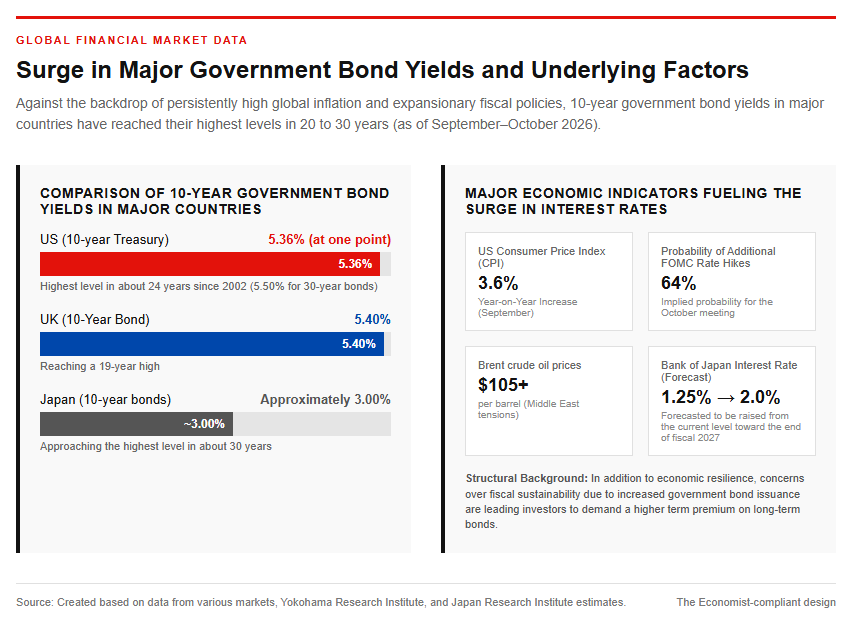
From September to October 2026, a rapid sell-off in global government bond markets and the accompanying surge in yields unfolded. In the United States, the benchmark 10-year Treasury yield exceeded 5.20%, temporarily reaching 5.36%—its highest level in roughly 24 years since 2002—while the 30-year Treasury yield also climbed to 5.50%. Synchronized movements intensified in European and Asian markets as well, with the UK’s 10-year Gilt yield recording a 19-year high of 5.40%, and Japan’s 10-year government bond yield reaching an approximately 30-year high approaching 3.00%. This global bond sell-off was triggered by a combination of factors: expectations for prolonged monetary tightening by central banks against the backdrop of the global economy’s better-than-expected resilience, alongside concerns over fiscal sustainability associated with increased government bond issuance by major countries. As compensation for long-term uncertainties and worsening supply-demand dynamics, investors are demanding a widening of term premiums on long-term bonds.
Sticky inflation and high crude oil prices fuel expectations of further central bank rate hikes
The major factor behind the bond sell-off is the persistence of inflationary pressure and expectations of corresponding policy rate hikes by central banks. Although the Federal Reserve raised its target policy rate range to 3.75%–4.00% in September 2026, the probability of an additional rate hike at the October Federal Open Market Committee meeting reached 64% as September U.S. Consumer Price Index forecasts pointed to a high 3.6% increase year-on-year. In particular, Brent crude oil prices rising above $105 per barrel amid escalating tensions in the Middle East have reignited inflation through gasoline and energy prices. In Japan as well, inflation expectations are on an upward trend due to supply constraints stemming from structural labor shortages and the entrenchment of corporate price-passing, leading the Bank of Japan to raise its policy rate to 1.25% in September 2026. According to estimates by the Yokohama Research Institute and the Japan Research Institute, the Bank of Japan is projected to raise its policy rate to around 2.00% by the end of fiscal 2027, officially bringing an easing environment to an end. Please refer to the figure below.
Transformation of Financial Markets and Comparison with Historical Case Studies
Turbulence in the U.S. Market: The AI Sector’s Runaway Lead and Uneven Profit Distribution Amid High Interest Rates
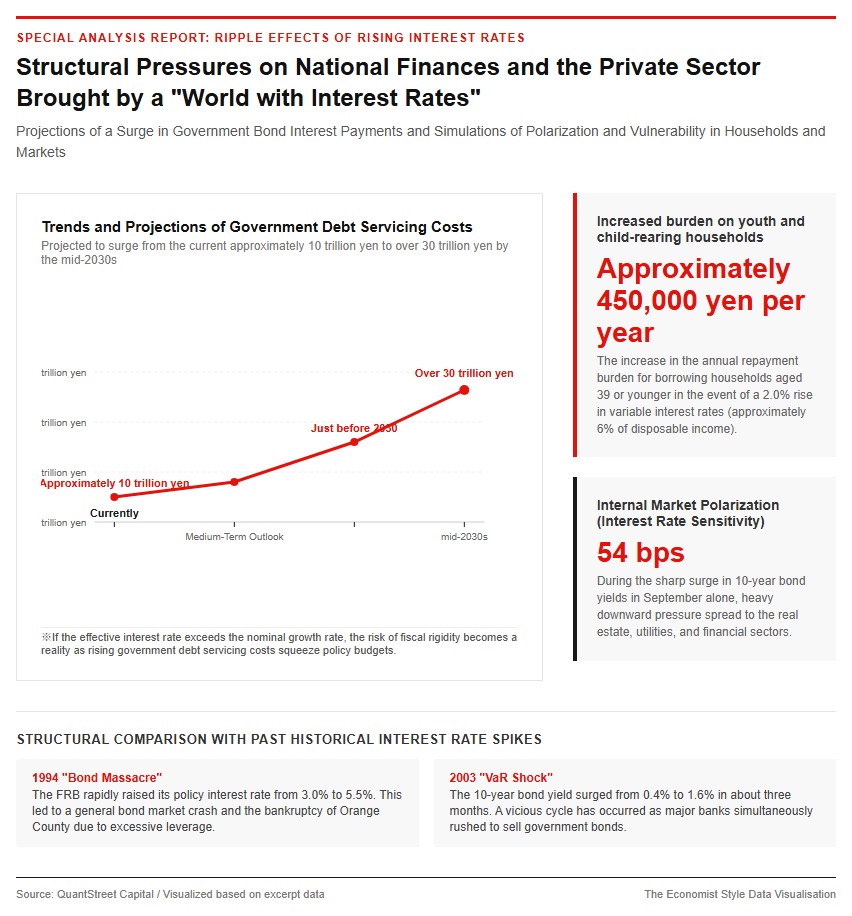
As the 10-year US Treasury yield reaches a high level exceeding 5%, an extreme polarization is occurring within the stock market. When the 10-year yield spiked by 54 basis points in September alone, interest-rate-sensitive sectors such as real estate investment trusts (REITs), utilities, and financials faced significant downward pressure, while semiconductor and AI infrastructure-related stocks continued their runaway rally. According to an analysis by QuantStreet Capital, the market is aggressively pricing in the massive capital demands of AI investment and expectations for future productivity gains, attempting to offset the upward pressure on discount rates from high interest rates with the future earnings growth prospects of mega-cap tech companies. However, the earnings of the S&P 500 equal-weight index and the broader corporate sector outside of AI are sluggish. In an environment where borrowing costs remain elevated, if the outcomes of AI investment fail to ripple across the entire economy, this capex-driven upward cycle carries the risk of becoming unsustainable.
Structural Comparison with Past “1994 Bond Market Crash” and “2003 VaR Shock”
The current global bond sell-off is being compared and analyzed against past historical phases of soaring interest rates. In the 1994 US “Bond Massacre,” the Federal Reserve rapidly raised its policy interest rate from 3.0% to 5.5%, triggering a widespread bond crash and leading to developments such as the bankruptcy of Orange County, which held excessive leverage. Furthermore, during Japan’s 2003 “VaR Shock,” the 10-year government bond yield surged rapidly from 0.4% to 1.6% in about three months, creating a negative feedback loop where major banks—facing a rise in VaR (Value at Risk), a risk management metric—were forced to sell government bonds en masse. In the current landscape of 2026, although immediate systemic deleveraging or a chain of forced liquidations is not seen, risks are gradually accumulating—through the expansion of unrealized losses on bonds held by financial institutions and investment funds, and an increase in funding costs—as interest rates remain elevated for a prolonged period.
Ripple effects and risks across the household, corporate, and government sectors
Disparities in Interest Rate Resilience and Their Impacts in the Domestic Household and Corporate Sectors
The full-scale transition to a “world with interest rates” is having uneven impacts on the domestic private sector. Although interest income exceeds interest payments for the household sector as a whole due to abundant cash and deposits, the increased financial burden is significant among younger generations and child-rearing households that have taken out variable-rate mortgages, which account for approximately 70% of housing loans. If variable interest rates were to rise by 2.0%, borrowing households aged 39 and under would face an increased annual repayment burden of about 450,000 yen (roughly 6% of disposable income), acting as a downward pressure on personal consumption. Across the corporate sector, resilience to higher interest rates has grown thanks to record-high cash flows and declining interest-bearing debt ratios, meaning the impact on capital investment is expected to be limited. However, for low-margin small and medium-sized enterprises (SMEs) and micro-enterprises, as well as industries with high borrowing dependency such as real estate, electricity and gas, and transportation, rising interest payments are directly squeezing ordinary profits.
A Direct Blow to Government Finances: The Surge in Interest Payments and Long-Term Fiscal Sustainability
The impact of rising interest rates will manifest most severely in the government sector. Driven by expansionary fiscal policies such as public-private investments in strategic fields and a reduction in the consumption tax on food, annual expenditures are expected to increase on the scale of 15 trillion yen, raising concerns about the widening structural primary balance deficit. Compounded by the decline in the government bond holding ratio accompanying the Bank of Japan’s balance sheet normalization, the risk premiums on government bonds are being pushed upward. Estimates indicate that as the refinancing of government bonds incurs higher interest rates, the government’s debt-servicing burden will surge from the current roughly 10 trillion yen to over 30 trillion yen by the mid-2030s. If effective interest rates exceed the nominal economic growth rate, the debt-to-GDP ratio will enter a divergent phase, heightening the risk of fiscal rigidity where soaring debt-servicing costs squeeze policy budgets. Please refer to the figure below.
Future Outlook and Key Focus Areas: Monitoring Indicators for Market Stability and Economic Soft Landing
To forecast future trends in financial markets and the global economy, it is necessary to closely monitor three key indicators and changes. First is the strength of U.S. inflation statistics (Consumer Price Index and Producer Price Index) and the labor market; if a re-acceleration of inflation is confirmed, expectations for further tightening by central banks will intensify, placing strong correction pressure on the bond and stock markets. Second is the “effectiveness of return on investment”—whether massive capital expenditures in AI-related fields will lead to improved productivity and better corporate performance in the general business sector. Third is whether major governments can transition to sustainable fiscal structures that curb their reliance on government bond issuance amid ballooning interest payments and fiscal demands. In the new normal of a high-interest-rate environment, securing market liquidity and the adaptability of various economic agents will determine whether a soft landing for the economy can be achieved.
Reference page
- [Federal Reserve Board 1994 FOMC Historical Materials] https://www.federalreserve.gov/monetarypolicy/fomchistorical1994.htm
- [Congressional Budget Office (CBO) The Budget and Economic Outlook] https://www.cbo.gov/publication/61882
- [Cabinet Secretariat: Basic Policy for the Introduction of the Refundable Tax Credit System] https://www.cas.go.jp/jp/seisaku/kokuminkaigi/contents/20260805/01_siryou1.pdf
- [Bank of Japan Working Paper] https://www.boj.org/research/wps_rev/wps_2006/wp06j13.htm
【#BondMarket #RateHike #Inflation #FiscalRisk #FinancialMarkets】
コメント