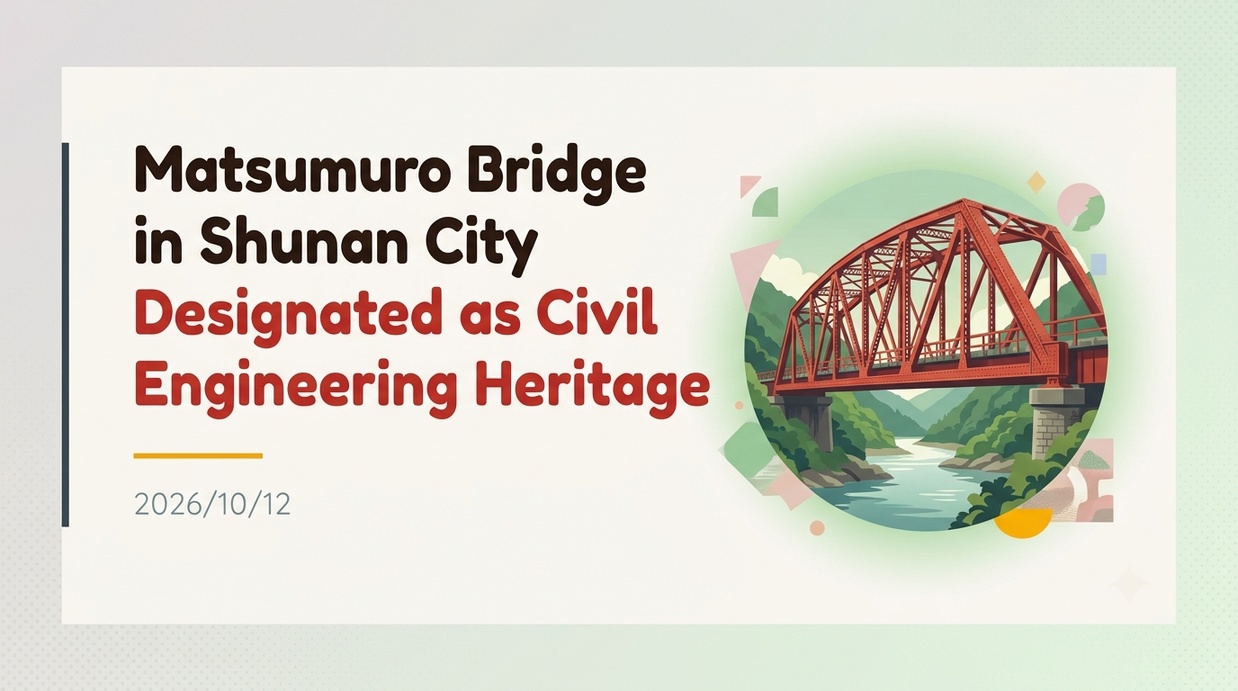
The Matsumuro Ohashi Bridge, spanning the Nishiki River in Mitake, Shunan City, Yamaguchi Prefecture, has been selected as a Selected Historic Civil Engineering Structure by the Japan Society of Civil Engineers (JSCE) for fiscal 2026. This recognition comes as a result of high praise for its historical value as Japan’s oldest surviving steel simple-truss road bridge in its original location, as well as the ongoing maintenance and management activities carried out by local residents.
- The background for the selection of Matsumuro Ohashi Bridge, which boasts a history of over 100 years
- Technical Value as Japan’s Oldest Steel Truss Road Bridge
- The History of the Creation of Bridges That Began with Hydroelectric Power Plant Construction
- Advanced Civil Engineering Techniques of the Taisho Era Conveyed by Riveted Joints
- Conservation and Cleanup Activities Supported by Local Residents and Technical College Students
- Dual Evaluation of Registered Tangible Cultural Properties and Modern Civil Engineering Heritage
- Tourism Utilization of Historic Infrastructure and Technology Transfer to the Next Generation
The background for the selection of Matsumuro Ohashi Bridge, which boasts a history of over 100 years
On September 24, 2026, the Japan Society of Civil Engineers (JSCE) announced 20 facilities nationwide as recipient structures for the 2026 Historic Civil Engineering Works certification. Among them, the Matsumuro Bridge, spanning the upper reaches of the Nishiki River in Kaho, Shunan City, Yamaguchi Prefecture, was selected, drawing significant attention.
The JSCE Historic Civil Engineering Works certification is a recognition program established in 2000 to promote the preservation and utilization of historical civil engineering structures and to honor the achievements of infrastructure that have contributed to regional development. With this latest certification, it becomes the 7th civil engineering heritage site in Yamaguchi Prefecture and the 2nd within Shunan City.
The Matsumuro Bridge is a bridge completed in 1920 (Taisho 9), and more than 100 years have passed since its completion. It is still used today as a roadway bridge for public roads, continuing to function as a daily local road in its original location without ever having been relocated from where it was built. It received high praise for retaining its original appearance from the time of construction despite being located in a gorge subject to harsh natural environments.
Furthermore, a major deciding factor for the selection was that local residents, civic organizations, and educational institutions have cooperated over many years to carry out regular cleaning activities and preservation management. Both the convenience and historical value of the infrastructure for the local community have thus been recognized.
Technical Value as Japan’s Oldest Steel Truss Road Bridge
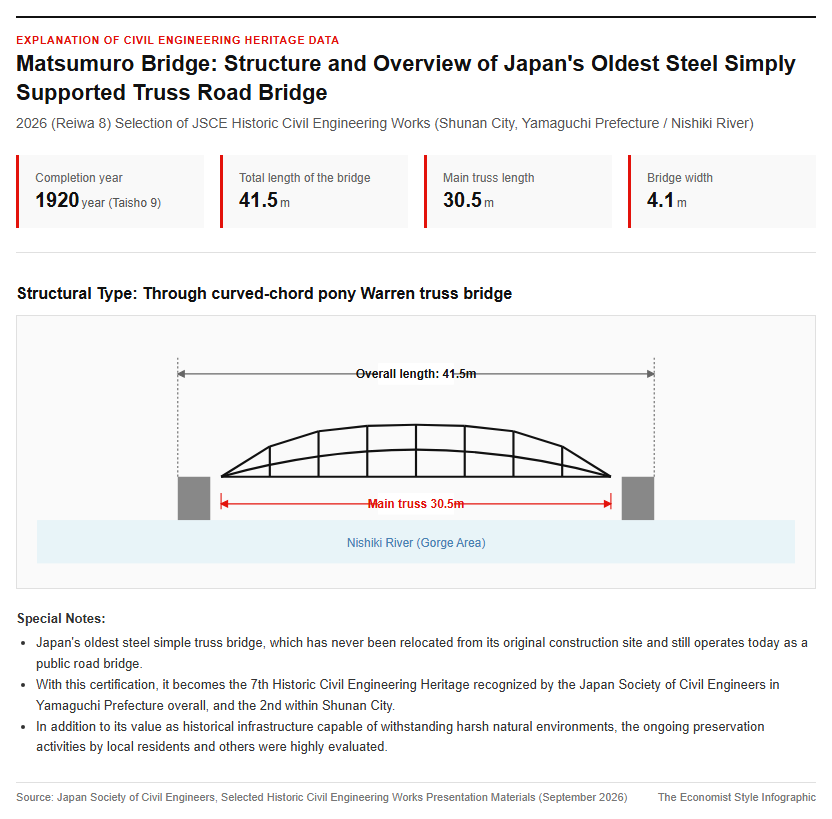
The greatest historical and technical value of the Matsumuro Bridge lies in the fact that it boasts being the oldest existing simple steel truss roadway bridge in Japan located in its original construction site. The bridge has a total length of 41.5 meters and a width of 4.1 meters, with the main steel truss section accounting for 30.5 meters of that length. Structurally, it falls under the classification known as a through curved-chord pony truss bridge. A pony truss refers to a relatively low-profile bridge type among truss structures—where upper and lower chords are connected by diagonals—that lacks upper lateral bracing. It is a valuable remnant that conveys in exceptionally good condition the state of Japan’s bridge construction and steel processing technologies from the early to mid-Taisho period. The following image shows the full view of the truss structure.
Construction was carried out by Nippon Bridge Co., Ltd., established in 1919 (Taisho 8), and it is also known as one of the company’s representative early works undertaken during its founding period. As physical evidence supporting the development process of road networks and steel infrastructure in modern and contemporary Japan, it possesses extremely high academic value from the perspective of civil engineering history. Even today, it continues to support local traffic while accommodating the passage of heavy vehicles, demonstrating the robust structural technology of the Taisho era to the present day.
The History of the Creation of Bridges That Began with Hydroelectric Power Plant Construction
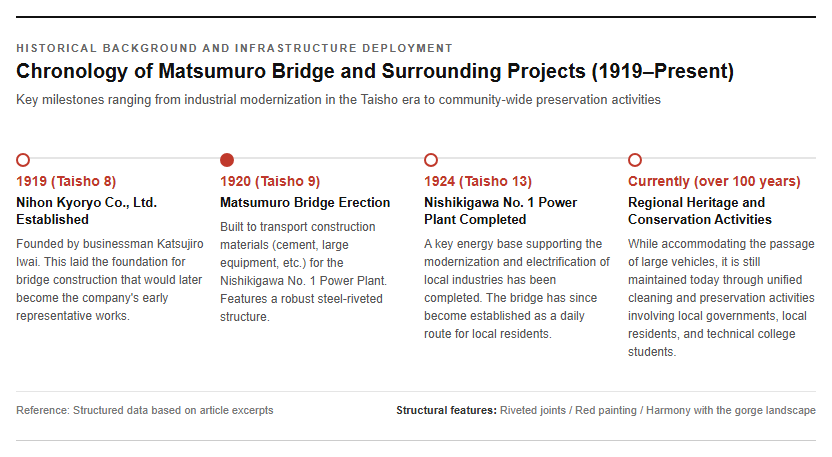
The background behind the construction of the Matsumuro Bridge is deeply tied to the industrial development of Yamaguchi Prefecture and the expansion of the electric power business during the Taisho period. This bridge was erected in 1920 (Taisho 9) primarily for the purpose of transporting construction materials for the Nishikigawa No. 1 Power Plant, which was to be built in the upper reaches of the Nishiki River. The Nishikigawa No. 1 Power Plant was a hydroelectric power facility completed in 1924 (Taisho 13), serving as a crucial energy hub for promoting the modernization and electrification of local industries at the time. Because the construction of the power plant required transporting massive amounts of cement, large power generation equipment, and steel frame components deep into mountainous areas, the erection of a sturdy steel bridge capable of withstanding heavy loads was deemed essential. Nippon Kyoryo Co., Ltd., which handled the construction, was a company that had just been established the previous year in 1919 (Taisho 8) by Katsujiro Iwai, a prominent businessman also known as the founder of Tokuyama Corporation. As a result of applying an up-and-coming construction organization and cutting-edge technological capabilities, a robust structure capable of withstanding harsh transport conditions and rising river waters was realized. Even after the completion of the power plant, the bridge was not dismantled; instead, it became established as a means of transportation and a logistics route for local residents, continuing to fulfill its role as an industrial heritage site to this day.
Structural Features and Community Efforts for Maintenance and Preservation
Advanced Civil Engineering Techniques of the Taisho Era Conveyed by Riveted Joints
A close inspection of the details of the Matsumuro Bridge reveals the technical characteristics of Taisho-era metalworking and joining techniques throughout the structure. At the time of its construction, high-strength bolts and advanced electric welding technologies like those used today were not yet widespread, so the riveting method—in which red-hot steel rivets are driven in and fixed—was comprehensively adopted to join the steel members. The countless rivet heads aligned orderly across the bridge body are the traces of precise manual work performed by the craftsmen of that era, and they also serve as a design element that speaks to the strength of modern industrialization. The truss section is painted in a vivid red that stands out even from a distance, forming a magnificent contrast with the deep green beauty of the valley. Despite being in a river environment where moisture and humidity easily accumulate, proper repainting and anti-rust treatments have been applied, successfully preventing severe deterioration and cross-sectional loss of the steel materials. The combination of advanced structural design from the Taisho period and meticulous manufacturing techniques has allowed it to maintain its designed load-bearing capacity even today, more than 100 years later. As a three-dimensional historical resource that lets observers directly experience the precision of modern civil engineering technology, it is highly acclaimed by experts studying architecture and civil engineering.
Conservation and Cleanup Activities Supported by Local Residents and Technical College Students
Routine inspection and maintenance are essential for extending the lifespan of infrastructure. At the Matsumuro Bridge, conservation activities are being carried out energetically through a collaborative effort involving not only regular government inspections but also local residents, civic groups, and students and alumni from the nearby Tokuyama College of Technology. The residents regularly mow the grass and pick up trash around the bridge, and have diligently cleaned areas prone to mud and fallen leaf accumulation. The following photo shows the cleanup activities being conducted by local residents and others.
Furthermore, on November 15, 2020 (Reiwa 2), the “Kiju Bridge Centennial Festival 2020 in Shunan: Make a Wish on the Bridge,” celebrating the 100th anniversary of its completion, was held. Although it was held amid the COVID-19 pandemic and thus incorporated an online format, approximately 3,000 paper cranes sent from across the country were displayed on the red truss bridge, colorfully celebrating the milestone. On the day of the event, students from Tokuyama College of Technology and employees of the construction contractor Nihon Kyoryo also rushed to the site; they conducted a bridge-cleaning activity in the morning, and in the afternoon, a prayer ritual for safety was performed by the chief priest of the local Yasaka Shrine. The circle of civic activities aimed at protecting and passing down local resources across generations became a major driving force behind its selection as a civil engineering heritage.
Preserving the Value of Cultural Properties and the Future Outlook for Regional Infrastructure
Dual Evaluation of Registered Tangible Cultural Properties and Modern Civil Engineering Heritage
Even before being selected as a Historic Civil Engineering Structure by the Japan Society of Civil Engineers (JSCE) this time, the Matsumuro Bridge had already received official recognition for its value as a historic structure. Since the 2000s, in addition to being registered as a National Tangible Cultural Property, it has also been designated as a Modern Civil Engineering Heritage site (one of 2,800 surviving important civil engineering structures) through surveys related to the Ministry of Health, Labour and Welfare and the Ministry of Land, Infrastructure, Transport and Tourism. Its selection this time by the JSCE signifies a renewed, comprehensive evaluation that encompasses not only its past cultural and design merits, but also its value in civil engineering and its relationship with the local community. Amidst a situation where many historic bridges are targeted for removal or replacement due to aging and the increasing size of vehicles, cases like the Matsumuro Bridge—where it is preserved while maintaining its original role as a road bridge—are extremely rare nationwide. Its major characteristic lies in achieving a high-level balance between preservation as a cultural property and practicality as a modern transportation infrastructure. It is positioned as an important historical asset within the government’s infrastructure longevity plan, and regular inspections and appropriate maintenance and repairs are being systematically carried out. It has also firmly established itself as a landmark shaping the region’s historic landscape, drawing even greater interest from academic and cultural perspectives.
Tourism Utilization of Historic Infrastructure and Technology Transfer to the Next Generation
Following its selection as a Historic Civil Engineering Structure by the Japan Society of Civil Engineers, further progress is expected in regional revitalization and educational initiatives utilizing the Matsumuro Bridge. In Shunan City and Yamaguchi Prefecture, the development of infrastructure tourism combined with the rich natural environment of the Nishiki River basin and related facilities such as the Nishiki River No. 1 Power Plant is being considered. The formation of tourism routes touring historic buildings can be an effective measure to attract visitors from outside the region and contribute to the revitalization of intermediate and mountainous areas. Furthermore, passing down technology to the next generation through collaboration with educational institutions is an important focus. At Tokuyama College of Technology, structural analysis, historical research, and resident awareness surveys of the Matsumuro Bridge have previously been conducted as graduation research themes. Initiatives to learn from actual historical structures as teaching materials and to experience firsthand the importance of maintenance are extremely meaningful for nurturing future civil engineers. As the increase in aging infrastructure and the securing of maintenance costs become major challenges throughout Japan, the case of the Matsumuro Bridge will continue to attract nationwide attention as an advanced model case of citizens, local government, and academic institutions cooperating to protect and foster historic civil engineering heritage.
Reference Page
- [Japan Society of Civil Engineers: FY2026 List of Selected Civil Engineering Heritage] https://committees.jsce.or.jp/doboku_isan/node/70
- [Japan Society of Civil Engineers Selected Historic Civil Engineering Structure: Matsumuro Bridge] https://www.jsce.or.jp/contents/isan/files/2026_15.shtml
【#MatsumuroBridge #CivilEngineeringHeritage #ShunanCity #JapanSocietyOfCivilEngineers #HistoricalStructure #InfrastructureHeritage】


コメント