On the morning of October 9, 2026, the Nikkei Stock Average continued to fall in the Tokyo stock market, with the morning session closing down 529.81 yen from the previous day at 68,512.30 yen. In addition to declines in high-tech stocks in the U.S. market, selling pressure mounted primarily on semiconductor- and AI-related stocks due to confusion surrounding the earnings outlook of generative AI development giant OpenAI.
- Key Events and Nikkei Average Morning Market Review
- Background Behind Heavy Selling in Semiconductor and AI-Related Stocks and the Trends of Major Stocks
- Impact of US Stock Declines and the Drop in the Philadelphia Semiconductor Index (SOX)
- Conflicting Reports on OpenAI’s Revenue and Their Ripple Effect on Market Sentiment
- Downside Firmness as Seen in Selective Buying of TSE Prime Stocks and TOPIX Resilience
- Future Outlook and Key Points
Key Events and Nikkei Average Morning Market Review
On the Tokyo stock market on October 9, 2026, selling orders took precedence, following the previous day’s decline in U.S. tech stocks. The Nikkei Stock Average opened at 68,648.50 yen, down 393.61 yen from the previous day, and expanded its losses right after trading began. The decline exceeded 500 yen immediately after the opening, and the morning session closed at 68,512.30 yen, down 529.81 yen from the previous day.
The recent decline in stock prices was led by high-priced semiconductor and AI-related stocks that have driven the market. SoftBank Group and Fast Retailing alone caused the Nikkei Stock Average to drop by about 470 yen in the morning session. Meanwhile, real consumer spending for August, announced around the same time, decreased by 3.1% year-on-year, a smaller drop than the market expectation of a 3.6% decline. In addition, the Special Quotation (SQ) settlement value for October contracts was estimated at 68,465.23 yen.
The figure below is an image showing the stock price trends in the morning session and the impact of major stocks.
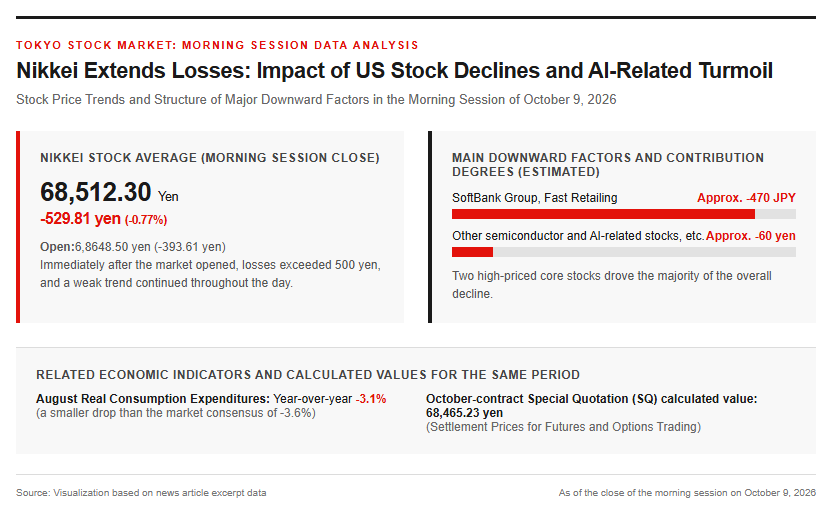
Looking at the overall movement of the Tokyo Stock Exchange Prime Market, while some high-priced stocks declined, the TOPIX (Tokyo Stock Price Index) maintained positive territory, resulting in a market environment where a clear divergence was observed among the indices.
Background Behind Heavy Selling in Semiconductor and AI-Related Stocks and the Trends of Major Stocks
During the morning session, selling pressure was particularly strong among major companies supporting AI infrastructure and semiconductor supply chains. Led by SoftBank Group, a wide range of high-tech and electronic component stocks fell across the board, including major printed circuit board maker Ibiden, electronic component manufacturers TDK and Murata Manufacturing, semiconductor memory company Kioxia Holdings, wire harness maker Fujikura, semiconductor test equipment provider Advantest, and chemical manufacturer Shin-Etsu Chemical.
The semiconductor sector inherently has high sensitivity (beta value) to the overall market, making its performance and stock prices prone to sharp fluctuations in both directions. In addition, there have been persistent concerns regarding the strengthening of U.S. semiconductor export controls against China and demand trends in the Chinese market. From the beginning of 2025 to early April 2025, while the TOPIX corrected by 17%, Tokyo Electron plunged 30% and Lasertec dropped 46%, highlighting the significant rate of decline during correction phases.
Furthermore, the Philadelphia Semiconductor Index (SOX), which is composed of major U.S. semiconductor stocks, is trading at levels roughly 15% lower than its all-time high, contributing to a cautious stance on semiconductor stocks across Asian markets as a whole. This latest sell-off is also said to be driven not merely by temporary profit-taking, but by underlying factors such as a growing perception that growth stocks are overvalued amid rising interest rates and lingering doubts about the profitability of data center investments.
US Market Volatility and Intersecting Reports Surrounding the AI Market
Impact of US Stock Declines and the Drop in the Philadelphia Semiconductor Index (SOX)
The direct impact on the decline of the Tokyo market was the slump in high-tech stocks in the U.S. stock market on the previous day, the 8th. On the 8th, the U.S. Dow Jones Industrial Average finished higher, up $51.77 from the previous day at $51,231.64, whereas the tech-heavy Nasdaq Composite Index tumbled significantly by 345.35 points (down 1.25%) to 27,193.34. Furthermore, the Philadelphia Semiconductor Index (SOX), which comprises major semiconductor-related stocks, also plunged by 3.38% (down 3.39%).
Behind the destabilization of the U.S. market were concerns over a resurgence of inflation driven by stubbornly high crude oil prices and trends in long-term interest rates. Amid escalating tensions in the Middle East, Brent crude briefly broke through the $100 mark, and the minutes of the U.S. Federal Open Market Committee (FOMC) also indicated an inclination toward further interest rate hikes due to caution regarding inflation. U.S. long-term interest rates have risen to the 5.2% range, recording their highest level since 2007.
The following figure is a conceptual diagram showing the correlation between the U.S. semiconductor stock index and Japanese high-tech stocks.
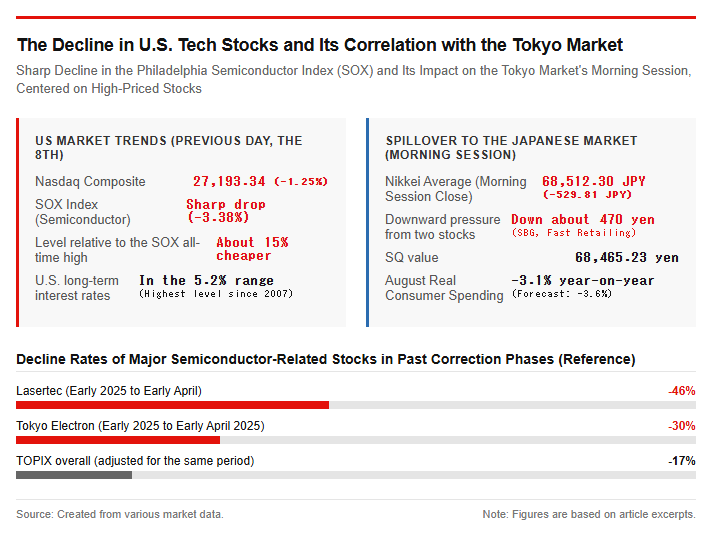
As high interest rates and high crude oil prices weigh on the stock markets, concerns over rising funding costs and the sustainability of capital expenditures for AI-related companies triggered selling in semiconductor stocks in both the Japanese and U.S. stock markets.
Conflicting Reports on OpenAI’s Revenue and Their Ripple Effect on Market Sentiment
What heavily shook market sentiment on the morning of the 9th was the flurry of conflicting reports regarding OpenAI, the US-based flagship company in the generative AI sector. On the 8th, the UK’s Financial Times (FT) reported that OpenAI’s annualized revenue as of the end of September appeared to have fallen short of market expectations by approximately $20 billion. Following this report, share prices of US-based Nvidia, Intel, and UK-based Arm Holdings—a subsidiary of SoftBank Group, which has invested in the company—plummeted across the board in the US market that same day.
However, on the morning of the 9th, Japan time, Bloomberg reported a different perspective. Bloomberg reported that, driven by the growth of OpenAI’s enterprise business, its annualized revenue is expected to reach or exceed $70 billion by the end of the year.
The monetization processes of AI model developers and the authenticity of demand are the most crucial keys to determining the sustainability of the current AI boom. Market participants have also pointed out that “whether we can confirm improvements in the profitability of AI model developers is the key, and stock prices tend to react overly sensitively to news reports.” Due to a series of conflicting reports, a cautious wait-and-see stance and buying-back movements have become intertwined among investors.
Structural Strengths and Future Outlook of the Japanese Stock Market
Downside Firmness as Seen in Selective Buying of TSE Prime Stocks and TOPIX Resilience
Although the Nikkei Stock Average recorded a significant decline in the morning session, a close examination of market-wide fundamentals and the movements of individual stocks indicated that this was not a collapse of the broader market. On the Tokyo Stock Exchange Prime Market, the number of advancing issues stood at 1,194, accounting for a little over 70% of the total.
While the Nikkei Average fell, dragged down by a handful of high-priced tech stocks, the TOPIX (Tokyo Stock Price Index) performed solidly, managing to hold onto positive territory despite a narrow margin. Widespread buying emerged for non-AI and domestic demand-driven stocks that had lagged behind, including gaming-related stocks (Konami Group, Nintendo), shipping companies (Kawasaki Kisen Kaisha), and service providers (Recruit Holdings).
Trading value on the Tokyo Stock Exchange Prime Market reached a massive 7.8454 trillion yen, while short-covering of Nikkei 225 futures by overseas short-term investors ahead of Japan’s three-day weekend also helped prevent a steeper decline. Regarding the net income outlook for TSE Prime-listed companies for the fiscal year ending March 2027, some projections expect major companies to see a profit increase of over 20%, with the strength of corporate earnings acting as a robust downside support base for Japanese equities.
Future Outlook and Key Points
The primary focus in the stock market going forward will be the April–September earnings reports of major companies, which kick off in earnest in late October, and the effectiveness of AI-related investments. While some point out similarities between the AI boom and the dot-com bubble of the late 1990s, the decisive difference is that, unlike back then, the current stock price gains are supported by the solid expansion of “corporate profits.”
Major tech companies continue to show strong willingness to invest in capital expenditures for data centers and AI infrastructure, and the irreplaceable demand for semiconductor manufacturing equipment is considered solid over the medium to long term. A strategist at Nomura Securities expects, as a main scenario, that the Nikkei Stock Average will move to 63,000 yen by the end of 2026 and 65,000 yen by the end of 2027. However, in an upside scenario where productivity improvements driven by AI and DX investments progress, the strategist projects that the index will break through the 70,000-yen mark (reaching 70,500 yen) by the end of 2026.
In the short term, crude oil prices, exchange rate trends, and interest rate decisions at monetary policy meetings in the US and Japan will be factors causing volatility. However, while calmly assessing concerns over overinvestment and the expansion of demand, capital is expected to return to high-performing stocks backed by solid earnings.
Reference Page
- [Dai-ichi Life Asset Management Economic Research Institute Research Report] https://www.dlri.co.jp/files/asset/654551.pdf
- [Nomura Securities NOMURA Well Style Market Commentary] https://www.nomura.co.jp/wealthstyle/
【#NikkeiAverage #SemiconductorStocks #AIBubble #TSEMorningClose #StockMarket #TOPIX #EarningsOutlook】


コメント