On September 14, 2026, the Nikkei 225 Average opened lower and extended its slide, plunging by over 1,200 points intraday at its low. The sharp decline was driven by heavy selling pressure across AI and semiconductor-related equities, triggered by calls from top U.S. AI executives to decelerate development alongside reports that OpenAI has shelved its 2026 IPO plans.
- Warnings from U.S. AI Tech Giants and the Shock of OpenAI’s Postponed IPO
- SoftBank Group’s Freefall and the Index-Weighted Drag Mechanism
- Selling Pressure Spreads Across the Supply Chain: Major Stock Movements
- The TOPIX Rebound Highlights the Nikkei “Divergence” and Market Reality
- Corporate AI Adoption Shifts Toward Cost-Effectiveness
- Spiking Crude Oil Prices and Key Central Bank Policy Meetings
- Overinvestment Risks and Long-Term Perspectives: Lessons from History
Warnings from U.S. AI Tech Giants and the Shock of OpenAI’s Postponed IPO
On September 14, 2026, financial markets in Tokyo were caught off guard by a series of statements and strategic decisions from leading executives in the U.S. AI industry. In an essay published on September 12, 2026, Dario Amodei, CEO of U.S.-based Anthropic, advocated for an industry-wide deceleration in the development of cutting-edge models to mitigate risks such as uncontrollable autonomous AI agents and widespread cyber misuse. OpenAI CEO Sam Altman and entrepreneur Elon Musk publicly aligned with Amodei’s concerns, sparking fears across global markets that the breakneck AI development race might be coming to a halt.
Adding further chill to investor sentiment was Sam Altman’s announcement that OpenAI would not pursue an initial public offering (IPO) within 2026. Citing safety concerns and the need to fortify organizational governance, this decision heightened uncertainty surrounding the commercialization timeline and investment return schedules for AI technologies. A slower pace of model advancement implies a more gradual growth trajectory in demand for data center servers and high-performance computing hardware. As excessive expectations for AI demand—hitherto the primary engine of global equity gains—receded, markets faced a risk-off wave from the opening bell.
SoftBank Group’s Freefall and the Index-Weighted Drag Mechanism
SoftBank Group, a major investor in OpenAI, bore the immediate brunt of the IPO postponement and the AI slowdown narrative. On September 14 in Tokyo, SoftBank shares were hit by a deluge of sell orders, tumbling over 13% intraday. The stock closed down 701 yen, or 10.72%, at 5,839 yen, marking the largest single-day percentage loss on the Tokyo Stock Exchange (TSE) Prime Market. Given that an OpenAI IPO was viewed as a critical milestone for realizing unrealized gains on SoftBank’s holdings and executing capital returns, the delayed timeline delivered a severe blow to its valuation outlook.
The sharp drop in SoftBank Group had a disproportionate downward impact on the broader Nikkei 225 Average. Because the Nikkei 225 is a price-weighted index, it is inherently sensitive to price swings in high-priced constituent stocks. SoftBank alone dragged the benchmark down by approximately 561 points—a figure that exceeded the Nikkei’s net closing loss of 518.35 points (down 0.81% to 63,492.99 yen). Intraday, the Nikkei plummeted by over 1,200 points, briefly dipping below the psychological 63,000 threshold. This price action underscored that the headline index loss was driven by extreme selling in a few heavily weighted tech giants rather than a systemic market-wide freezing of capital.
The Darkening Semiconductor Outlook and Market Distortion
Selling Pressure Spreads Across the Supply Chain: Major Stock Movements
Anxieties over slowing AI development rapidly rippled through the semiconductor supply chain involved in manufacturing and testing advanced chips. Amid growing caution over potential capital expenditure cutbacks by data center operators and sluggish memory demand, Kioxia Holdings—the day’s top stock by trading value—extended its steep decline, breaching the 50,000 yen mark intraday. Major industry players, including semiconductor testing equipment leader Advantest, chip-making equipment giant Tokyo Electron, and substrate maker Ibiden, all faced heavy liquidations, accelerating the Nikkei’s slide. Please refer to the diagram below.
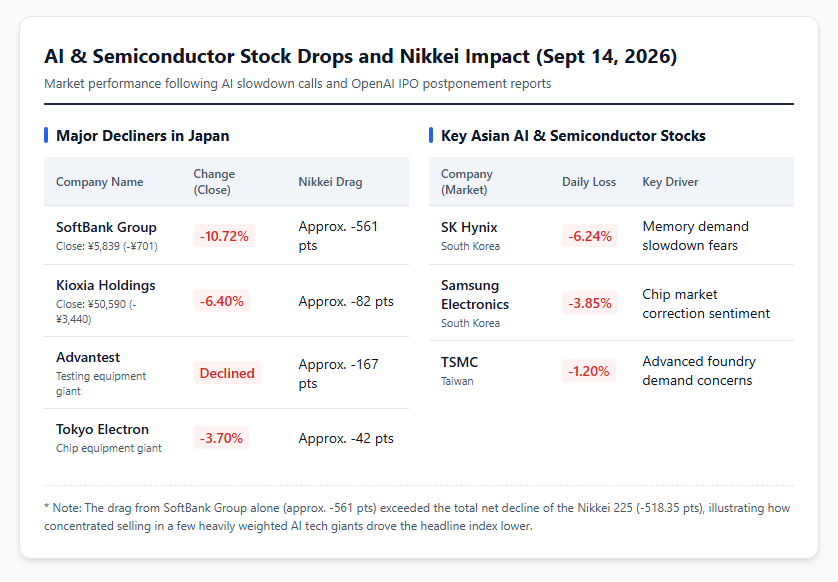
This selling wave extended well beyond Japan to key Asian semiconductor equities. In South Korea, Samsung Electronics dropped 3.85% while SK Hynix plunged 6.24%. In Taiwan, TSMC fell 1.2%, signaling a regional domino effect. AI infrastructure chipmakers had previously traded at elevated valuations, propelled by high operating margins and explosive demand expectations. However, as risks of supply chain inventory adjustments and deferred capex surfaced, high-PER stocks relying heavily on rapid earnings growth were forced into a swift valuation recalibration.
The TOPIX Rebound Highlights the Nikkei “Divergence” and Market Reality
In stark contrast to the Nikkei 225’s continued drop, the Tokyo Stock Price Index (TOPIX)—the market’s broader benchmark—demonstrated notable resilience. On September 14, 2026, TOPIX closed up 29.91 points, or 0.74%, at 4,058.21. Of all listed equities on the TSE Prime Market, over 1,200 stocks advanced, representing roughly 79% of the total. With 26 out of 33 industry sectors posting gains, the broader reality of the TSE Prime Market reflected a risk-on environment with capital actively flowing into a wide spectrum of issues.
This striking index divergence stems from structural differences between the two benchmarks. As a market-capitalization-weighted index, TOPIX captured gains across a broad array of domestic value stocks, including megabanks such as Sumitomo Mitsui Financial Group and Mizuho Financial Group, as well as insurance, land transportation, and Recruit Holdings. While investor capital exited high-priced AI and semiconductor stocks, it did not flee the equity market altogether; instead, funds rotated into value-oriented sectors benefiting from current profitability and changing interest rate dynamics.
Structural Shifts and the Long-Term Market Outlook
Corporate AI Adoption Shifts Toward Cost-Effectiveness
The current valuation adjustment in AI-related equities aligns with real-economy trends, reflecting a fundamental shift in how corporations approach AI integration. Globally, particularly in the U.S., businesses initially rushed to adopt AI to bolster productivity and curb fixed costs against a backdrop of tariffs, elevated energy prices, and high interest rates. However, with the proliferation of agentic AI dramatically increasing token consumption during inference, companies now face the managerial challenge of structurally rising AI operational expenses.
Consequently, enterprises have moved past the initial phase of uniformly deploying top-tier paid models and entered a phase of strict “selective allocation” based on ROI. While high-precision domains like R&D continue to demand premium models, routine tasks are increasingly shifted to lower-cost alternatives, including open-weight models. This evolution from “quantitative expansion” to “qualitative selection” is creating performance divergence among AI vendors and establishing a market environment that rigorously scrutinizes capital allocation and monetization timelines.
Spiking Crude Oil Prices and Key Central Bank Policy Meetings
Market complexity is further compounded by external macroeconomic headwinds, notably geopolitical tensions in the Middle East. Following reports of an attack on pipeline facilities in Saudi Arabia, WTI crude futures have risen into the \$100–\$103 per barrel range. For energy-dependent Japanese enterprises, high crude prices present a cost-push headwind, though they simultaneously spurred buying interest in resource-development equities like INPEX. Please refer to the diagram below.
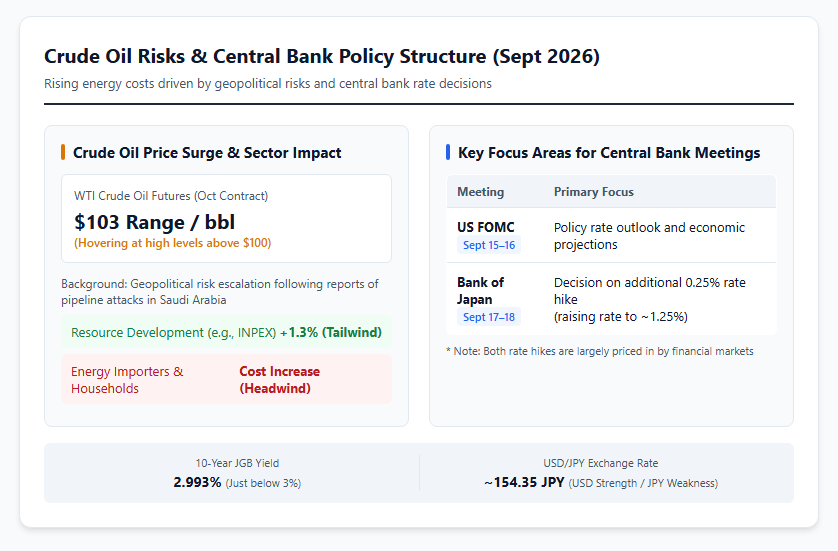
Furthermore, mid-September 2026 presents a pivotal juncture as central bank policy decisions converge in the U.S. and Japan. Financial markets are closely watching the U.S. Federal Open Market Committee (FOMC) rate decision, alongside the Bank of Japan (BOJ) monetary policy meeting, where a potential 0.25% rate hike—raising the policy rate to around 1.25%—is the central focus. Although rate hikes by both central banks are largely priced in, rising long-term yields and currency fluctuations in the USD/JPY exchange rate remain critical variables shaping capital flows between domestic value and financial stocks.
Overinvestment Risks and Long-Term Perspectives: Lessons from History
Analyses of the ongoing AI boom frequently draw comparisons to the Dot-Com Bubble (IT Bubble) of the late 1990s. While current stock market valuations reflect historically high levels reminiscent of that era, a fundamental difference exists: whereas the late-1990s rally was driven primarily by valuation expansion and speculative expectation, today’s AI boom is accompanied by substantial corporate earnings growth amidst massive infrastructure spending. Nevertheless, as historical technological revolutions—such as railways, electrification, and the early internet—demonstrate, genuine technological validity does not immunize an industry against overinvestment driven by intense corporate competition.
Looking ahead, investors must closely monitor performance disparities among AI firms during the monetization phase, as well as credit risks among entities relying heavily on external funding. Investors should avoid concentrated bets fueled by short-term AI hype, opting instead for dollar-cost averaging and disciplined portfolio management aligned with individual risk tolerance. Distinguishing between long-term societal transformation powered by AI and short-to-medium-term market cyclical adjustments will be essential for navigating the evolving financial landscape.
Reference Pages
-
【BOJ Monetary Policy After the September Rate Hike | Kiuchi’s Global Economy & Policy Insight】https://www.nri.com/jp/media/column/kiuchi/20260915.html
-
【Is the AI Bubble a Repeat of 2000? | Dai-ichi Life Research Institute】https://www.dlri.co.jp/report/asset/654551.html
[#Nikkei225 #AISemiconductors #StockMarket #SoftBankGroup #MonetaryPolicy #JapanEconomy #InvestmentStrategy]

コメント