
In the September 2026 BOJ Tankan, the business conditions DI indicating business sentiment among large manufacturers improved to plus 24, against the backdrop of expanding AI-related demand and progress in price pass-through. The pass-through of rising input costs to selling prices and the acceleration of labor-saving investments are underpinning corporate earnings and business sentiment.
- Large Manufacturers’ DI Improves for 6 Consecutive Quarters to Reach a High Not Seen in About 8.5 Years
- The Expansion of AI and Semiconductor Demand and Recovery Dynamics in the Materials Industry
- Progress in passing on input costs and upward revisions to earnings and business forecasts
- Severe labor shortages and an aggressive stance on labor-saving and manpower-reducing investments
- The Background Behind the Polarization of Raw Materials and Final Products and Concerns Over Deteriorating Outlook
- Future Outlook and Key Points for the Sustainable Growth of the Manufacturing Industry
Large Manufacturers’ DI Improves for 6 Consecutive Quarters to Reach a High Not Seen in About 8.5 Years
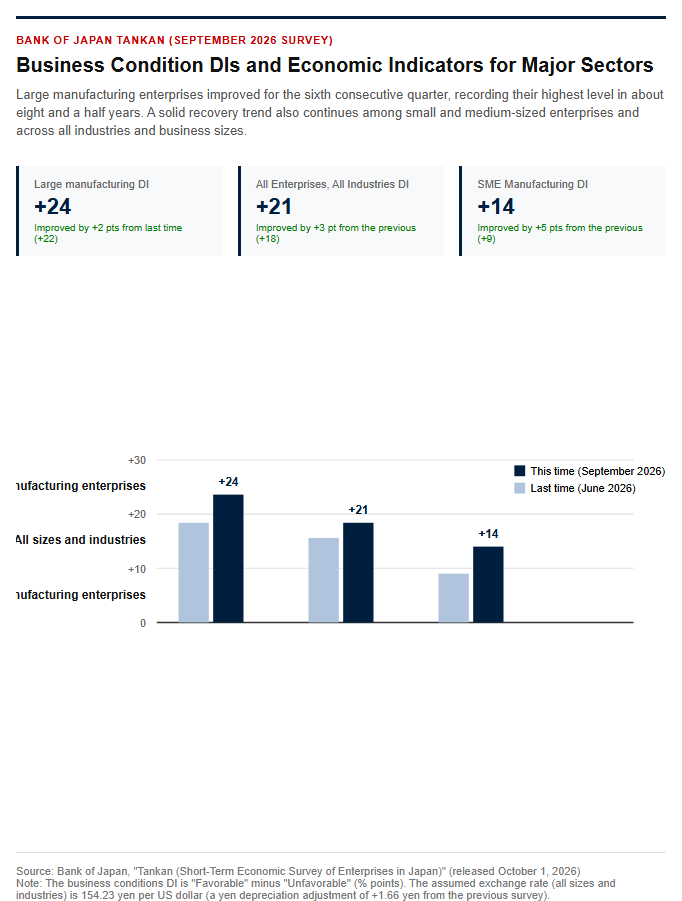
According to the Tankan (Short-Term Economic Survey of Enterprises in Japan) for September 2026, released by the Bank of Japan on October 1, 2026, the Business Conditions Diffusion Index (DI) for large manufacturers (calculated by subtracting the percentage of respondents saying “unfavorable” from those saying “favorable”) stood at plus 24. This represents a 2-point improvement from the previous survey in June 2026, which recorded plus 22, marking an improving trend for the sixth consecutive quarter and reaching its highest level in about eight and a half years, since the March 2018 survey. Furthermore, the Business Conditions DI for small and medium-sized manufacturers also registered plus 14, achieving a significant 5-point improvement from the previous survey. The Business Conditions DI across all industries and enterprise sizes came in at plus 21, rising 3 points from the June survey and confirming the robustness of business sentiment. As for the assumed exchange rate, the all-industry, all-size average for fiscal 2026 was set at 154.23 yen per U.S. dollar, a revision toward a weaker yen from the previous rate of 152.57 yen. The results of this Tankan clearly demonstrate that domestic companies are maintaining a solid earnings foundation despite challenging business environments such as rising raw material costs and increased expenses. As shown in the graph below, the recovery in business sentiment is particularly noticeable in major manufacturing sectors.
The Expansion of AI and Semiconductor Demand and Recovery Dynamics in the Materials Industry
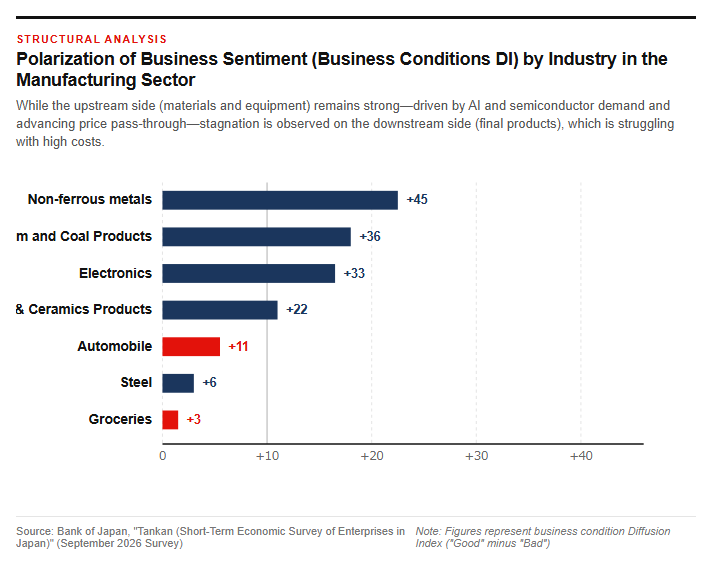
The primary factor strongly driving up business sentiment in the manufacturing sector is the expansion of global data center construction and AI (artificial intelligence)-related semiconductor demand. Along with this, demand for semiconductor manufacturing equipment and related components has surged, boosting the performance of related industries. Looking at DI fluctuations by industry, non-ferrous metals, benefiting from AI-related demand, improved by 9 points to +45, while electrical machinery reached a high level of +33. In addition, notable improvements were seen in the materials sector, where rising crude oil prices and the pass-through of procurement costs progressed: steel improved by 12 points, turning from -6 to +6; ceramic, stone and clay products improved by 11 points to +22; and petroleum and coal products surged to +36. Meanwhile, food products—which have failed to sufficiently pass on surging raw material costs and labor expenses to final product prices—worsened by 6 points to +3, and automobiles edged down 1 point to +11, highlighting a distinct polarization of business sentiment across industries. The structural divide has become clear: upstream industries such as materials and equipment are enjoying a boom, while downstream final product manufacturers are struggling with high costs.
Analysis of Structural Factors: Progress in Price Pass-Through and Capital Investment Trends
Progress in passing on input costs and upward revisions to earnings and business forecasts
Another critical factor underpinning the recent improvement in business conditions for the manufacturing sector is the entrenchment and progress of “price pass-through” by companies. According to an analysis by the Daiwa Institute of Research, amid the inflationary phase since the spring of 2021, the price pass-through rate for intermediate input costs—which indicates the degree of influence that purchase prices have on selling prices—rose significantly across the manufacturing sector as a whole from the previous 0.41 to 0.75. Particularly in industries where the intermediate input ratio exceeds 75%, such as automobiles and non-ferrous metals, proactive price hikes have been implemented, advancing the absorption of cost burdens. Furthermore, the progress in price pass-through has significantly improved corporate earnings plans. The sales plans for all-size enterprises across all industries for fiscal 2026 were revised upward to a 4.1% increase year-on-year (5.9% for manufacturing), and ordinary profit plans achieved a V-shaped recovery to a 2.2% increase for all industries (a double-digit increase of 11.6% for manufacturing, rebounding from the previous profit-decline plan). A virtuous cycle is beginning to form in which the earnings capacity gained through price pass-through underpins corporate business plans. The image below shows the transition of price pass-through and the earnings structure.
Severe labor shortages and an aggressive stance on labor-saving and manpower-reducing investments
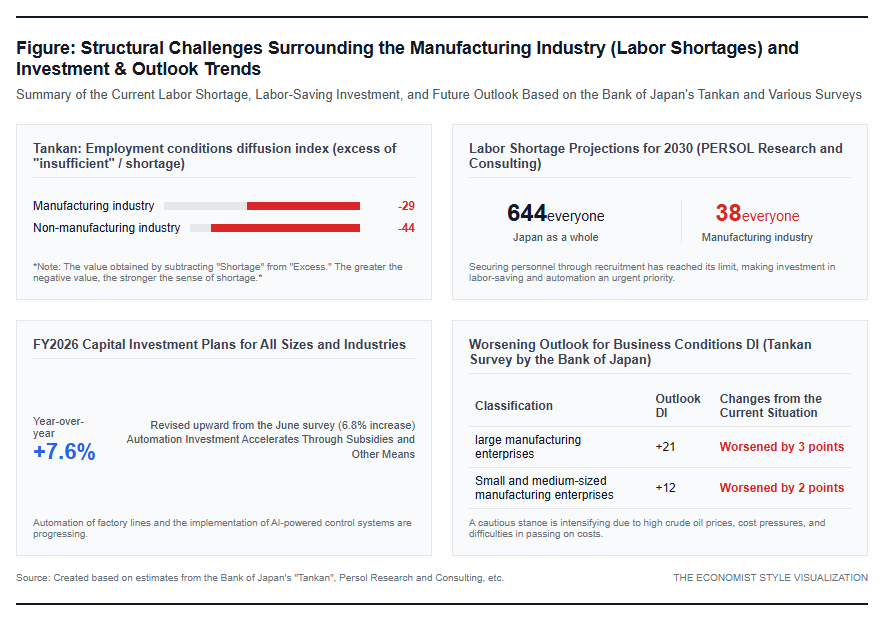
Along with the recovery in business sentiment, the labor shortage problem at manufacturing sites is becoming increasingly serious. According to the Bank of Japan’s Tankan survey, the employment conditions diffusion index (calculated by subtracting “excessive” from “insufficient”) stands at minus 29 for the manufacturing sector and minus 44 for the non-manufacturing sector, indicating a significant expansion in the sense of labor shortages across all business sizes. According to estimates by the Persol Research and Institute, Japan will face a labor shortage of 6.44 million workers nationwide by 2030, with 380,000 in the manufacturing sector alone, meaning that securing personnel through hiring has reached its limit. To address this serious structural challenge, companies are responding by promoting labor-saving and automation through capital investment and digitization. Capital investment plans across all scales and industries for fiscal 2026 show a 7.6% increase compared to the previous fiscal year, which was revised upward from the 6.8% increase in the June survey. In particular, the national “SME Labor-Saving Investment Subsidy (General Type),” which supports the automation of factory lines and the introduction of AI-equipped control systems, offers a subsidy cap of up to 100 million yen (when wage increases are achieved), strongly backing initiatives to integrally advance equipment installation and system construction.
Medium- to Long-Term Outlook and Risks: Future Challenges and Points to Watch
The Background Behind the Polarization of Raw Materials and Final Products and Concerns Over Deteriorating Outlook
While current business conditions remain strong, companies’ outlooks reveal a strong stance of caution. In the Bank of Japan’s Tankan survey, the future business sentiment DI is expected to worsen regardless of company size: large manufacturing enterprises stand at plus 21 (a 3-point drop from the current level) and small and medium-sized manufacturing enterprises at plus 12 (a 2-point drop). Behind this trend lie concerns over a resurgence in crude oil prices driven by escalating tensions in the Middle East, as well as cost pressures stemming from rising imported materials and labor costs. Furthermore, while upstream companies handling raw materials and primary processing have been able to pass on rising purchase prices to their selling prices, downstream sectors close to consumers—such as food, automobiles, and lumber—continue to struggle with passing on costs, raising concerns over profit disparities among industries. In sectors facing severe labor shortages such as shipbuilding, heavy machinery, and textiles, the degree of passing on labor input costs has improved from 0.26 to 0.55; however, if sluggish growth in final demand persists, it carries the risk of stalling future price negotiations.
Future Outlook and Key Points for the Sustainable Growth of the Manufacturing Industry
For the manufacturing industry to achieve sustainable growth moving forward, it is essential to pursue fundamental productivity improvements and continued growth investments that go beyond mere cost-passing. Specifically, the first is operational efficiency and the enhancement of domain expertise through the use of AI and DX. It has been pointed out that combining generative AI and physical AI with skilled techniques and on-site tacit knowledge has the potential to boost the labor productivity growth rate by 0.5 to 1.5 percentage points annually over the next decade. The second is the establishment of a virtuous cycle in which the surplus capacity generated by labor-saving investments is allocated to personnel placement for new high-value-added operations, reskilling, and continuous wage increases. The third is the requirement to thoroughly conduct appropriate cost-passing consultations regarding labor and energy costs with subcontractors, based on compliance with “fair trade practices (Subcontract Act).” Utilizing public-private cooperative investments, such as the “17 priority investment areas” set forth by the Takaichi administration, and accelerating investments in resolving aging equipment and innovative technologies will be the key to determining the international competitiveness of Japan’s manufacturing industry. The layout diagram below shows the focus of future growth investments.
Reference page
- [Bank of Japan] Tankan (Short-Term Economic Survey of Enterprises in Japan) (September 2026 Survey)
[suspicious link removed] - [Daiwa Institute of Research] Trends in Price Pass-Through by Input Cost Category
 2026年9月日銀短観 | 大和総研2026年9月日銀短観では、大企業製造業の業況判断DI(最近)は+24%pt(前回差+2%pt)に改善した一方、大企業非製造業は+35%pt(同▲2%pt)へと悪化した。製造業では、旺盛なAI関連需要が景況感を押し上げた。www.dir.co.jp
【#BOJTankan #Manufacturing #AIDemand #CostPassThrough #CapEx #EconomicNews】

コメント