Google has significantly expanded its collaboration with Marvell Technology, entering into a commercial agreement that grants up to $12.2 billion in stock purchase warrants. Behind this move is Google’s strong strategy to secure a stable supply of custom semiconductors that complement its in-house processors in the rapidly growing artificial intelligence (AI) infrastructure market.
- Key Points of Commercial Contracts and Unusual Warrant Issuance
- Supply of peripheral semiconductors supporting the TPU ecosystem
- Competitive relationship with its rival Broadcom
- The Impact on the Stock Market and Wild Stock Price Fluctuations
- The Background of Custom Silicon In-House Development by Tech Giants
- Challenges and Outlook for the Surge in “Circular Trading”-Style Infrastructure Investment
Key Points of Commercial Contracts and Unusual Warrant Issuance
By August 20, 2026, U.S. semiconductor giant Marvell Technology disclosed in a filing with the U.S. Securities and Exchange Commission (SEC) that it has entered into a commercial agreement with Google regarding custom semiconductor products. The agreement was dated July 29, 2026, and accordingly, Marvell issued warrants to Google on August 18, 2026, granting the right to purchase Marvell common stock. The details of the warrants granted to Google are as follows:
-
Up to 58,970,907 shares of common stock can be acquired.
-
The exercise price is $206.58 per share.
-
The estimated total amount if all are exercised is approximately $12.18 billion (about $12.2 billion).
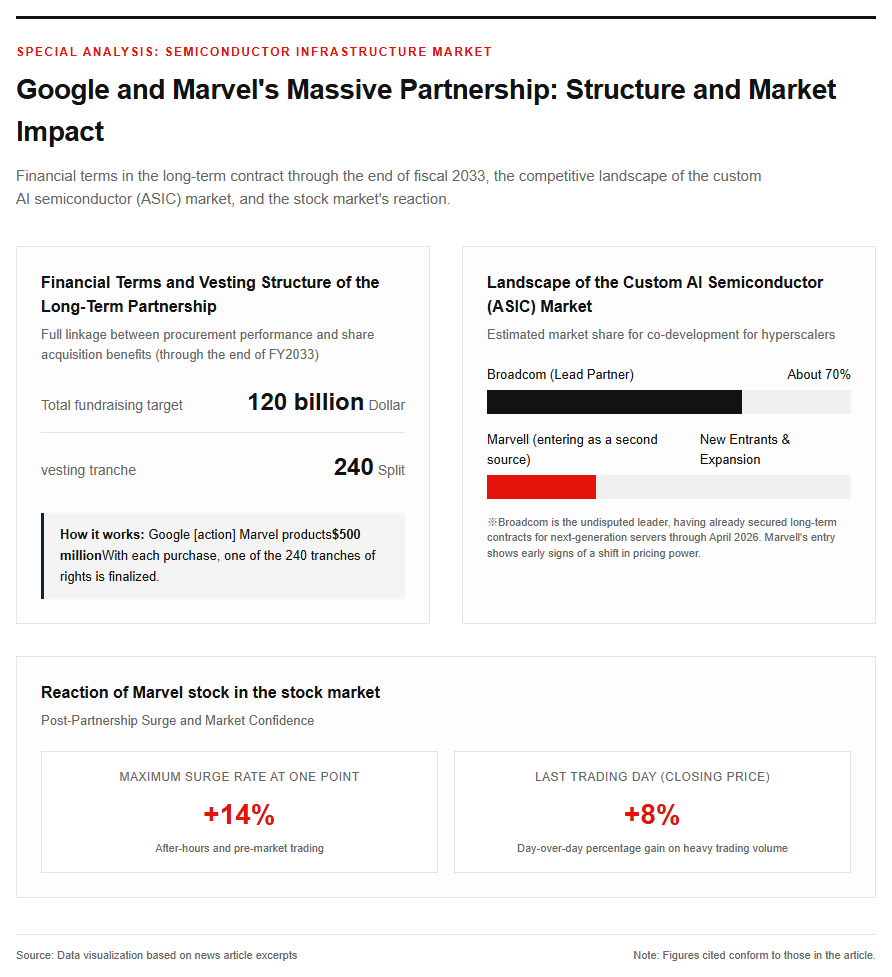
These stock acquisition rights do not vest all at once. Approximately 1.36 million shares are structured to vest equally on a quarterly basis over the course of a year. However, for the majority of the remaining shares, a mechanism is in place where vesting occurs in stages based on Google’s actual procurement of custom semiconductors from Marvell. Specifically, from the third quarter of fiscal 2027 through the end of fiscal 2033, for every $500 million of Marvell products Google purchases, one of the 240 vested tranches will be unlocked. To fulfill all conditions, Google must purchase a cumulative total of $120 billion worth of products from Marvell, making this a partnership that directly links procurement performance with equity acquisition benefits.
Supply of peripheral semiconductors supporting the TPU ecosystem
What stands out in this collaboration between Google and Marvell is the breadth of the technology domains it covers. The target products span the entire custom silicon program related to the ecosystem of “TPU,” Google’s proprietary AI processors deployed in its data centers. Specifically, the collaboration primarily covers the following areas:
-
Accelerators for speeding up AI inference processing
-
A storage controller for storing data
-
Ultra-high-speed inter-system network interface controller
-
next-generation memory technologies such as near-memory computing
Currently, simply boosting the processing performance of the main processor is no longer sufficient for handling advanced artificial intelligence such as large language models. To continuously feed massive amounts of data to computing units without latency, it has become essential to co-design and optimize the entire system, ranging from memory and storage to the networks connecting server racks. Leveraging its strengths accumulated in the fields of data center semiconductors and high-speed interconnects, Marvell will play a comprehensive role in supporting the overall advancement of AI data centers utilizing Google’s TPUs.
The Rapidly Changing Landscape of the Semiconductor Industry and Market Reactions
Competitive relationship with its rival Broadcom
Historically, semiconductor giant Broadcom has been Google’s steadfast primary partner in custom silicon development. Broadcom is the industry’s undisputed leader, commanding an exceptionally high market share of around 70% in the co-development market for custom AI chips (ASICs) designed by hyperscalers—massive IT enterprises—for their own use. In fact, Broadcom already signed a long-term contract with Google in April 2026, running through 2031, to develop and supply custom semiconductors for next-generation AI server racks.
However, Google’s decision to bring in Marvell as a secondary supplier in this deal significantly reshapes the competitive landscape of the semiconductor industry. Market analysts note that this is not intended to completely shut out Broadcom, but rather part of a second-source strategy to pit multiple suppliers against each other in order to stabilize the supply chain and reduce procurement costs. That said, Marvell emerging as a viable alternative for Google could undermine Broadcom’s formidable pricing power, posing a threat as a factor that may squeeze profit margins over the medium to long term.
The Impact on the Stock Market and Wild Stock Price Fluctuations
The announcement of this massive partnership sent shockwaves through the U.S. semiconductor sector. Immediately following the announcement, Marvell’s stock surged by as much as 14% in after-hours and pre-market trading, eventually closing up about 8% from the previous day in heavy trading. The fact that Google, one of the world’s largest cloud providers, committed to procuring systems from Marvell and indicated potential participation as a shareholder decisively solidified market confidence in Marvell’s growth roadmap. Please refer to the stock chart below.
Meanwhile, Broadcom’s stock temporarily dropped by about 5% amid concerns that it would have to share Google’s orders with Marvell. The market is beginning to price in the risk that Broadcom’s monopoly-like dominance is changing, which could compress future market shares and profit margins. Meanwhile, the stock price of Google’s parent company, Alphabet, remained flat with almost no change in response to the reports of the partnership. Analysts have framed the deal as a massive win for Marvell, proving that competition in data center semiconductors has entered a new phase.
Shift to In-House Design and Concerns Over “Circular Transactions”
The Background of Custom Silicon In-House Development by Tech Giants
Behind Google’s deepening partnership with Marvell to strengthen the ecosystem around its custom chips is a broader industry trend toward in-house semiconductor design. Currently, the market for high-performance chips required to power cutting-edge artificial intelligence is virtually monopolized by NVIDIA’s GPUs. However, NVIDIA’s processors are extremely expensive, costing tens of thousands of dollars each. This not only results in astronomical procurement costs, but also poses a serious risk that global shortages could constrain the pace of infrastructure expansion.
To break away from their dependence on NVIDIA, major tech companies such as Google, Amazon, Meta, and Microsoft are rapidly increasing their investments in developing proprietary AI chips. Especially in the inference process—where already-trained AI models are run as practical applications—using custom silicon optimized for specific system configurations and software is overwhelmingly more cost-efficient and power-efficient than using general-purpose GPUs. Google is not only utilizing its self-developed TPUs for its own services but also offering them to cloud customers, aiming to make them a powerful pillar of differentiation in service competition against other companies.
Challenges and Outlook for the Surge in “Circular Trading”-Style Infrastructure Investment
What is drawing the most investor attention—and concern—in this partnership is a complex transaction scheme in which the supplier’s stock options are granted to the customer based on their procurement amount. Critics point out that this structure—where a customer’s spending becomes the partner’s revenue, which is then returned to the customer as equity value—resembles the circular transactions surging in the AI industry. Recently, NVIDIA provided up to $105 billion in guarantees to data center developers, exemplifying contracts where funds and resources circulate within the same group and fueling concerns over a market bubble.
For all the warrants granted to Marvell to vest, Google must continuously procure massive quantities of semiconductors over the long term until 2033. However, uncertainties remain as to whether AI-driven business models will establish sufficient profitability in the future. If demand for Google’s cloud business or AI services falls short of expectations, this ambitious $120 billion procurement plan could stall along the way. Whether the fruits of this long-term partnership result in sustainable growth backed by tangible demand or end up as a bubble of over-investment in infrastructure is the most critical point to watch going forward.
Reference Page
- [Marvell Technology SEC Filing (Form 8-K)] https://www.sec.gov/ix?doc=/Archives/edgar/data/0001835632/000119312526356217/d412696d8k.htm
【#Semiconductors #Google #AIChips #Marvell #InfrastructureInvestment #Cloud #BusinessNews】
📈 Based on this article, we can also create charts and graphs that provide a more detailed comparison of Marvell and Broadcom’s financials and market share. Please let us know if you need them.

コメント