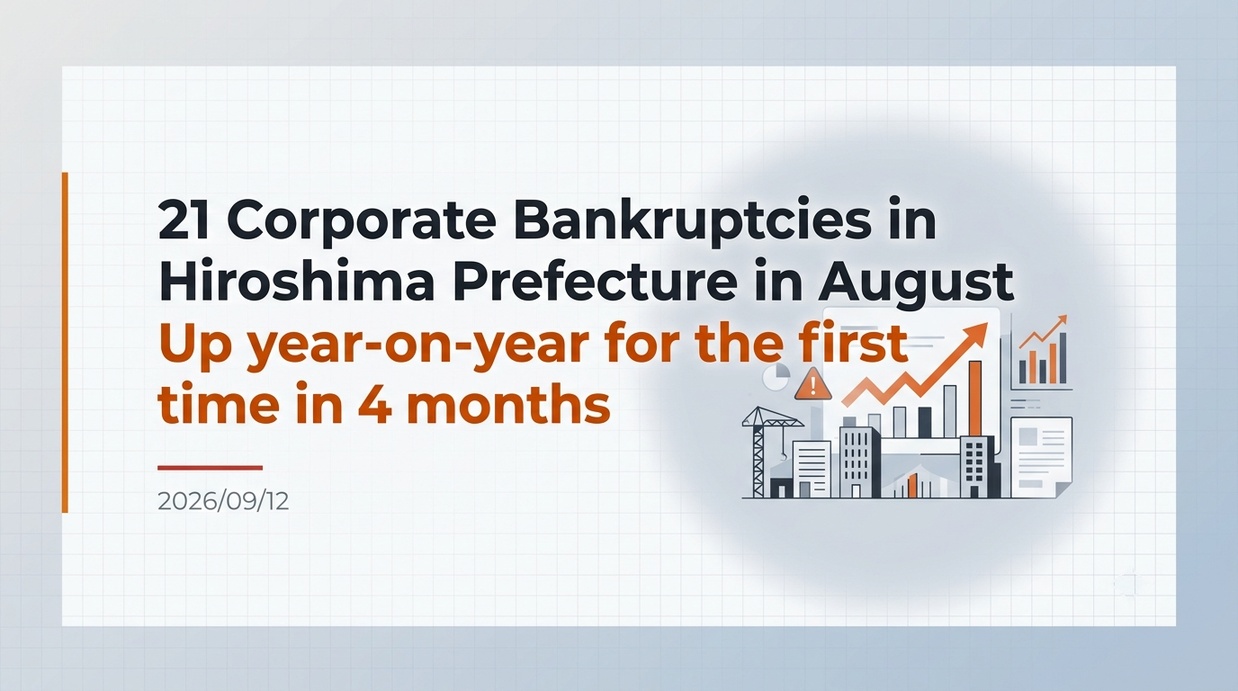
Corporate bankruptcies in Hiroshima Prefecture rose to 21 cases in August 2026, surpassing the previous year’s monthly figure for the first time in four months (including flat months). This trend is driven by a combination of surging raw material and construction costs, rising labor expenses caused by labor shortages, and the full-scale onset of repayment obligations for COVID-19 relief loans, making profitability increasingly difficult to sustain, particularly for small and micro-enterprises.
- Bankruptcies Reach 21 Cases in August, Exceeding Year-Earlier Levels for the First Time in Four Months
- Total Liabilities Reach 3.118 Billion Yen, Marking Three Consecutive Months of Month-over-Month Growth
- Construction Industry Leads Insolvencies with 6 Cases, Primarily Driven by Sluggish Sales
- Soaring Material Costs and Delayed Price Pass-Through Strain Corporate Management
- Full-Scale Repayment of “Zero-Zero Loans” and Cash Flow Pressures on Small Businesses
- Structural Issues Facing High-Risk Enterprises and Trends in Business Suspensions and Dissolutions
- Forecast for Continued Insolvency Growth in Second-Half 2026 and Strategic Policy Utilization
Bankruptcies Reach 21 Cases in August, Exceeding Year-Earlier Levels for the First Time in Four Months
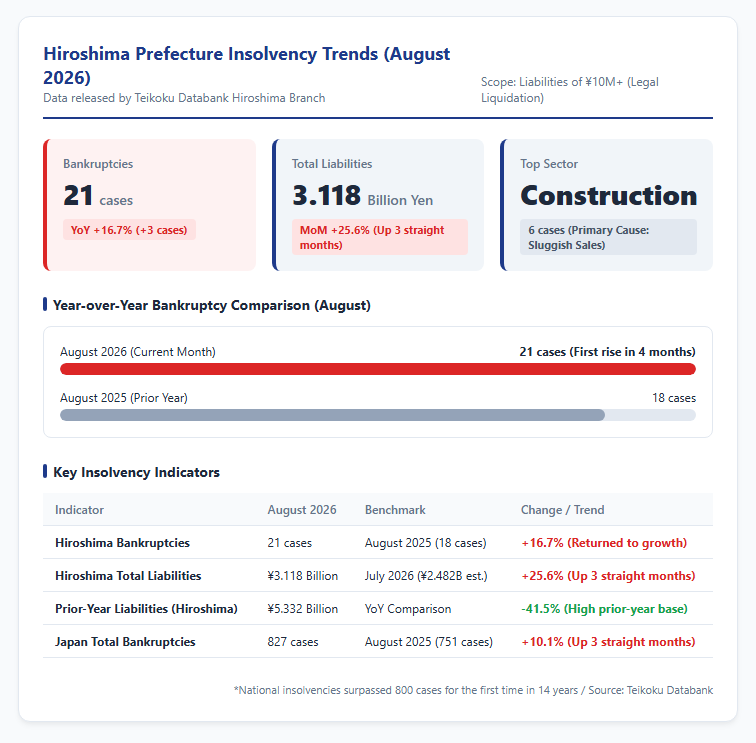
According to a survey released in September 2026 by Teikoku Databank’s Hiroshima Branch, corporate bankruptcies in Hiroshima Prefecture (involving liabilities of 10 million yen or more and legal liquidation) reached 21 cases in August 2026. This represents an increase of 3 cases, or 16.7%, compared to the 18 cases recorded in August 2025. It marks the first time in four months that bankruptcies have risen year-over-year, following a period of flat monthly comparisons. Nationwide, corporate bankruptcies in August 2026 reached 827 cases, exceeding prior-year figures for the third consecutive month. This indicates that the upward trend observed nationally is becoming increasingly pronounced within Hiroshima Prefecture as well.
A detailed analysis of these bankruptcy trends reveals that the majority of affected businesses are small and micro-enterprises that form the backbone of the local economy. In 2024, annual corporate bankruptcies in the prefecture reached 200 cases, the highest level since 2014, establishing an ongoing upward baseline. Although a temporary lull was observed earlier in 2026, the resurgence in August underscores the eroding financial resilience of local businesses. Prolonged cost pressures are dealing a particularly critical blow to companies lacking the capacity to absorb expenses independently.
Total Liabilities Reach 3.118 Billion Yen, Marking Three Consecutive Months of Month-over-Month Growth
Total liabilities stemming from corporate bankruptcies in Hiroshima Prefecture stood at 3.118 billion yen in August 2026. This represents a 25.6% month-over-month increase, marking the third consecutive month of growth. The continued expansion of total liabilities is attributed to a steady occurrence of mid-sized insolvencies, as well as an increasing number of companies collapsing under heavy trade payables and institutional debt. On a year-over-year basis, liabilities declined by 41.5% compared to the 5.332 billion yen reported in August 2025; however, this drop is largely a reaction to a major bankruptcy recorded in the prior-year period, meaning overall liability levels remain elevated.
Examining the monthly breakdown by debt size, small-scale legal liquidations involving under 50 million yen continue to account for the vast majority of cases. Nevertheless, even small-scale bankruptcies carry significant risks of triggering chain-reaction insolvencies and disrupting regional supply chains due to uncollectible trade receivables among business partners. In Hiroshima Prefecture, formal restructuring procedures are already underway for local players, such as Kohatsu Kogyo Co., Ltd., a pipe installation contractor that entered special liquidation. As expanding liabilities increase credit costs for financial institutions, vigilant monitoring of regional financial health remains essential.
Construction Industry Leads Insolvencies with 6 Cases, Primarily Driven by Sluggish Sales
Categorized by industry, the construction sector accounted for the highest number of bankruptcies in August 2026, with 6 cases. While construction insolvencies are trending high nationwide, the severity of the situation is particularly acute in Hiroshima Prefecture. The most frequently cited cause of failure was “sluggish sales.” In this context, sluggish sales reflects not merely a decline in contract orders, but a widespread pattern where soaring execution costs drastically outpace contract prices, forcing projects into substantial operating losses.
The construction industry continues to suffer from unchecked price escalation for key materials such as steel, lumber, and ready-mix concrete, alongside rising labor costs driven by an aging workforce and acute worker shortages. Small and medium-sized contractors unable to pass higher costs onto clients—especially in private-sector projects—find themselves trapped in a vicious cycle where taking on more work only compounds their losses. Subcontractors with weak price negotiation leverage face even severe strain, as they are forced to absorb cost increases out of pocket until cash flow collapses. Because distress in construction ripples through surrounding sectors such as real estate, housing, and material wholesaling, industry developments warrant close attention.
Compounding Risk Factors Behind the Bankruptcy Surge
Soaring Material Costs and Delayed Price Pass-Through Strain Corporate Management
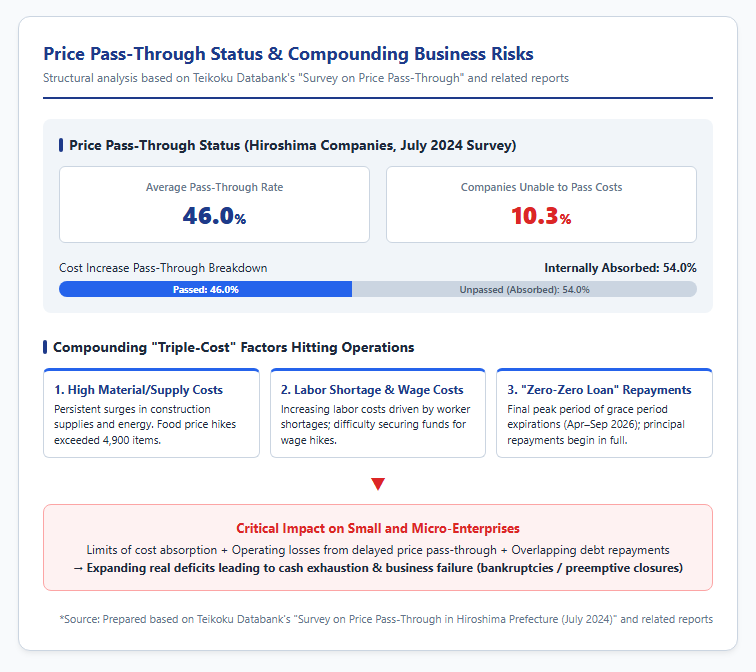
The primary factor driving the rise in corporate bankruptcies is prolonged inflation coupled with delays in passing costs on to customers. According to Teikoku Databank’s analysis, price increases extend far beyond retail and consumer services, heavily affecting industrial materials—including construction supplies—and energy across the board. A survey on price pass-through conducted among companies in Hiroshima Prefecture in July 2024 revealed an average pass-through rate of just 46.0%, indicating that businesses are forced to absorb more than half of their cost increases internally. Furthermore, 10.3% of responding companies reported being “completely unable to pass through costs,” highlighting the steep hurdles small and micro-enterprises face when attempting price adjustments.
In addition, elevated import prices, high crude oil costs, and a persistently weak yen are driving up corporate procurement expenses. Inflationary pressures are mounting further, as evidenced by major food manufacturers raising prices on over 4,900 items in September 2026—the largest price surge of the year. Businesses are confronting a triple burden of rising labor, fuel, and material costs, leading to deteriorating profits among firms unable to implement swift price increases. For companies lacking sufficient financial reserves, delayed price pass-through directly triggers cash exhaustion and serves as a main driver of business closures.
Full-Scale Repayment of “Zero-Zero Loans” and Cash Flow Pressures on Small Businesses
Another critical factor straining corporate liquidity is the debt burden associated with “Zero-Zero Loans” (virtually interest-free and collateral-free loans introduced during the COVID-19 pandemic). Between April and September 2026, the market faces the final peak period for the expiration of loan grace periods on principal repayments. As debt obligations transition from interest-only payments or principal deferrals to full-scale amortizations, cash flows are being hit hard—particularly for companies whose operational earnings have been slow to recover.
Nationwide, insolvencies following the receipt of Zero-Zero Loans have surpassed 2,000 cumulative cases, and bankruptcies among firms unable to secure repayment funds are rising in Hiroshima Prefecture as well. Many small business owners are forced to begin principal repayments before sales have restored to pre-pandemic levels. Consequently, firms are scrambling to secure refinancing guarantee programs (such as the Management Improvement Support Guarantee) or negotiate debt restructuring (rescheduling) with lenders. However, companies already in negative net worth or unable to formulate viable business revitalization plans cannot secure additional financing, leaving formal legal liquidation as their only remaining option.
Mid-to-Long-Term Economic Outlook and Challenges for Local Enterprises
Structural Issues Facing High-Risk Enterprises and Trends in Business Suspensions and Dissolutions
A broader evaluation of Hiroshima Prefecture’s corporate landscape highlights structural vulnerabilities, including a deep pool of potential bankruptcy candidates and a surge in business suspensions. According to Teikoku Databank’s Insolvency Risk Survey, 5,042 out of 38,276 analyzed companies headquartered in Hiroshima Prefecture are classified as “high-risk” (Grades 8 to 10), indicating a high probability of bankruptcy within one year. By sector, three industries exceed 1,000 high-risk companies: construction (1,157 firms), manufacturing (1,059 firms), and wholesaling (1,257 firms). Furthermore, small-scale businesses face disproportionate risk, with companies generating under 100 million yen in annual sales accounting for 69.9% of high-risk entities, and those with fewer than 5 employees making up 67.8%.
Additionally, trends in “business suspensions and dissolutions” that do not involve formal bankruptcy court filings cannot be overlooked. In 2025, suspensions and dissolutions in Hiroshima Prefecture reached 1,406 cases—a figure 7.1 times larger than the 198 legal bankruptcies recorded in the same year. Driven by aging business owners, succession challenges, and severe labor shortages, an increasing number of profitable businesses are opting for voluntary “preemptive closures” due to future uncertainty. The dissolution of companies without transferring management resources poses a severe threat to the regional economy by eroding supply capacity and eliminating local jobs.
Forecast for Continued Insolvency Growth in Second-Half 2026 and Strategic Policy Utilization
Looking ahead, Teikoku Databank projects that “the upward trend in corporate bankruptcies will persist through the second half of 2026, centered on small and micro-enterprises that bear the heaviest brunt of procurement and pricing pressures.” Furthermore, rising interest burdens present an emerging management risk, driven by the Bank of Japan’s policy rate hikes (reaching 1.00% in 2026) and increases in long-term interest rates. In an economic sentiment survey of Hiroshima businesses regarding the 2026 outlook, 19.3% anticipated an “economic downturn,” significantly outnumbering the 8.6% expecting an “economic recovery,” underscoring widespread caution.
Navigating this challenging environment requires proactive measures from enterprises to improve cash flow and negotiate price adjustments at an early stage. Government agencies, public institutions, and Approved Support Agencies (such as certified public accountants, tax accountants, and small business support centers) offer various financial support tools, including the Management Improvement Support Guarantee (Improvement & Revitalization Strengthening Type), Safety Net Guarantees, and Post-Crisis Management Stabilization Loans. Seeking early consultations with financial institutions or specialized advisory desks (such as the Hiroshima City Small and Medium Enterprise Assistance Center) before debt defaults occur—and formulating management improvement plans to achieve business turnaround or smooth succession—stands as the top priority for corporate survival.
Reference Pages
- [Teikoku Databank, Ltd.] https://www.tdb.co.jp
[#HiroshimaPrefecture #CorporateInsolvency #ConstructionIndustry #PricePassThrough #ZeroZeroLoans #TeikokuDatabank #SMEs]

コメント