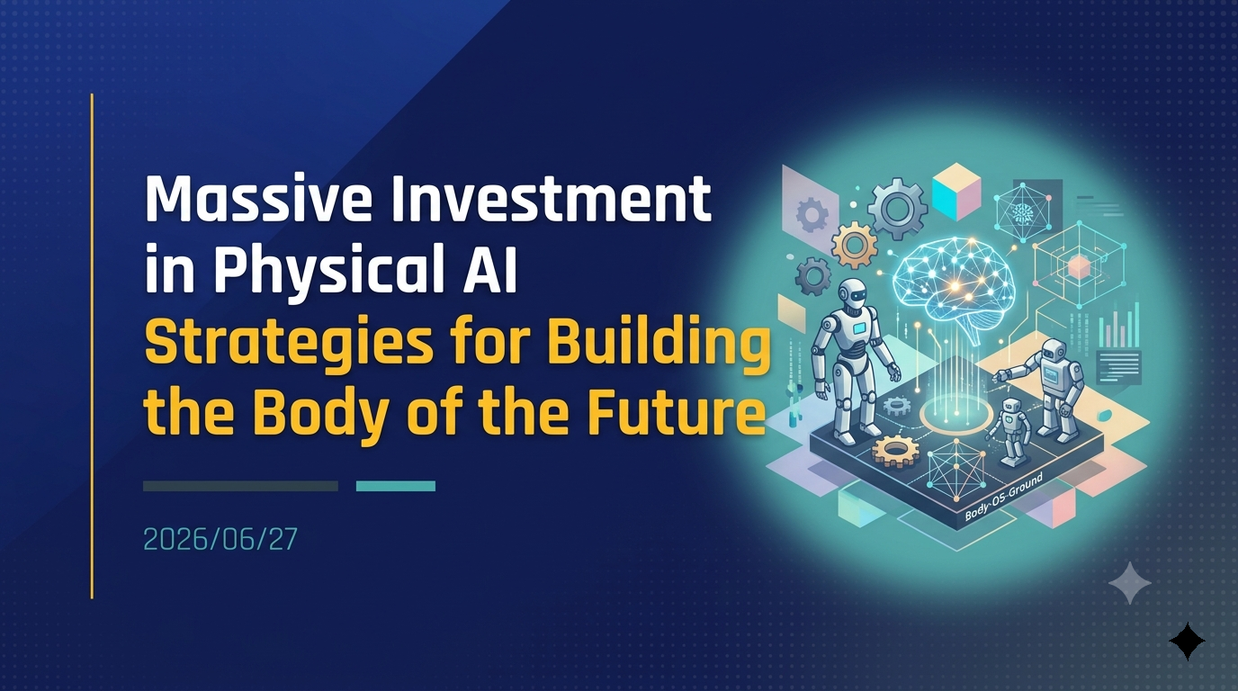
On June 19, 2026, the Japanese government finalized a policy to invest 10.5 trillion yen in the physical AI sector by fiscal year 2040, as a key part of its growth strategy. Behind this large-scale investment is the aim of resolving severe labor shortages and strengthening national industrial competitiveness to reclaim “physical hegemony” from digital defeat.
- 1-1 The Impact of the 10.5 Trillion Yen Investment Toward Fiscal Year 2040
- 1-2 Next-Generation Industries Defined by Physical AI
- 2-1 Expectations for ‘National Policies’ Shaking the Stock Market
- 2-2 Unraveling the Industrial Structure of the Three Layers: ‘Earth, OS, and Body’
- 3-1 “Unified Power” to Counter US-China Hegemony Struggle
- 3-2 Realization of Human-Machine Integration and Milestones for Fiscal Year 2030
1-1 The Impact of the 10.5 Trillion Yen Investment Toward Fiscal Year 2040
On June 24, 2026, the Japanese government presented a timetable to the Council of Economic and Fiscal Policy and the Japan Growth Strategy Council to invest over 370 trillion yen in 17 strategic sectors by fiscal year 2040. At the core of this grand plan is the field of “physical AI,” which autonomously operates robots using artificial intelligence, with 10.5 trillion yen allocated to this. The Takaichi administration plans to establish a “Strong and Affluent Japan Investment Quota” separately from regular expenditures, accelerating funding in areas important for economic security without setting a demand cap. Please refer to the diagram below.
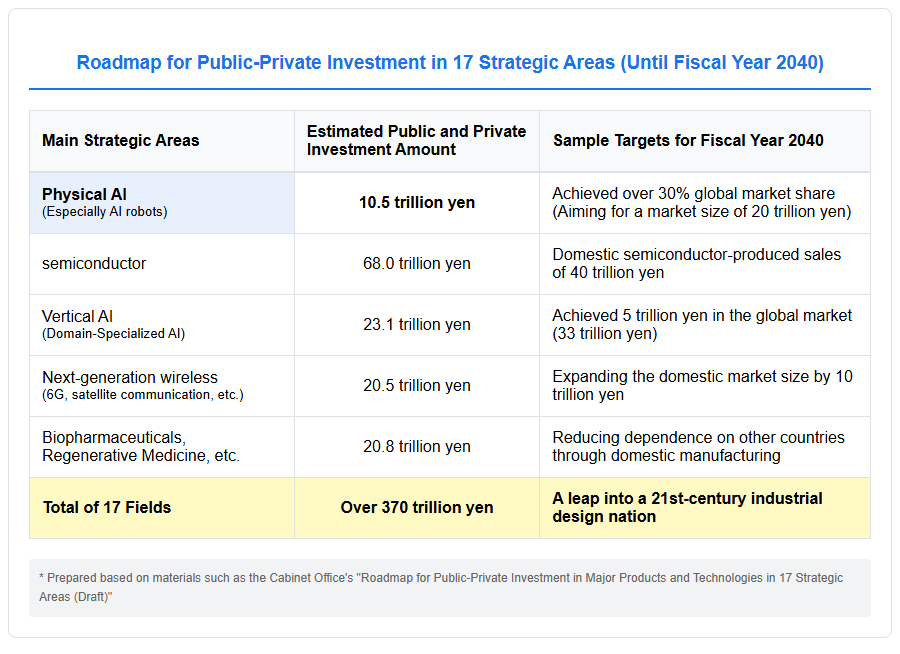
This scale of investment is connected to the existing framework of over 50 trillion yen over ten years in the entire AI and semiconductor fields, and takes on the character of a national survival strategy that goes beyond mere technical support. Although the breakdown of public and private sectors has not been clearly specified, the government has proposed a plan to implement a 1.5 trillion yen advance budget measure by fiscal year 2030, urging early implementation. Through this, the company aims to fundamentally transform Japan’s core industries, such as manufacturing and construction, toward AI-driven systems.
1-2 Next-Generation Industries Defined by Physical AI
Physical AI is a technology that sets it apart from conventional AI that generates text or images. It refers to “artificial intelligence with embodiment” that recognizes real-world situations through sensors and other means, makes judgments on its own, and operates physical machines or robots. According to materials from the Government Growth Strategy Council, the essence of this is to integrate information from images, audio, video, and various sensors to generate actions based on an understanding of the real world. The anticipated applications are extremely diverse, ranging from precise parts assembly in factories, automated picking in logistics warehouses, remote and automated construction at construction sites, to infrastructure inspections and medical support robots. There is growing expectation of social implementation in diverse sites where robots have been difficult to introduce until now, and the market is expected to expand rapidly around 2030, growing into a global market worth about 60 trillion yen by 2040. Japan aims to become a game-changer in this field by integrating its powerful existing hardware technology with cutting-edge AI, transforming the global industrial structure from a “tightly coupled” to a “loosely coupled” model.
2. Ripple Effects on the Market and Stock Prices and the Rise of the Japanese M7
2-1 Expectations for ‘National Policies’ Shaking the Stock Market
Following the government’s large-scale investment policy, a flood of buying of related stocks surged in the Tokyo market on June 22, 2026. In particular, Fanuc’s stock price rebounded sharply, boasting a world-class market share in machine tools and industrial robots, and market attention quickly shifted toward physical AI-related sectors. It is also notable that the search for related stocks spread across the board, including Yaskawa Electric and Harmonic Drive Systems, which holds a high market share in reducers essential for robot joints. Prior to this move, on June 18, the Nikkei Stock Average had surpassed the 70,000 yen mark for the first time at the close, and the market was buzzing with signs of a historic seismic shift. Please refer to the diagram below.
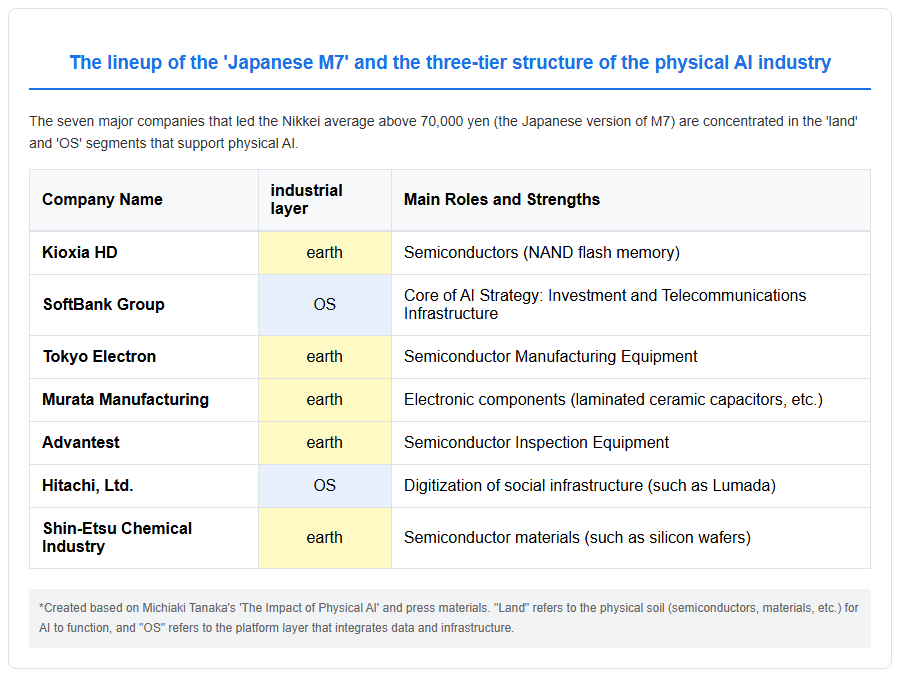
The market was led by seven companies, known as the ‘Japanese M7,’ including Kioxia HD, SoftBank Group, and Tokyo Electron. These companies hold the layers of semiconductors and infrastructure—the ‘land’ and ‘OS’—that are the foundations for physical AI to take off. Investors are closely watching when the 10.5 trillion yen inflowed by the government will elevate the “robot” segment of companies operating on these soil into the spotlight.
2-2 Unraveling the Industrial Structure of the Three Layers: ‘Earth, OS, and Body’
The industrial structure of the physical AI era is interpreted by experts as a three-layer structure: ‘Earth, OS, and Body.’ The first layer, ‘Daichi,’ refers to the physical soil for AI to function, such as semiconductors, electronic components, and semiconductor materials, and is home to companies where Japan has overwhelming strengths, such as Shin-Etsu Chemical and Murata Manufacturing. The second layer, “OS,” is the platform layer that holds the core of AI strategy and digitizes data centers and social infrastructure, with SoftBank Group and Hitachi being prime examples. And the third layer, the “body,” is the main driver systems for this 10.5 trillion yen investment, such as robots and actuators. The government’s policy package focuses on “fostering multi-purpose robot OEMs” and “strengthening the design and manufacturing capabilities of key components (motors, reducers, batteries, etc.),” aiming to complete Japan’s industrial map through investment in the core of these “body” segments. With the market leading the way in buying “land” and “OS,” it is expected that by strongly backing the “body,” a vertically integrated cross-tier competitiveness will be brought to Japan.
3. Japan’s winning streak and future outlook
3-1 “Unified Power” to Counter US-China Hegemony Struggle
In the battle for physical AI supremacy, the U.S. is competing with the “brain (AI models),” while China is competing on “quantity” (field data and production scale). As of March 2026, the performance gap between the US and China in AI model performance is virtually zero, and China, which boasts nine times the speed of industrial robot introductions compared to the US, is currently accumulating overwhelming operational data. In this situation, the “winning principle” Japan advocates is not quantity or brainpower, but “integration power” and “operational capability” that the world cannot imitate. Japan holds about 70% of the global market share in industrial robots and maintains strong competitiveness in sensors and drive components. The core of the strategy is to build an ecosystem that feeds back high-quality data from “qualitatively different sites” such as factories onto domestically produced robot foundation models, leveraging the strengths of these hardware. The government has set a goal to become the third pole alongside the US and China by 2040, aiming to capture over 30% of the global market share and 20 trillion yen. Abandoning self-centeredness, flexibly incorporating general-purpose AI models, and building a “specialized body” × specialized OS on top of that operational knowledge is considered a survival strategy for Japanese companies.
3-2 Realization of Human-Machine Integration and Milestones for Fiscal Year 2030
The true potential for physical AI is expected to be in the field of “human-machine fusion” (fusion with the human body), evolving from robots that move outside the body to technology embedded within the body. Japan’s precision control technologies and safety expertise, such as wearable cyborgs and robot-assisted medicine, are the battlegrounds where it is most applicable, and companies like Cyberdyne and Terumo have already begun pioneering this field. It has been proposed that concentrating at least 1 trillion yen out of the government’s 10.5 trillion yen into this area is the only path for Japan to become a leading player in the 2040s. As a concrete step ahead, the plan is to invest 1.5 trillion yen by fiscal year 2030 to promote the multifunctionality of AI robots and the development of domestically produced multimodal foundation models. Additionally, in June 2027, AIRoA is scheduled to release the domestic robot base model as an open source source, marking an important milestone in combining the “OS” and the “body.” Please refer to the diagram below.
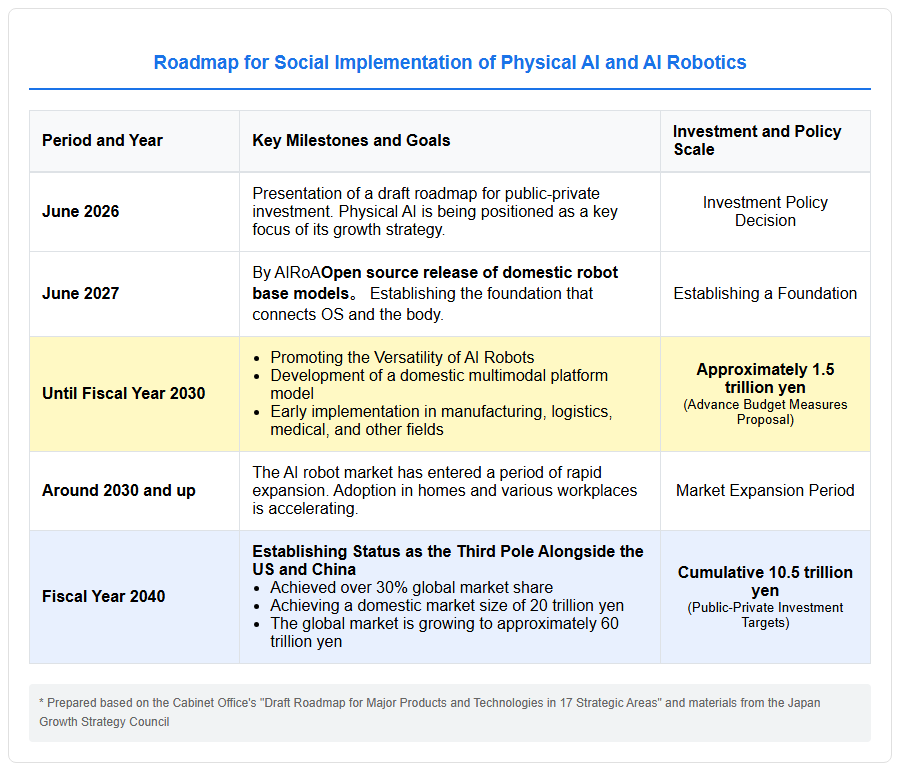
Now that a decade-by-decade structural change has begun, the turning point for whether Japan can return to the center of the world as a 21st-century “industrial design nation” or remain merely an “implementing nation” depends on the investment decisions currently underway.
[#フィジカルAI #官民投資 #成長戦略 #産業ロボット #日本版M7 #経済安全保障 #人手不足解消]


コメント