Following the launch of the Second Takaichi Reshuffled Cabinet on September 17, 2026, the full text of the policy directives issued to all cabinet ministers was unveiled, revealing a major realignment of ministerial portfolios centered on economic security, AI, and regional revitalization. The restructuring reflects Prime Minister Sanae Takaichi’s goal to rapidly drive state-led growth investments under her doctrine of “responsible active fiscal policy” to build a resilient national economic structure.
- Core Principles of the “Cabinet of Decision, Challenge, and Execution”
- Reorganization of Portfolios for Economic Security, AI, and Regional Revitalization
- First Cabinet Post for Nippon Ishin and a Cross-Ministerial Execution Framework
- Shifting from Single-Year Budgeting to Multi-Year Investment Frameworks
- Boosting Supply Capacity Through Growth and Crisis Management Investments
- Key Strategic Fields and the Rollout of State-Led Industrial Policy
- Temporary Reduction of Food Consumption Tax to 1% and Implementation Timeline
- Refundable Tax Credits and Burden Reduction for Current Generations
- The Challenge of Securing Revenue Sources vs. Single-Year Budgeting
- Policy Continuity and Stability from Retaining Key Economic Ministers
- Capital Inflows into Semiconductor, Defense, and AI Sectors
- Market Alert Signals: Long-Term Interest Rates and Currency Volatility
- The Autumn 2026 Extraordinary Diet Session and Tax Legislation Debates
- Revision of Security Strategy Documents and FY2027 Budget Compilation
- The Core Challenge: Balancing Economic Growth with Fiscal Sustainability
Core Principles of the “Cabinet of Decision, Challenge, and Execution”
On September 17, 2026, the Second Takaichi Reshuffled Cabinet was officially launched. In a press conference held that evening at the Prime Minister’s Official Residence, Prime Minister Sanae Takaichi characterized her newly appointed administration as a “Cabinet of decision, challenge, and execution,” handing detailed policy directives to all 18 cabinet ministers. Rather than a mere list of general goals, these directives serve as a concrete operational roadmap, translating the national vision outlined in the “Basic Policy on Economic and Fiscal Management and Reform 2026” (Bonefuto Hoshin) into specific ministerial mandates.
The core doctrine of these policy directives rests on four central pillars: realizing a strong economy, empowering regions while protecting daily livelihoods, strengthening diplomacy and defense, and enhancing policy public relations. Departing from traditional administrative consensus-building that relied heavily on bureaucratic autonomy, Prime Minister Takaichi has adopted a top-down leadership style steered directly by the Prime Minister’s Office. To achieve complete exit from deflation and secure long-term economic growth, the administration has explicitly signaled a state-led investment posture.
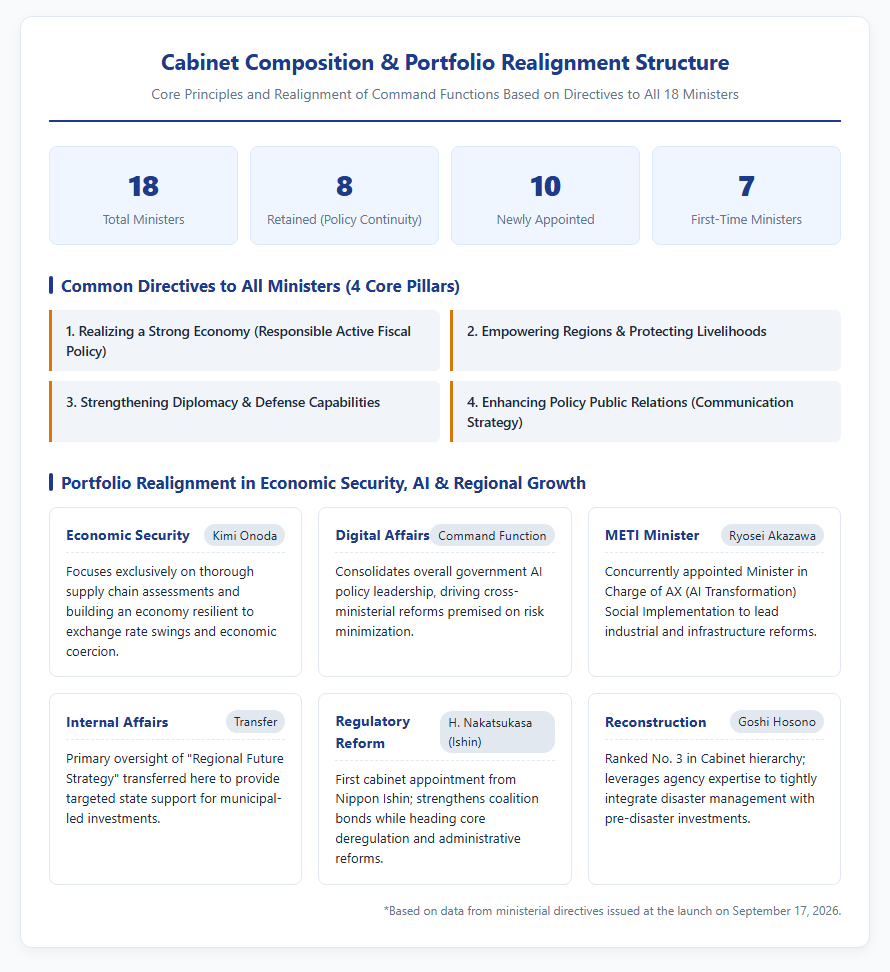
In terms of cabinet composition, 8 out of the 18 ministers retained their posts, while 10 were newly appointed, including 7 first-time cabinet members. By retaining key ministers responsible for the core economic and foreign policy portfolios, the administration ensured policy continuity while simultaneously executing a decisive realignment of responsibilities to address emerging geopolitical and technological risks.
Reorganization of Portfolios for Economic Security, AI, and Regional Revitalization
The most prominent feature of this portfolio realignment lies in the areas of economic security, artificial intelligence (AI), and regional revitalization. In response to rising geopolitical tensions and economic coercion, the role of Minister for Economic Security Kimi Onoda has been substantially expanded. Specifically, core responsibilities—such as comprehensive supply chain vulnerability assessments for semiconductors and critical minerals, as well as building an economic structure resilient to foreign exchange volatility and external economic pressure—have been consolidated under her command.
Furthermore, to adapt to the rapid evolution of artificial intelligence, the Minister for Digital Affairs has been designated as the central commander for overall government AI policy. Correspondingly, Minister of Economy, Trade and Industry Ryosei Akazawa has been assigned the concurrent role of Minister in Charge of AX (AI Transformation) Social Implementation. This move demonstrates an intent not merely to subsidize technology development, but to fundamentally restructure industrial sectors and public infrastructure around AI integration.
In the realm of regional revitalization, primary oversight of the “Regional Future Strategy”—which aims to develop regional industrial clusters—has been transferred to the Minister of Internal Affairs and Communications. This establishes a framework wherein the central government provides targeted fiscal support for municipal-led investments, simultaneously addressing the over-concentration of population in Tokyo and stimulating regional economies.
First Cabinet Post for Nippon Ishin and a Cross-Ministerial Execution Framework
To solidify the political foundation and accelerate structural reform, Hiroshi Nakatsukasa, former Secretary-General of Nippon Ishin no Kai, entered the cabinet as Minister for Regulatory Reform, marking the coalition partner’s first-ever cabinet appointment. Prime Minister Takaichi emphasized that this appointment symbolizes the coalition entering a new stage, demonstrating a firm commitment to deregulation and administrative reform. Because regulatory reform is a cornerstone of the national growth strategy, Ishin now shares direct executive responsibility for driving policy changes from within the cabinet.
Additionally, Goshi Hosono was appointed Minister for Reconstruction, gaining a prominent role within the administration’s decision-making hierarchy. By tightening coordination between reconstruction efforts and disaster management, the government aims to unify the command structure—not only for ongoing recovery from the Great East Japan Earthquake and the Noto Peninsula Earthquake, but also for proactive pre-disaster infrastructure investments and swift response operations in future natural disasters.
Through this strategic realignment, the administration seeks to dismantle bureaucratic silos, establishing a cohesive, government-wide framework capable of tackling complex, overlapping challenges in economic security, digital transformation, and national resilience.
“Responsible Active Fiscal Policy” and the 17 Strategic Growth Sectors
Shifting from Single-Year Budgeting to Multi-Year Investment Frameworks
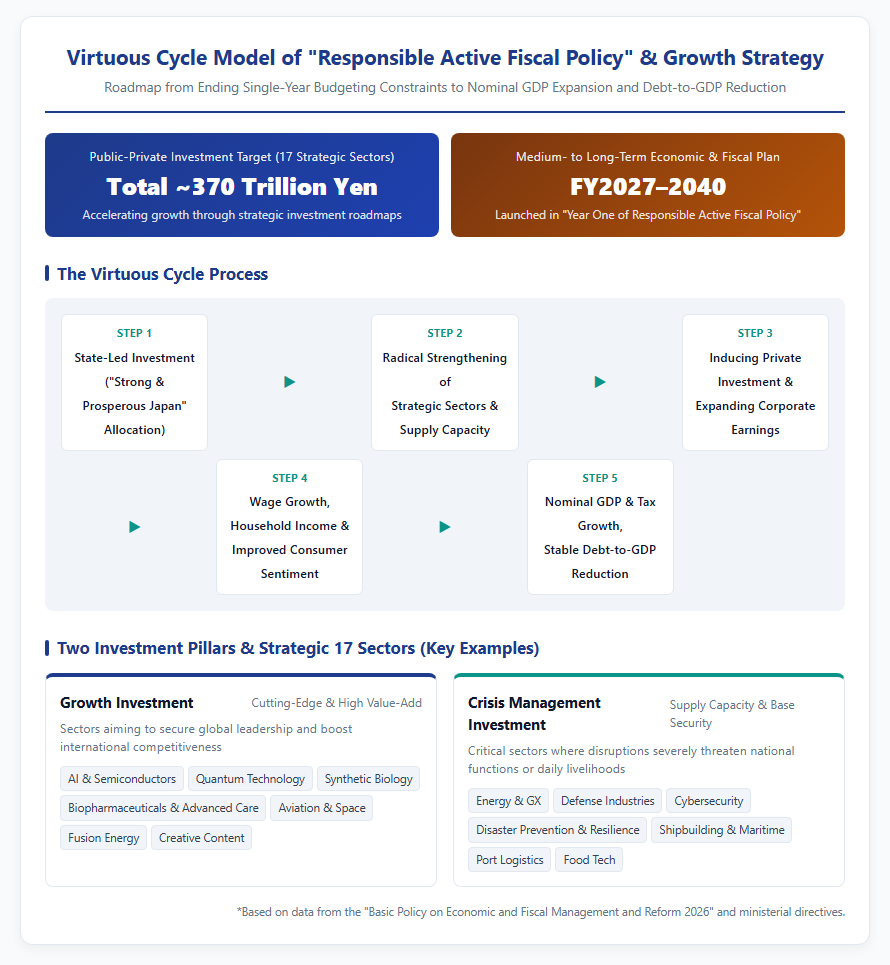
At the center of the Takaichi administration’s economic policy is the concept of “responsible active fiscal policy.” Traditional Japanese fiscal management prioritized strict annual expenditure caps and achieving a primary budget balance every fiscal year. However, the latest directives explicitly order a departure from single-year budgeting constraints, establishing multi-year fiscal commitments instead.
By guaranteeing long-term government spending in growth and crisis management sectors, the administration aims to enhance predictability for private enterprises, thereby inducing large-scale capital expenditure and corporate R&D investments. This policy cycle is designed to boost productivity, expand corporate earnings and household incomes, and ultimately drive natural growth in tax revenue.
Specifically, Fiscal Year 2027 has been designated as “Year One of Responsible Active Fiscal Policy,” launching a long-term plan spanning from FY2027 through FY2040. Under this plan, a dedicated “Strong and Prosperous Japan” investment allocation will be created, deploying comprehensive industrial development measures that combine budgetary allocations, tax incentives, regulatory reforms, and strategic government procurement.
Boosting Supply Capacity Through Growth and Crisis Management Investments
The investment framework outlined in the directives is broadly divided into two categories: “Growth Investment” and “Crisis Management Investment.” Growth investments aim to foster cutting-edge technologies and high-value-added industries capable of securing global market leadership. Conversely, crisis management investments focus on establishing domestic supply capacity for critical sectors—such as energy, food, and infrastructure—where supply chain disruptions would severely threaten national functions or public livelihoods.
To counteract sluggish potential growth rates and weakened industrial supply capabilities, the government is taking the lead by absorbing initial investment risks. Rather than relying on short-term stimulus through conventional public works, funds will be strategically channeled into structural initiatives designed to fundamentally elevate productivity and long-term supply capacity.
Through this public-private investment expansion, the administration aims to enlarge the overall scale of Japan’s nominal GDP. Under this economic model, expanding nominal GDP enables the government to stably and sustainably lower the debt-to-GDP ratio, even if the absolute nominal debt level increases in the near term.
Key Strategic Fields and the Rollout of State-Led Industrial Policy
The government has designated 17 strategic fields for targeted investment: AI and semiconductors, digital and cybersecurity, quantum technology, defense industries, aviation and space, maritime industries, shipbuilding, advanced materials, synthetic biology, biopharmaceuticals and advanced medical care, energy and Green Transformation (GX), fusion energy, disaster prevention and national resilience, port logistics, food tech, and creative content.
These sectors share a vital commonality: over-reliance on foreign supply chains or technologies exposes Japan to severe national security and economic risks during geopolitical crises or global market disruptions. For instance, semiconductor or critical mineral shortages can halt automotive and electronics manufacturing, while energy disruptions paralyze broader industrial operations.
Consequently, this growth strategy transcends traditional economic promotion, taking on the distinct character of a “state-led industrial policy” that fully integrates industrial strategy with national security. The government has mapped out a combined public-private investment roadmap totaling approximately 370 trillion yen across these 17 fields, providing robust backing for domestic production bases and technological sovereignty.
The Blueprint for Consumption Tax Reductions and Social Security Reform
Temporary Reduction of Food Consumption Tax to 1% and Implementation Timeline
The central political debate of the Autumn 2026 Extraordinary Diet session revolves around consumption tax policy. According to the ministerial directives and related policy outlines, to protect household purchasing power against persistent inflation, the government plans to submit legislation temporarily lowering the consumption tax rate on food items (excluding alcoholic beverages and dining out) from the current 8% to 1% for a two-year period starting April 2027.
This temporary tax cut is positioned as a bridging measure until a comprehensive system of income-linked cash transfers and refundable tax credits is fully implemented. By significantly reducing the tax burden on essential foodstuffs, the policy aims to support the real disposable income of low- and middle-income households and prevent a contraction in consumer sentiment.
Addressing the estimated annual revenue shortfall of approximately 5 trillion yen, the government emphasizes the immediate relief provided to household budgets. Positioned as a high-impact economic measure during a transitional period where wage growth has struggled to outpace inflation, the administration seeks swift parliamentary passage of the bill.
Refundable Tax Credits and Burden Reduction for Current Generations
Alongside temporary tax cuts, the directives mandate structural burden reductions through an integrated reform of tax and social security systems. Specifically, the Minister of Finance and the Minister of Health, Labour and Welfare have been instructed to immediately begin designing a “refundable tax credit” framework to assist low- and middle-income earners struggling under heavy tax and social insurance contributions.
By leveraging the My Number digital identity system, the government aims to accurately assess individual and household income levels, providing direct cash payouts to those whose tax liabilities fall below credit thresholds. This mechanism is intended to eliminate income distortion traps—commonly referred to as “income barriers”—where increased working hours lead to net reductions in take-home pay, thereby fostering workforce participation.
Furthermore, to curb rising social insurance contribution rates for the working-age population, ministers were instructed to streamline healthcare and long-term care administration through digitalization and data-driven optimizations. Combining preventive healthcare promotion with labor-saving automation aims to enhance the long-term sustainability of the social security framework.
The Challenge of Securing Revenue Sources vs. Single-Year Budgeting
Securing stable, permanent revenue sources remains the primary challenge in executing tax cuts and expanded support measures. Regarding the estimated 5 trillion yen annual revenue gap resulting from the food tax cut, Minister of Finance Satsuki Katayama signaled an intent to avoid relying on deficit-financing bonds, seeking funding instead through reviews of special tax measures, streamlining government subsidies, and reallocating unspent budget balances.
However, given that annual expenditure structures tend to be rigid, identifying several trillion yen in offsetting cuts through discretionary budget realignments alone presents significant hurdles. Balancing these tax relief commitments against expanding financial requirements—including defense spending hikes, growth investments, and child-support initiatives—requires careful fiscal management.
To maintain financial market confidence while aiming to keep new government bond issuance around the 40 trillion yen threshold for FY2027, the administration must present concrete revenue-offsetting mechanisms alongside rigorous expenditure reforms during upcoming budget negotiations.
Market & Equity Impact: Sector-by-Sector Analysis
Policy Continuity and Stability from Retaining Key Economic Ministers
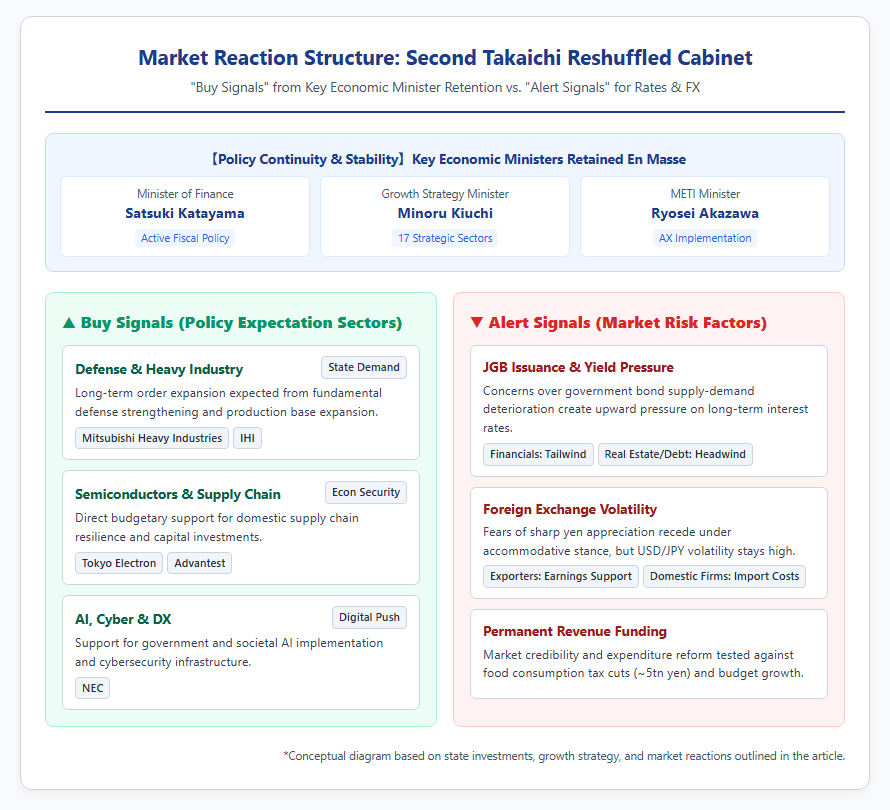
Equity markets responded positively to the retention of core economic policy leadership during the cabinet reshuffle. Retaining Minister of Finance Satsuki Katayama, Minister for Growth Strategy Minoru Kiuchi, and Minister of Economy, Trade and Industry Ryosei Akazawa conveyed a strong message to global investors that the administration’s active fiscal stance and structural growth strategies will remain steadfast.
By removing risks associated with policy delays or sudden strategic pivots, market uncertainty dissipated. In particular, the re-appointment of Finance Minister Katayama—who has successfully secured growth investment budgets while coordinating with fiscal authorities—was interpreted by institutional investors as confirmation that the public-private investment schedule will proceed as planned.
With policy continuity guaranteed, corporations can more confidently formulate long-term capital expenditure, M&A, and business restructuring strategies. Environmentally, the backdrop is now set for accelerated execution across state-supported growth initiatives.
Capital Inflows into Semiconductor, Defense, and AI Sectors
Following the clarification of growth strategies and portfolio realignments, investor interest has surged toward specific industrial sectors. Key stock categories tied to the administration’s agenda—notably semiconductor equipment, defense hardware, AI and cybersecurity, and physical infrastructure—have seen pronounced capital inflows from both institutional and retail market participants.
With the fundamental strengthening of national defense, heavy industry leaders such as Mitsubishi Heavy Industries and IHI have experienced heightened long-term order expectations backed directly by state budgetary allocations. Similarly, supply chain resilience initiatives spearheaded by Economic Security Minister Onoda offer strong tailwinds for semiconductor equipment manufacturers like Tokyo Electron and Advantest.
Furthermore, directives aimed at accelerating AI and digital transformation across public and industrial spheres continue to support earnings perspectives for IT infrastructure and security providers, including NEC. Capital flows remain concentrated in sectors directly aligned with state policy priorities.
Market Alert Signals: Long-Term Interest Rates and Currency Volatility
While policy expectations have triggered buying signals across targeted equities, caution persists within broader financial markets. In bond markets, anticipation of expansionary fiscal policy and potential debt issuance has generated upward pressure on long-term interest rates due to concerns over future government bond supply-demand balances. While rising yields benefit financial sectors like banking and insurance, they impose higher borrowing costs on real estate developers and highly leveraged firms.
Simultaneously, volatility in the USD/JPY exchange rate remains a critical variable. While the administration’s pro-growth and accommodative policy stance mitigates expectations of sudden yen appreciation, currency markets experience elevated volatility influenced by US monetary policy trajectories and global macroeconomic trends. Because excessive currency weakness inflates import costs for domestic-demand industries and households, maintaining balanced exchange rate dynamics remains essential.
For market participants, navigating this environment requires selective investment strategies—capturing growth upsides in policy-backed sectors while carefully monitoring the broader market impact of rate fluctuations and currency swings.
Upcoming Timeline and Key Policy Watchpoints
The Autumn 2026 Extraordinary Diet Session and Tax Legislation Debates
The first major legislative test for the Second Takaichi Reshuffled Cabinet will be the Extraordinary Diet session scheduled to convene in early October 2026. The primary legislative focus will be the bill to temporarily reduce the food consumption tax rate to 1%, alongside supplementary budget proposals containing immediate cost-of-living relief measures.
Opposition parties are expected to scrutinize the administration over the specific funding sources for the estimated 5 trillion yen tax cut, as well as political accountability regarding parliamentary appointments. The ruling coalition must leverage its partnership with Nippon Ishin no Kai to maintain a stable legislative majority, while clearly articulating to the public the economic benefits and fiscal offset plans underlying the tax proposal.
The speed and quality of legislative deliberation during this Extraordinary Diet session will serve as a crucial bellwether for whether the administration can sustain its initial public support and momentum.
Revision of Security Strategy Documents and FY2027 Budget Compilation
Concurrently with Diet proceedings, formal work on national security strategies and annual budget formulation will intensify toward the end of 2026. Led by the Ministry of Defense, revisions to the three core security strategy documents—including the National Security Strategy—are slated for completion by late 2026. These updates will define specific defense expenditure targets and operational shifts involving uncrewed systems, AI, space, cyber defense, and counterstrike capabilities.
Simultaneously, the Ministry of Finance will lead the compilation of the FY2027 initial budget. As FY2027 marks “Year One of Responsible Active Fiscal Policy,” the budget must simultaneously accommodate revenue reductions from food tax cuts, multi-year growth investments across the 17 strategic fields, defense spending increases, and natural growth in social security costs.
Under the self-imposed constraint of capping new debt issuance at approximately 40 trillion yen, the fiscal authorities face a rigorous test in balancing competing funding demands into a coherent financial plan.
The Core Challenge: Balancing Economic Growth with Fiscal Sustainability
The ultimate success of the Takaichi doctrine hinges on whether state-led investments can generate real economic expansion and yield long-term corporate tax revenue growth. Direct state involvement in selecting strategic industries carries inherent structural risks, including misallocating capital or fostering inefficient subsidy reliance among recipient firms.
To mitigate these risks, the government must strictly enforce Evidence-Based Policy Making (EBPM), establishing clear evaluation metrics to modify or exit underperforming initiatives. Preventing public funds from devolving into passive subsidies requires rigorous performance management capable of driving genuine private-sector innovation and productivity gains.
Whether the administration can establish a sustained growth trajectory—aiming for over 1% real and over 3% nominal GDP growth beginning in FY2027—and place the debt-to-GDP ratio on a downward path will ultimately determine the historical legacy of Takaichi’s economic model.
References
- 【Roster of Cabinet Ministers (Second Takaichi Reshuffled Cabinet)】https://www.kantei.go.jp/jp/105/meibo/index.html
- 【Prime Minister Takaichi’s Press Conference】https://www.kantei.go.jp/jp/105/statement/2026/0917kaiken.html
- 【Basic Policy on Economic and Fiscal Management and Reform 2026】https://www5.cao.go.jp/keizai-shimon/kaigi/minutes/2026/0630_shiryo01.pdf
【#EconomicSecurity #CabinetReshuffle #MinisterialDirectives #ResponsibleActiveFiscalPolicy #JapaneseEconomy #IndustrialPolicy #ConsumptionTaxCut #TakaichiAdministration】

コメント