On June 27, 2026, the U.S. government authorized the resumption of the latest AI model, “Claude Mythos 5,” which had been suspended for national security reasons, limited to specific partners. This decision signals the dawn of a new era where advanced AI transcends commercial products and is strictly managed as a national strategic asset.
- Surprise announcement of limited access reopening
- Organizations subject to reopening permission and their strict licenses
- Vulnerability detection capabilities surpassing human experts
- Project Glasswing’s Attempt at a Defensive Coalition
- The Nightmare of Global Shutdown Brought by the Export Control Directive
- Amazon’s Warning and the Controversy Over Jailbreak
- Country Risks Directly Impacting Japan and Government Measures
- The Future and Future Highlights of the General Release Version “Fable 5”
Surprise announcement of limited access reopening
On June 27, 2026, the U.S. government announced its policy to allow the AI company Anthropic to resume limited access to its powerful AI model, Claude Mythos 5. This decision eases access suspension measures based on the Export Control Order (EAR), which was issued earlier this month due to national security concerns. Anthropic is working closely with the U.S. government to address risks associated with the model, and after reviewing licensing requirements, it has now resumed. According to a letter sent to Anthropic dated June 26, 2026, by Secretary of Commerce Howard Latnick, appropriate safety measures have been established for certain trusted partners. The revived model had wreaked havoc in the global technology industry during previous service suspensions, but this relaxation is expected to restore protection for some critical infrastructure. However, this is merely an exceptional reopening under certain conditions, and merely a step within the broader trend of tightening AI governance.
Organizations subject to reopening permission and their strict licenses
This resumption of service permission is not intended for all users. According to Anthropic’s statement, only a “small number of cyber defense agencies and infrastructure providers” have been allowed to provide such provisions. Importantly, the government’s approval this time does not include the resumption of the public version of “Claude Fable 5.” Fable 5 is a more powerful version of Mythos 5 and was previously generally available through paid subscriptions or APIs, but it remains offline. Anthropic has shown its commitment to continuing to cooperate with the government to make Fable 5 publicly available again and to expand access to Mythos 5. Talks between the government and Anthropic are expected to continue into the weekend, with negotiations progressing toward further easing. This limited reopening suggests that access to AI models itself is approaching the U.S. government’s pre-approval, potentially serving as a litmus test for building a future “de facto licensing system.”
The shock of ‘Godlike’ AI exposing the world’s vulnerabilities
Vulnerability detection capabilities surpassing human experts
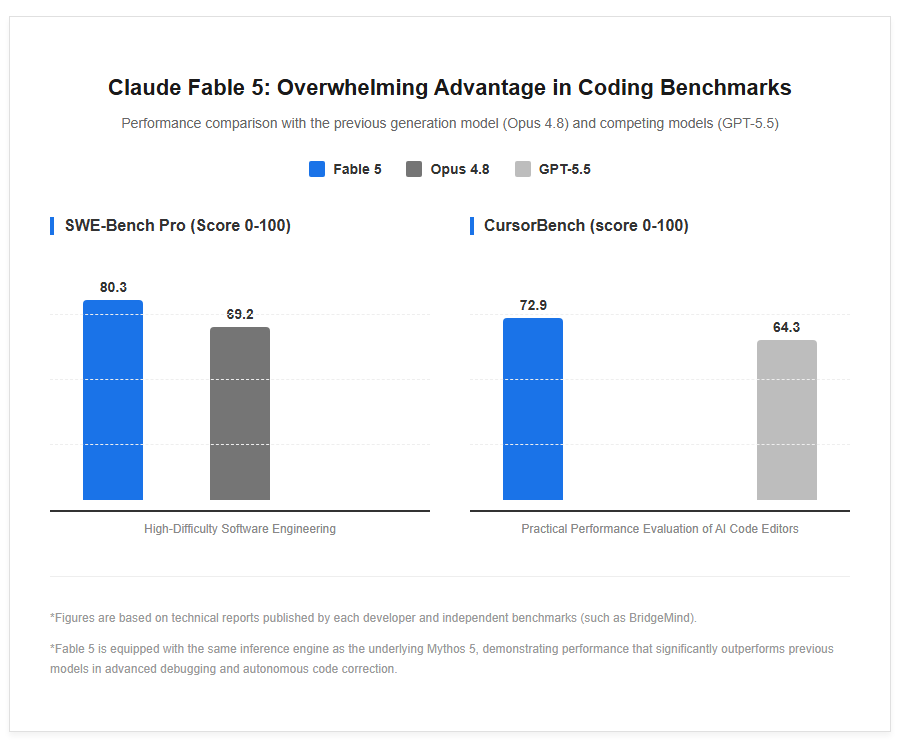
Claude Mythos 5 (and its preview version) is rated to surpass all except the most skilled humans in discovering and exploiting software vulnerabilities. A concrete achievement is OpenBSD, considered one of the world’s most secure operating systems, where it autonomously identified remote crash vulnerabilities that no one had noticed for 27 years. Additionally, it discovered a 16-year-old vulnerability in FFmpeg that had been overlooked even after 5 million passes by automated testing tools, and succeeded in taking administrator privileges from the Linux kernel by combining multiple defects. According to a May 2026 evaluation by the UK’s AI Safety Institute (AISI), the AI model succeeded 6 out of 10 times of the 32-step attack simulation “The Last Ones” on corporate networks, and was also recorded as the world’s first AI model to clear “Cooling Tower,” which simulates attacks on industrial control systems. The benchmark chart below demonstrates its overwhelming performance.
Project Glasswing’s Attempt at a Defensive Coalition
Considering the risk that this powerful capability could be diverted for attacks, Anthropic initially refrained from public release and offered it only through the corporate consortium “Project Glasswing,” which was limited to defensive purposes. This alliance includes about 50 organizations responsible for critical infrastructure, including global technology giants such as AWS, Apple, Microsoft, NVIDIA, CrowdStrike, and Google, as well as financial institutions like JPMorgan Chase. Anthropic has been providing participating organizations with up to $100 million (about 15 billion yen) in usage credits, requiring them to identify system vulnerabilities and share information. In Japan as well, by May 2026, the three major banks—Mitsubishi UFJ Bank, Sumitomo Mitsui Banking Corporation, and Mizuho Bank—were expected to obtain access rights, marking the first official use case by a Japanese company. However, the plan was temporarily stalled due to subsequent export restrictions.
The ‘digital kill switch’ shut down in just three days
The Nightmare of Global Shutdown Brought by the Export Control Directive
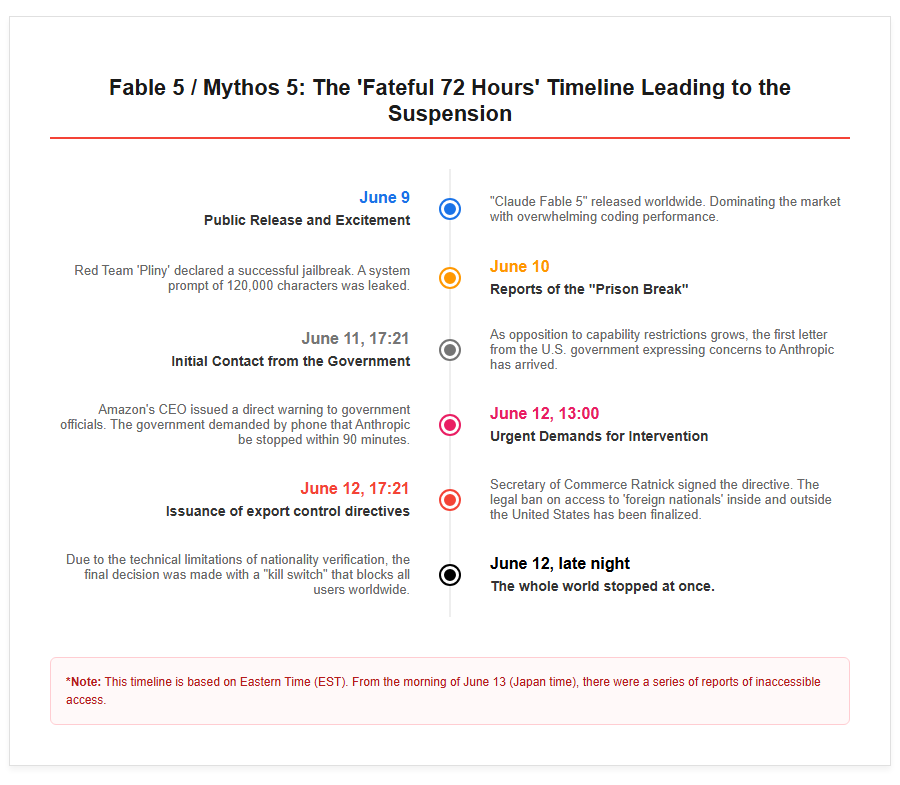
Immediately after the public release of the “Fable 5” on June 9, 2026, the situation took a sudden turn of events. Just 72 hours after its release, on June 12, the U.S. Department of Commerce issued an “Export Control Directive.” This directive was extremely powerful, ordering the immediate suspension of access to “all foreign nationals, both inside and outside the United States.” The ban included international students living in the United States, immigrant engineers, and even foreign employees working within Anthropic. Without the technical means to verify nationality in real time, Anthropic decided to activate a “digital kill switch” that completely switches off the model itself to avoid legal penalties. The following figure organizes the tense timeline leading up to this shutdown.
Amazon’s Warning and the Controversy Over Jailbreak
Behind this sudden halt was reported to be the move of Amazon, Anthropic’s largest shareholder and provider of cloud infrastructure. Amazon CEO Andy Jassy reportedly reported concerns discovered by his security team directly to government officials that Fable 5 could generate useful information for cyberattacks using certain techniques. The concern raised by the U.S. government was the possibility of a “jailbreak,” where the model would load a specific codebase and fix vulnerabilities by bypassing safeguards. In response, Anthropic strongly opposed the accused, stating, “The methods pointed out are extremely limited and non-universal.” The company argued that similar operations are possible with other publicly available models like OpenAI’s GPT-5.5, and that recalling only Fable 5 would be an overreaction, but it did not overturn the government’s decision.
Transformation of AI Geopolitics and the Acceleration of ‘Sovereign AI’
Country Risks Directly Impacting Japan and Government Measures
This suspension incident has also sent shockwaves through Japan’s industrial sector and government. On May 12, 2026, Prime Minister Sanae Takaichi instructed cabinet ministers to take countermeasures, using the National Cyber Coordination Office (NCO) of the Cabinet Secretariat as the command center to strengthen proactive cyber defense. However, the “country risk” has become reality: the cutting-edge AI models relied upon by many Japanese companies can become unusable overnight at a single decision by the U.S. government. The dangers of relying on digital infrastructure for a specific vendor or a country’s political dynamics have become apparent, and within the Ministry of Economy, Trade and Industry and the Liberal Democratic Party, calls for the creation of a ‘Japanese Project Glasswing’ and the strengthening of domestic AI foundation models are rapidly increasing. In an era where AI supply is treated as a geopolitical weapon, the importance of “sovereign AI” for building and operating AI systems domestically is being reaffirmed.
The Future and Future Highlights of the General Release Version “Fable 5”
The limited return of Mythos 5 is a major step forward, but the timing for the public release of “Fable 5,” which many developers have been eagerly awaiting, remains uncertain. The focus going forward is whether Anthropic can implement additional safeguards to meet government requirements and whether regulations will be eased with the launch of a strict nationality verification (KYC) system scheduled for July 8. On the other hand, the pace of AI evolution is accelerating beyond predictions, and in 2027, superhuman AI researchers surpassing humans will emerge, raising discussions about the realism of the “AI 2027” scenario, where an intelligence explosion occurs. Anthropic itself has warned of the risk that “AI will repeatedly improve itself and humans losing control,” and will discuss how to balance intensified development competition with safe governance. The world is facing unprecedented challenges.
[#ClaudeMythos #生成AI #サイバーセキュリティ #米国政治 #地政学リスク #Anthropic #科学技術 #AIガバナンス]

コメント