On July 21, 2026, Sakana AI unveiled a new AI model specialized in cybersecurity, called “Fugu-Cyber.” This is a groundbreaking initiative aimed at avoiding the risk of dependence on major U.S. vendors and establishing a robust cyber defense system within Japan.
- Release of domestic AI specialized in defense and security
- “AI Sovereignty” as a Countermeasure to Geopolitical Risks
- Orchestration where the command center model brings together multiple AIs
- Benchmark results comparable to top U.S. models
- Strict operations and risk management aimed at preventing abuse
- Future Developments: The Potential of a Self-Evolving AI Ecosystem
Release of domestic AI specialized in defense and security
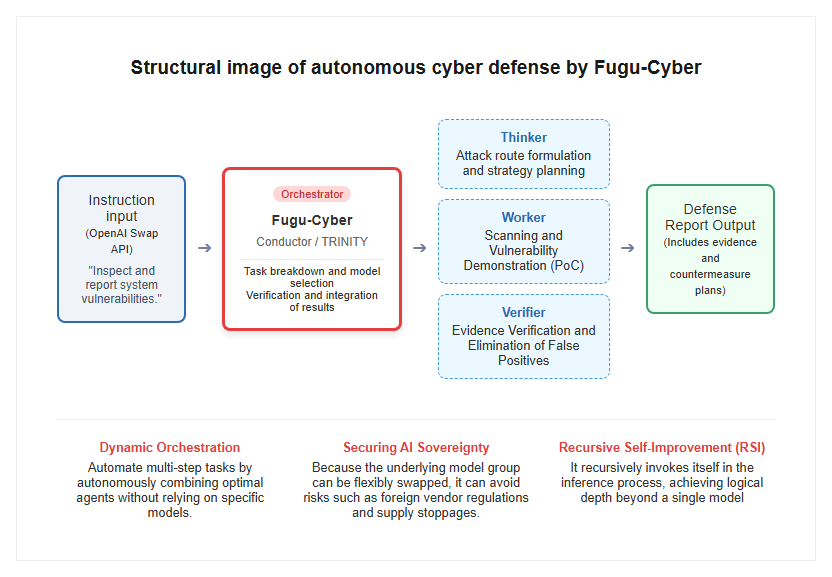
On July 21, 2026, Sakana AI unveiled a new orchestration model specialized in the cybersecurity field, “Fugu-Cyber.” This model is positioned as the latest in the “Sakana Fugu” series, announced on June 22 of the same year, and has the ability to dynamically combine multiple AI agents to autonomously handle advanced multi-stage tasks. Users can call this model through a single OpenAI-compatible API, enabling advanced security analysis without being aware of the complex internal processes such as agent selection, role delegation, and performance verification. In terms of performance, CyberGym, a benchmark for cybersecurity, achieved high success rates of 86.9% and CTI-REALM achieved 72.1%. This figure rivals the world’s top frontier models such as OpenAI’s “GPT-5.5-Cyber” and Anthropic’s “Claude Mythos Preview.” The provision adopts an application system that pre-reviews users’ identities and specific intended uses, granting access only to approved users. The diagram below illustrates how Fugu-Cyber groups multiple agents for defense.
“AI Sovereignty” as a Countermeasure to Geopolitical Risks
Behind the development of Fugu-Cyber lies the urgent challenge of rapidly increasing geopolitical risks and the urgent challenge of securing “sovereignty” over AI technology. On June 12, 2026, due to the U.S. government’s export control directive, access from within Japan to Anthropic’s ultra-high-performance models, the Claude Fable 5 and Mythos 5, was suddenly restricted or suspended. This incident highlighted the dangers of relying on a single foreign vendor for the foundations of critical infrastructure, finance, and administrative systems. The risk of “overnight loss” of access to AI models due to changes in certain corporate policies or national regulations is no longer just a hypothetical scenario—it has become a real threat. As a practical measure against this dependence on single vendors, Sakana AI proposes an orchestration-based AI that allows the underlying model group to be flexibly swapped. Fugu-Cyber is an extremely important solution from a business continuity planning (BCP) perspective because it can autonomously bypass processing to other models even if a specific model becomes unavailable. We aim to build a resilient cyber defense system that is not affected by changes in external environments using technologies originating from Japan.
[Technology & Performance] World-class defense capabilities realized by collective intelligence
Orchestration where the command center model brings together multiple AIs
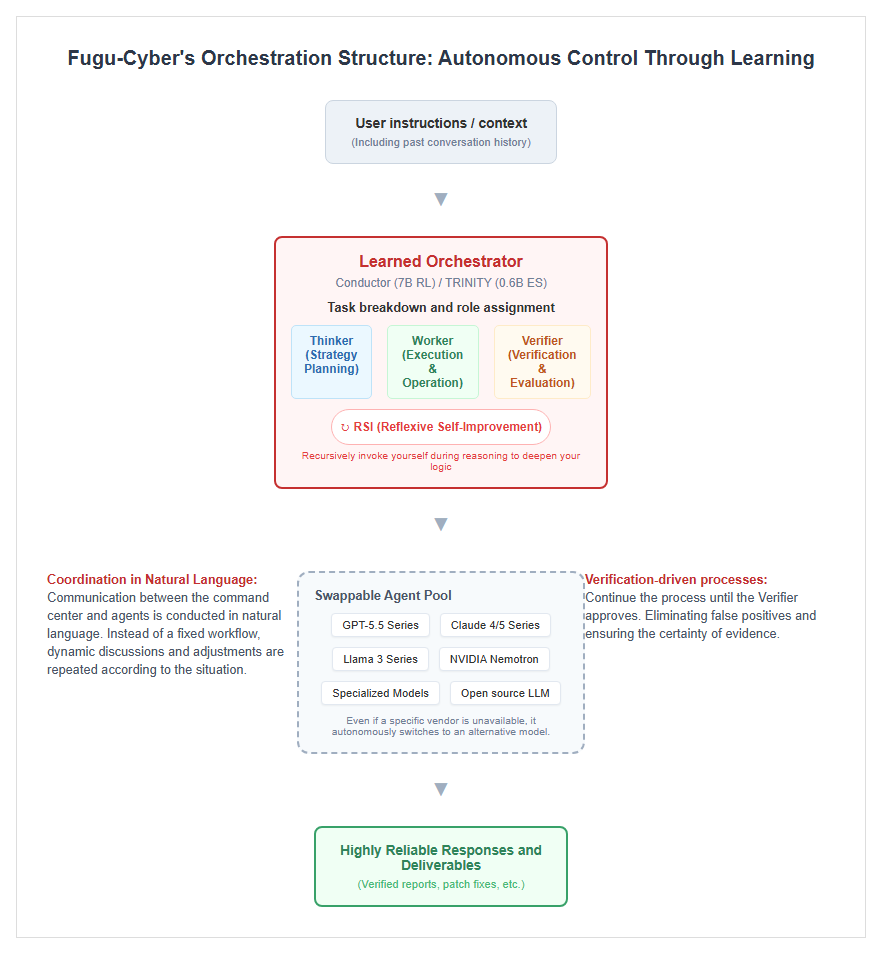
The technical essence of Fugu-Cyber lies in its “collective intelligence” approach, which coordinates multiple AI agents with different roles, rather than relying on a single massive language model. At the core of this system is Sakana AI’s proprietary models called “Conductor” and “TRINITY,” which serve as conductors. These command center models, upon receiving user instructions, break tasks down into three roles: “Thinker,” “Worker,” and “Verifier,” assigning them to the optimal model within the agent pool. In particular, Conductor, which forms the basis of the high-performance version, is a 7B (7 billion parameter) model trained by reinforcement learning, which explores optimal solutions by enabling agents to communicate in natural language. Additionally, by executing “RSI (Recursive Self-Improvement),” which calls itself recursively during the reasoning process, advanced logical reasoning that cannot be achieved with a single model can be achieved. Details of this orchestration technology can be found in the structural diagram below.
Benchmark results comparable to top U.S. models
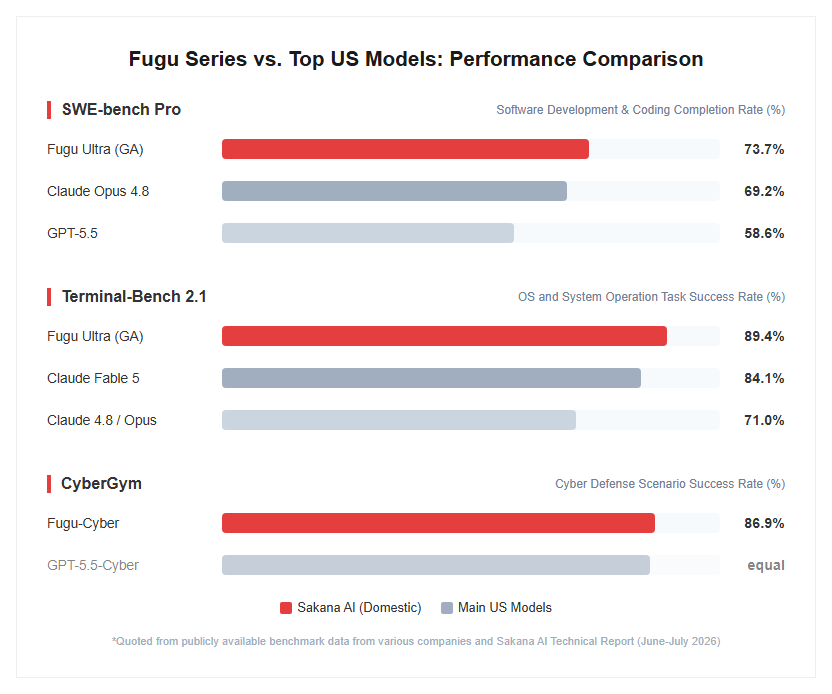
Fugu-Cyber and its foundation, Fugu Ultra, have outperformed frontier models developed by major U.S. tech companies in the industry’s toughest benchmarks. In the “SWE-bench Pro” coding ability measurement test, Fugu Ultra recorded a success rate of 73.7%, surpassing Claude Opus 4.8 (69.2%) and GPT-5.5 (58.6%). Additionally, in the “Terminal-Bench 2.1” test, which tests system operation ability, it achieved an extremely high score of 89.4%, far ahead of Anthropic’s “Fable 5” with 84.1%. In terms of scientific reasoning and chart reading performance, it demonstrates capabilities comparable to existing cutting-edge models. Not only the benchmark numbers but also actual test users have given high praise. According to a report by a cybersecurity engineer, Fugu-Cyber handled everything from information gathering, various vulnerability inspections, to creating detailed reports with evidence in a seamless process, using only targeted instructions. The graph below summarizes performance comparisons with major frontier models.
[Outlook and Challenges] Building Resilient Cyber Resilience
Strict operations and risk management aimed at preventing abuse
The advanced cyber capabilities provided by Fugu-Cyber can be a powerful defensive weapon when used wisely, but if misused, they also carry the risk of becoming tools for serious cyberattacks. For this reason, Sakana AI operates with an extremely cautious “application system” when providing Fugu-Cyber. Individuals or organizations wishing to use the service must submit an application form stating their intended use, contact information, and identity information, and access rights are granted only after passing a rigorous review by Sakana AI. The terms of use clearly prohibit exploitation for attack purposes, and if violations are confirmed, access rights will be immediately revoked. Additionally, security when data is transmitted to the model behind the scene during orchestration is also a key consideration. In response, Sakana AI is expanding its partnership with NVIDIA and integrating its open model stack, broadening options for operation in on-premises environments and more closed secure environments. A high level of convenience and safety will be key to future social implementation.
Future Developments: The Potential of a Self-Evolving AI Ecosystem
The launch of Fugu-Cyber is just the first step for Japan-based AI to take the lead at the forefront of the world. Sakana AI plans to further expand its pool of specialized agents, incorporating open-source models, Japanese-specific models, and the latest in-house developed models as needed. The biggest feature of the Fugu series is that it is based on “orchestration through learning” rather than fixed workflows. Therefore, as the underlying AI ecosystem evolves, Fugu, the command center, is automatically updated and continues to enhance its performance. In the future, it is expected to become the core of “AI resilience,” which dynamically responds to changes in the external environment and autonomously continues defense in mission-critical areas where even a single second of downtime is not permitted, such as financial infrastructure and defense systems. From the traditional scaling race pursuing a single giant model to building a “collective intelligence ecosystem” that coordinates diverse intelligences. The new paradigm presented by Fugu-Cyber is poised to dramatically transform security and industrial competitiveness in the AI era.
Reference Page
-
【Sakana Fugu】https://sakana.ai/fugu/
-
【Sakana Fugu Technical Report】https://arxiv.org/abs/2606.21228
-
【TRINITY: An Evolved LLM Coordinator】https://arxiv.org/abs/2512.04695
-
【Learning to Orchestrate Agents in Natural Language with the Conductor】https://arxiv.org/abs/2512.04388
[#SakanaAI #サイバーセキュリティ #AI主権 #人工知能 #FuguCyber #地政学リスク #国産AI]

コメント