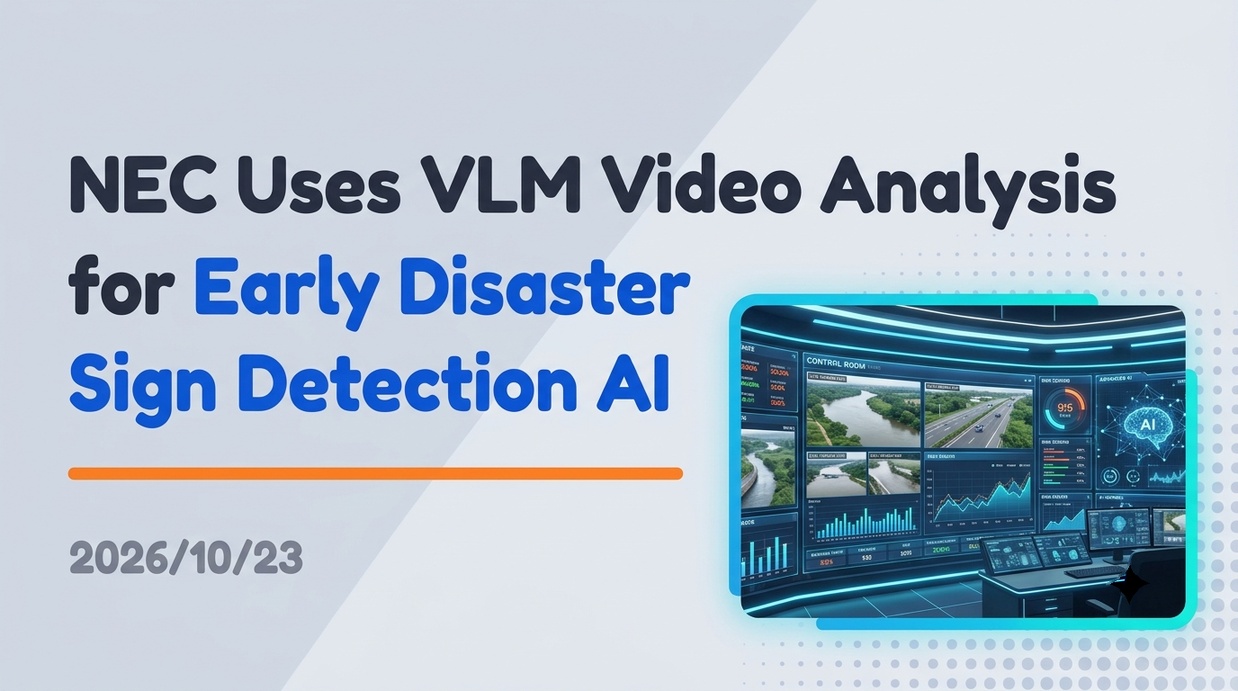
On October 23, 2026, NEC Corporation developed a Vision-Language Model (VLM) AI technology that scores and early-detects disaster precursors, such as river flooding and inundation, from road and river live camera footage. Against the backdrop of increasingly severe weather disasters and labor shortages in municipal operations, the technology aims to enhance monitoring systems by utilizing existing camera equipment.
- Overview and Development Background of New Technologies Announced in October 2026
- Operational Challenges Faced by Conventional Image Recognition and VLMs
- The mechanism for converting continuous numerical values (scores) through the analysis of sentence generation likelihood
- Automation of Prompt Adjustment Tailored to Composition and Disaster Types
- NEC’s Disaster Prevention AI Framework as Seen in In-Vehicle Camera Analysis, Satellite Image RAG, and More
- Expectations and Challenges for Practical Implementation in Fiscal 2027
Overview and Development Background of New Technologies Announced in October 2026
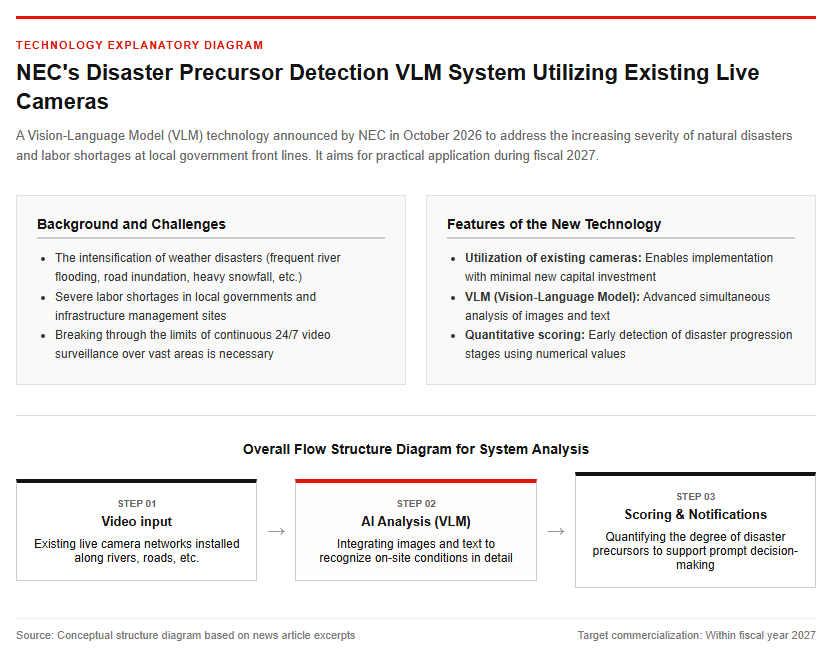
On October 23, 2026, NEC Corporation announced a new technology that uses AI to analyze live camera footage monitoring rivers and roads, enabling the early detection of disaster precursors such as river flooding, road inundation, and snow accumulation. The core feature of this technology, which leverages a Vision-Language Model (VLM) capable of handling images and text simultaneously, is its ability to score the progression of on-site conditions as quantitative numerical values. Because it can utilize existing live camera networks already installed and operated by local governments, relevant ministries, and infrastructure operators as they are, it can be implemented while keeping the burden of new capital investment to a minimum. The company aims for practical application within fiscal year 2027. The background of this development includes the rapidly increasing severity of natural disasters in recent years and the severe labor shortages faced by local governments and infrastructure management sites. While early on-site confirmation and prompt decision-making are essential to prevent the expansion of damage during a disaster, there have been limits to continuously monitoring vast regional footage 24 hours a day with limited human resources. This technology is positioned as a solution to fill this gap in information gathering at monitoring sites. The figure below shows an overview of the video analysis performed by the system.
- Publication Date: October 23, 2026
- Developer: NEC Corporation (NEC)
- Target disasters: River flooding, road flooding, snow accumulation on roads, etc.
- Target equipment: Existing live cameras operated by local governments and infrastructure administrators
- Target practical application timing: Scheduled for mid-FY 2027
Operational Challenges Faced by Conventional Image Recognition and VLMs
In conventional disaster prevention monitoring operations, it has been mainstream for personnel to visually check numerous monitor feeds, but a major concern has been the high workload and the susceptibility to overlooking subtle changes. To automate this with conventional computer vision (image recognition AI), it was necessary to collect massive amounts of image data for each specific site—such as rivers or roads—and each disaster type—such as torrential rain or heavy snow—and conduct additional training. Building this training process demanded substantial time and costs, hindering rapid deployment. While expectations grew with the emergence of general-purpose VLMs (Vision-Language Models) capable of understanding images without additional training, conventional VLMs still faced challenges unique to disaster prevention. For instance, when given prompts like “Is the road flooded?”, they were prone to generating factually incorrect answers (hallucinations) or inconsistent judgment results, making it difficult to accurately capture minute changes. Furthermore, designing prompts to achieve stable results required fine-tuning by expert engineers, presenting a barrier to on-site implementation.
- Limits of Visual Inspection: Risks of Oversight and Workload from Continuous Monitoring of Multiple Camera Feeds
- Challenges of Conventional AI: Requires massive data collection and additional training for each site or disaster.
- Challenges of General VLMs: The Risk of Overlooking Subtle Signs Due to Response Variance and Hallucinations
- Operational challenges: Prompt design and tuning by experts require a significant amount of trial and error.
Scoring and Automated Prompt Generation Enabled by Proprietary Algorithms
The mechanism for converting continuous numerical values (scores) through the analysis of sentence generation likelihood
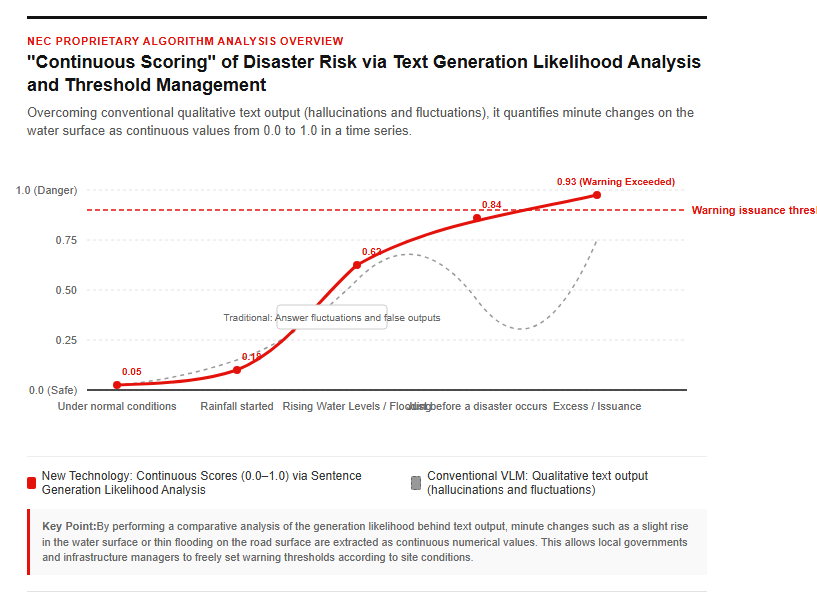
The new technology developed by NEC adopts a proprietary algorithm that analyzes the calculation probabilities (certainty, sentence generation likelihood) calculated internally when a Vision-Language Model (VLM) outputs text. Because conventional VLMs can only output answers as text such as “flooded,” it has been difficult to continuously capture quantitative numerical values such as the depth of flooding or the degree of progress of damage. In contrast, this technology has succeeded in extracting minute differences captured in images and changes over time as continuous scores (numerical values) by performing a comparative analysis of the generation likelihood behind the answer text. For example, it becomes possible to grasp slight rises in the water level or thin flooding conditions on a road surface as continuous values ranging from “0.1 to 0.9.” This scoring allows operations managers to freely set thresholds for issuing warnings according to the geographical conditions and risk level of each site. The foundational technology of this analysis method is scheduled to be presented in a research paper at ACM Multimedia Asia 2026 (MMAsia 2026), an international conference in the multimedia field. The following figure illustrates the concept of time-series scoring.
- Core technology: A proprietary method for contrastively analyzing sentence generation likelihood (generation probability) inside VLMs
- Value provided: Supplementing qualitative text responses by scoring inundation depths and snowfall amounts as continuous numerical values
- Operational benefits: Allows flexible configuration of hazard judgment thresholds tailored to site and disaster characteristics
- Academic Presentation: Scheduled to present research at the international conference MMAsia 2026
Automation of Prompt Adjustment Tailored to Composition and Disaster Types
To address the challenge of prompt tuning that hinders the stable operation and rapid deployment of AI, this system is equipped with a function to automatically generate prompts tailored to specific compositions and disaster types. By simply specifying the camera angle, the subjects to be captured (such as rivers, roads, or slopes), and the observation objective (such as inundation or snow accumulation), the AI automatically builds the optimal instructions. Furthermore, it incorporates a mechanism that sequentially adjusts parameters within the prompt while processing time-series video inputs, ensuring that score changes are smooth and continuous. During this process, the VLM automatically distinguishes between regions it should focus on (like water and road surfaces) and regions it should ignore (like background buildings and passing vehicles), reflecting only the information necessary to improve scoring accuracy into the prompt. This suppresses VLM output fluctuations caused by weather changes, day-and-night brightness differences, and image noise, enabling highly stable automated judgment. Because it eliminates the need for specialized AI engineers to repeatedly trial and adjust settings for each site, the system can be deployed to numerous observation points across the country in a short period.
- Auto-Generation: Prompt Generation Tailored to Observation Purposes Such as Camera Composition, Flooding, and Snow Cover
- Region Discrimination: Automatically identifies gazed and non-gazed regions within an image to reduce noise
- Output Stabilization: Suppressing score fluctuations and spikes through time-series image comparison
- Benefits: Eliminating the need for manual adjustments by specialized engineers, significantly reducing initial implementation costs
The Expansion of Disaster Prevention DX and Prospects for Future Social Implementation
NEC’s Disaster Prevention AI Framework as Seen in In-Vehicle Camera Analysis, Satellite Image RAG, and More
Beyond its current live camera video analysis technology, NEC is advancing the development of multifaceted disaster prevention AI solutions. In October 2026, the company announced a disaster VLM (Vision-Language Model) technology developed jointly with the Okayama Laboratory at Tohoku University, which efficiently identifies damaged areas from in-vehicle camera images. In a demonstration using recorded footage from the Great East Japan Earthquake (5,035 in-vehicle images), it was confirmed that primary filtering by the VLM reduced the targets for human review to an average of 544 images, cutting the review time by approximately 90% from the conventional roughly 7 hours to about 45 minutes (just under an hour). The technology incorporates local region understanding to detect small damaged areas occupying 10% or less of an image, as well as continuous learning technology that prevents the degradation of existing recognition capabilities even when additionally trained on new disaster events. Furthermore, similar to DamageScope—which is being developed mainly by its U.S. research institute—research is also underway to utilize Retrieval-Augmented Generation (RAG), combining satellite imagery with VLMs and LLMs, to interactively grasp wide-area damage conditions using natural language.
- Automotive Camera VLM: Image Review Time Reduced from Approx. 7 Hours to Approx. 45 Minutes (Primary Filtering Technology)
- Local Region Understanding: Accurately identifying even tiny damaged areas covering 10% or less of the entire image
- Continual Learning: Maintaining Past Recognition Capabilities Even When Adding New Disaster Events (Preventing Catastrophic Forgetting)
- DamageScope: Interactive Analysis of Wide-Area Damage via Satellite Imagery and a VLM/LLM-Based RAG Infrastructure
Expectations and Challenges for Practical Implementation in Fiscal 2027
Research and development of this AI technology are underway with the aim of practical application during fiscal 2027, and it is expected to be provided to local governments and river and road administrators nationwide. The smart disaster prevention market in Japan has reached a scale of approximately 200 billion to 240 billion yen as of 2024–2025, and disaster prevention DX-related fields continue to experience high growth at an annual rate of 10% to 15%. Furthermore, the global smart disaster prevention market is projected to expand rapidly from $63.95 billion in 2024 to $129.42 billion by 2030. Meanwhile, challenges for practical operation also exist. These include enhancing resilience against dirty camera lenses and poor visibility at night or during bad weather, as well as standardizing human confirmation processes after score determinations. How to build a “human-centric disaster response line”—where AI automatically detects anomalies to issue alerts and humans make the final judgment—will be the key to success. NEC aims to integrate these technologies to establish next-generation infrastructure that supports regional safety and security.
- Target for practical application: Social implementation and provision for local governments and businesses by the end of fiscal year 2027.
- Market Background: Japan’s smart disaster prevention market exceeds 200 billion yen, and the global market is set to expand to over $120 billion by 2030.
- Operational Challenges: Maintaining accuracy at night and during poor visibility, and establishing a human verification process after an alert is issued.
- Social impact: Contributing to reducing the monitoring burden on local governments and strengthening disaster response capabilities.
Reference Page
- [NEC Press Release] https://jpn.nec.com/press/202610/20261023_02.html
【#DisasterPreventionAI #VLM #NEC #DisasterPreventionDX #LiveCameraFootageAnalysis #SmartDisasterPrevention】

コメント