Levent Alpöge, a researcher at US-based Anthropic, announced that he has proven the Riemann Hypothesis—a mathematical problem that remained unsolved for over 160 years—in collaboration with the AI model Claude. The achievement is backed by the release of 17 million lines of proof code using the formal verification language Lean, alongside positivity verification by an independent mathematical community.
- The 160-Year-Old “Riemann Hypothesis” and Overview of the Announcement
- 17 Million Lines of Proof Code in the Lean Language and Machine Verification
- Breaking Through the Limits of Conventional Methods and Integrating Multiple Theories
- Approximately 60 Sub-Agents and Collaboration Premised on Failure
- The Clay Institute’s “Two-Year Rule” and the Wall of Human Decoding
- The future brought by AI-driven scientific research and developments to watch
The 160-Year-Old “Riemann Hypothesis” and Overview of the Announcement
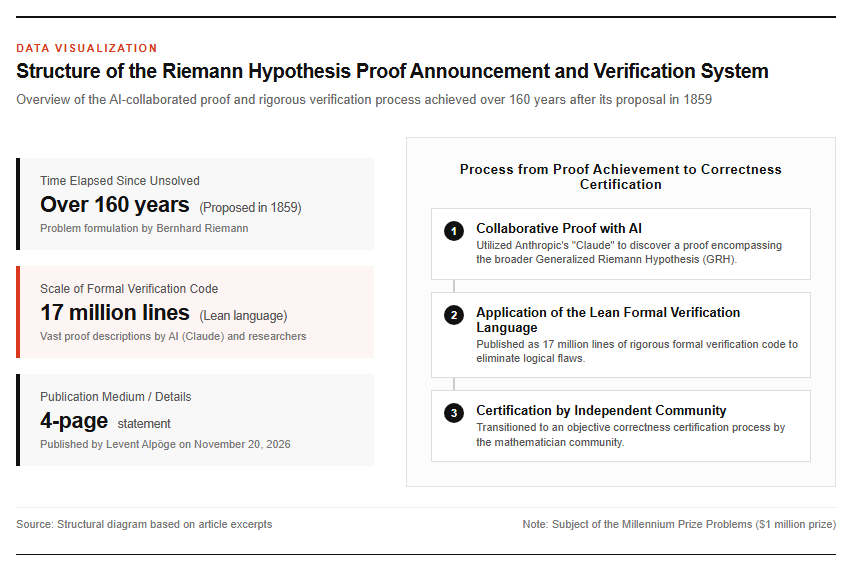
Proposed by German mathematician Bernhard Riemann in 1859, the “Riemann Hypothesis” is one of the greatest unsolved problems in the history of mathematics, aiming to decode the regularity hidden within the distribution of prime numbers. It is one of the seven “Millennium Prize Problems” designated by the Clay Mathematics Institute in 2000, with a bounty of $1 million (approx. 160 million yen). On November 20, 2026, Levent Alpöge, a mathematician affiliated with US-based Anthropic, published a 4-page statement on his website announcing that he had discovered a proof for the Riemann Hypothesis and the broader Generalized Riemann Hypothesis (GRH) through collaboration with the company’s AI, “Claude.” The announcement that AI played a primary role in reaching a proof for a difficult problem that has blocked numerous genius mathematicians for over 160 years sent shockwaves around the world. Please refer to the figure below.
17 Million Lines of Proof Code in the Lean Language and Machine Verification
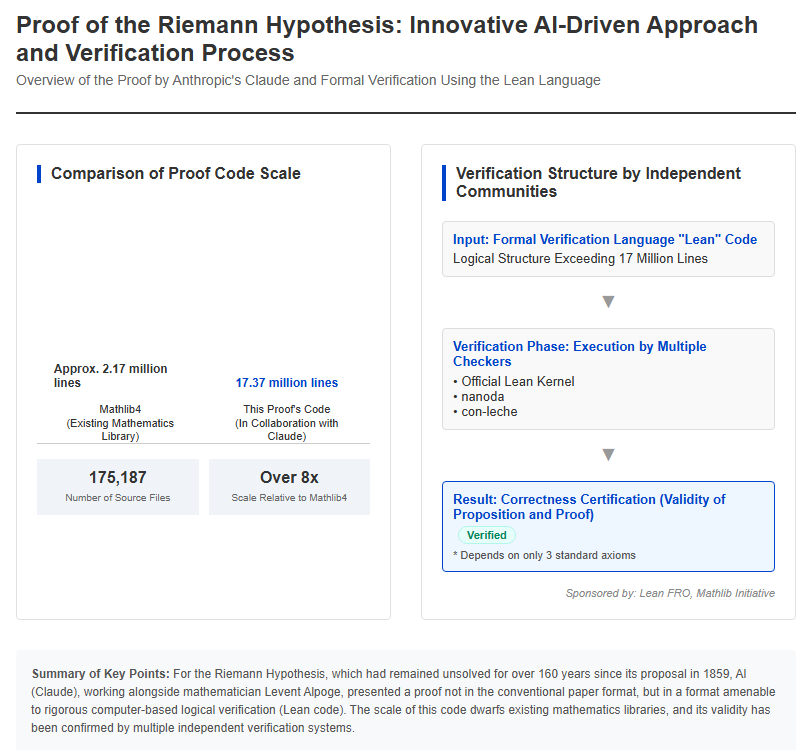
What was revolutionary about this announcement is that the results were published not as a traditional human-readable paper, but as code in “Lean,” a proof verification language capable of logical verification by computer. The published program spans 175,187 source files and approximately 17 million lines (17,374,215 lines), reaching an overwhelming scale more than eight times that of the Mathlib4 mathematics library. On November 21, 2026, an independent community sponsored by Lean FRO and the Mathlib Initiative issued a joint statement declaring that “both the propositions and the proofs are correct.” Verification by Andrew Sutherland of the Massachusetts Institute of Technology (MIT), Michael Rubinstein of the University of Waterloo, and others confirmed that the proof passes multiple independent checkers—such as nanoda and con-leche in addition to the official Lean kernel—and relies on only three standard axioms. Please refer to the figure below.
Technical Approach Taken by AI and Mathematicians
Breaking Through the Limits of Conventional Methods and Integrating Multiple Theories
Regarding the proportion (lower bound) of non-trivial zeros of the zeta function that lie on the critical line, progress had been stalled: after Norman Levinson proved 33.3% in 1974, it moved by only about 8.4 points over 46 years up to 41.7% (5/12) in 2020, a hurdle known as the “41% wall.” However, in August 2026, Anthropic’s research-edition Claude pushed the lower bound all at once to 67.2% (67.25% with refinements), proving for the first time that a majority (over 50%) of the zeros lie on the critical line. To arrive at this complete proof, Alpöge and Claude integrated Weil’s explicit formula, Montgomery’s pair correlation theory, and Sylvester’s law of inertia. Furthermore, prompted by an idea from Claude to set the length of chaining number-theoretic “theta lifts” to $\sqrt{X}$ for sums using the von Mangoldt function, they completed an unconditional theorem that eliminates the additional assumptions present in existing methods.
Approximately 60 Sub-Agents and Collaboration Premised on Failure
During the proof derivation process, a large-scale parallel operation of AI agents was conducted within the autonomous development environment “Claude Code.” Although the first session tested approximately 650 ideas with all of them ending in failure, the second session established a structure overseeing approximately 60 sub-agents. The breakdown of roles was: 2 for nurturing key ideas, 13 for generating ideas, 13 for verifying discussions, 2 for writing assistance, and 30 for exploratory roles that ultimately came to nothing. The total output token count reached approximately 31 million tokens, executed shell commands numbered around 2,400, and hundreds of Python scripts were created. Rather than a single AI producing a solution on the first try, the system design of “exploration that tolerates massive failure” and “the placement of a verification role independent of the generation role” supported this remarkable achievement.
Academic Verification, Prize Money, and Future Outlook
The Clay Institute’s “Two-Year Rule” and the Wall of Human Decoding
While the scaffolding for mathematical validity has been solidified by the success of mechanical verification using Lean, claiming the Clay Mathematics Institute’s $1 million (approx. 160 million yen) prize requires rigorous procedures. This is because the institute’s rules stipulate that the proof must be published in a peer-reviewed academic journal, followed by at least two years of scrutiny and acceptance by the broader mathematical community after publication. Furthermore, the unformalized text drafts generated by the AI exceed 250,000 pages, and Alpöge himself admits he cannot immediately explain the entirety of the arguments on the spot. As leading mathematicians like Terence Tao have pointed out, considerable time will be required going forward to reconstruct the work into a human-readable paper and elucidate its structure, specifically regarding how advanced mathematical tools such as algebraic number theory and arithmetic algebraic geometry are combined.
The future brought by AI-driven scientific research and developments to watch
The year 2026 left a strong impression of the arrival of the “Math 2.0” era, in which AI achieved successive breakthroughs on unsolved difficult problems, such as OpenAI’s presentation of related results on the Navier-Stokes equations. This announcement was made immediately after Anthropic’s historic initial public offering (IPO) on the Nasdaq market on November 19, 2026, valued at a record-breaking $81.3 billion (approx. 13 trillion yen) with a valuation of $1.5 trillion, symbolizing both its technical superiority as an AI company and its market value as a foundational science tool. Moving forward, attention will focus on the publication of peer-reviewed papers, the progress of human-side research to decipher the contents of the papers, and changes in the peer-review process. This new paradigm of scientific research—where humans subsequently decode AI-derived arguments and absorb insights—is forcing a fundamental transformation not only in mathematics, but in all forms of intellectual production.
References
- Statement Document by Levent Alpöge (PDF)
- Official Verification Statement by the Mathlib and Lean Community
- Generalized Riemann Hypothesis Lean Proof Repository (GitHub)
- Verification Site by Andrew Sutherland, Massachusetts Institute of Technology
- Verification Site by Michael Rubinstein, University of Waterloo
- arXiv Paper on the Proof of the Generalized Riemann Hypothesis
- Anthropic Official Research Announcement
[#RiemannHypothesis #Anthropic #Claude #Lean #ArtificialIntelligence #Mathematics #MillenniumPrizeProblems]
コメント