Autodesk has released “Maya 2027.3,” a 3DCG software package with significantly enhanced AI integration. Behind this launch are the growing demand for automating repetitive tasks in production environments and high expectations for advanced integration with external AI clients.
- Key Takeaways and AI Feature Enhancements in Maya 2027.3
- Evolution of Autodesk Assistant and Enhanced Control Features
- Evolution of Deformed Textures and USD/Material Workflows
- Accelerated Simulation and Viewport Rendering
- The Reality of AI Adoption and On-Site Challenges According to Industry Research
- Future Outlook and Skills Required of Creators
Key Takeaways and AI Feature Enhancements in Maya 2027.3
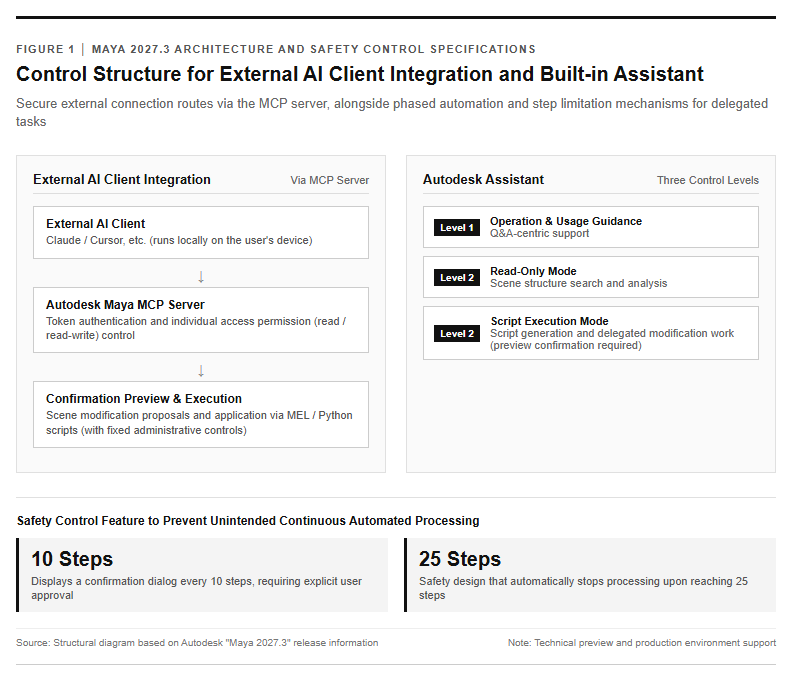
Autodesk has released Maya 2027.3, the latest version of its 3DCG production software. The standout feature of this update is the technical preview introduction of the “Autodesk Maya MCP Server,” which supports the Model Context Protocol (MCP). This feature enables Maya to connect directly with external AI clients such as Claude and Cursor via a local server running on the user’s machine. With the user’s permission, AI clients can read scene configuration information, as well as propose and execute scene modifications using MEL and Python scripts. Security has also been taken into consideration: token authentication and individual access permission settings (read-only or read-write) are provided, and a confirmation preview is always displayed before execution. Additionally, it features administrative control functions that allow enterprise managers to lock down tool settings using environment variables. Production use is permitted as long as the user is within an active subscription period.
Evolution of Autodesk Assistant and Enhanced Control Features
Autodesk Assistant, the AI assistant built into Maya, has also received significant functional enhancements. Evolving from its traditional focus on Q&A, it is now capable of analyzing scenes and even performing actual tasks on behalf of the user. The assistant’s operations are categorized into three levels, ranging from guiding users on how to use the software, to a read-only mode for searching scene structures, and finally a mode that generates scripts and executes modification tasks. During task delegation, script previews are enabled by default, and processes are applied only after obtaining user approval. Furthermore, to prevent unintended consecutive automated processes, safety control features have been built in, such as confirmation dialogs every 10 steps and automatic stopping at 25 steps. For a visual reference of how operations look during complex scene construction and adjustment tasks, please refer to the figure below.
In this way, a design centered on boosting work efficiency while guaranteeing operational safety has been thoroughly implemented.
Graphics and Technology Infrastructure Boosting Production Efficiency
Evolution of Deformed Textures and USD/Material Workflows
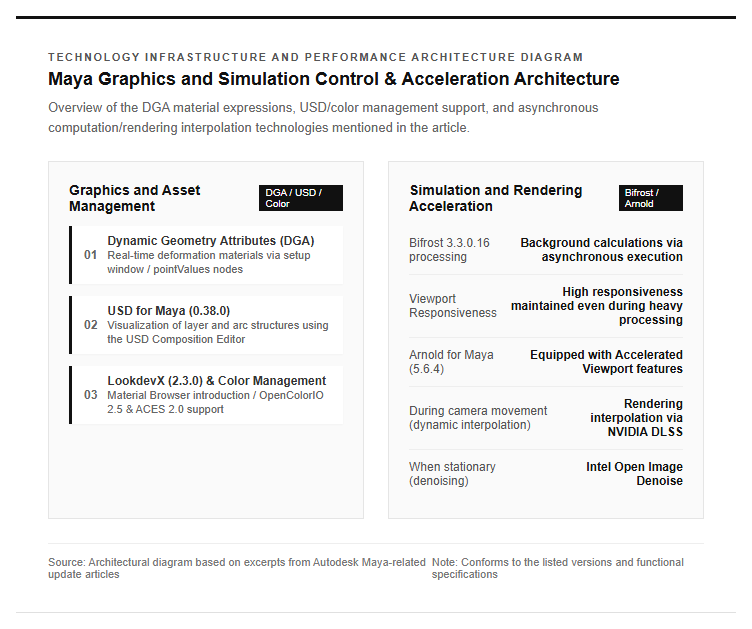
Numerous practical feature improvements have also been incorporated into the fields of graphics and asset management. “Dynamic Geometry Attributes” (DGA), which leverage mesh deformation data for shading, have been updated with a dedicated setup window and a new pointValues node. This makes it easy to build texture expressions that generate real-time material changes matching facial expressions and body distortions, without requiring manual node wiring. USD for Maya 0.38.0, which supports asset integration, enhances the USD Composition Editor to allow detailed visualization and organization of layer and arc configuration states. Furthermore, LookdevX 2.3.0, the material editing tool, has added a Material Browser that allows users to browse and import materials from a free library. It also supports OpenColorIO 2.5 and ACES 2.0, improving color management accuracy.
Accelerated Simulation and Viewport Rendering
Bifrost 3.3.0.16, the node-based simulation environment, features a dropdown format for property searches and visual updates to pass nodes to organize connection lines. On the computational side, asynchronous execution is now enabled by default, allowing heavy calculation processes to run in the background while maintaining viewport responsiveness. In terms of the rendering engine, Arnold for Maya 5.6.4 is bundled, introducing the Accelerated Viewport feature. A mechanism has been built in where NVIDIA DLSS is used to interpolate rendering during camera manipulation, while Intel Open Image Denoise interactively removes noise when movement stops. For real-time rendering verification and the texture quality of interactive drawing, please refer to the figure below.
Additionally, overall stability across the production pipeline has been improved through features such as OpenPBR support via the Substance 3.1.1 plugin and enhanced smart bevel accuracy.
Trends in the Design and Creative Industries and Future Outlook
The Reality of AI Adoption and On-Site Challenges According to Industry Research
According to the “2027 State of Design and Make Report” conducted by Autodesk surveying 5,500 people across 23 countries worldwide, 70% of leaders in the media and entertainment industry responded that future growth depends on digital tools. Currently, the most widely used AI applications are the automation of repetitive tasks at 36%, followed by design intelligence and concept generation at 35%. On the other hand, the proportion of respondents rating their own digital maturity as high dropped from 57% in 2025 to 47%. This indicates that required standards have risen in tandem with the rapid evolution of AI technology. Furthermore, a skeptical perspective and a decrease in trust toward AI can be seen, particularly in the film and television sectors, suggesting a shift into a phase where companies are carefully evaluating the true value of AI implementation scope and institutionalization.
Future Outlook and Skills Required of Creators
In the survey, 92% of “pacesetters”—the group of companies leading the way in digital transformation and AI adoption—have established in-house AI specialist teams, significantly outpacing the 59% of general companies. By connecting digital capabilities across the entire organization, they have achieved faster decision-making and improved productivity. Regarding the adoption of production tools, there is a growing trend to place greater emphasis on AI utilization skills (45%) and digital design skills (40%) rather than traditional programming development skills. As for usage formats for Maya 2027.3, in addition to the annual subscription of 345,400 yen (including tax), the Maya Indie license is also offered at 56,100 yen for creators with an annual income of less than 15 million yen. As the harmonization of AI-driven automation and human decision-making progresses, the importance of creators equipped with the digital literacy to master these tools is expected to increase even further in the future.
Reference Pages
- [Maya 2027.3 New Features | AREA JAPAN] https://area.autodesk.jp/product/maya/features/2027-3/
- [Autodesk Official Newsroom] https://adsknews.autodesk.com/
[#Autodesk #Maya2027 #GenerativeAI #3DCG #ModelContextProtocol #MCP #CGProduction]


コメント