Google has launched an experimental satellite equipped with its proprietary AI semiconductor into orbit, initiating a demonstration experiment to build an AI data center in outer space. This initiative is driven by severe terrestrial power shortages and environmental concerns associated with the proliferation of generative AI, with high expectations placed on utilizing abundant solar energy in space.
- Launch of the Orbital Demonstration Experiment “Project Suncatcher”
- The Terrestrial Power Crisis for Data and the Superiority of Space-Based Solar Power
- Technical Approaches to Vibration, Radiation, and Heat Dissipation Issues
- Inter-Satellite Laser Communication and the 81-Satellite Formation-Flying Concept
- Launch Cost Tipping Point and Major Contract with Blue Origin
- Intensifying Space Infrastructure Competition and Future Challenges
Launch of the Orbital Demonstration Experiment “Project Suncatcher”
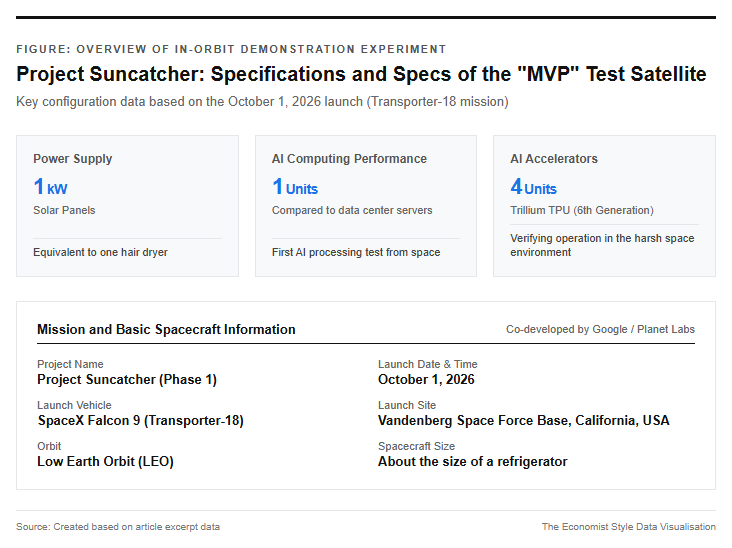
On October 1, 2026, as the first phase of its long-term research project “Project Suncatcher,” Google launched its first test satellite, “MVP,” carrying its proprietary AI semiconductor into low Earth orbit. Launched from Vandenberg Space Force Base in California, USA, via a SpaceX Falcon 9 rocket (Transporter-18 mission), the refrigerator-sized spacecraft was developed in partnership with satellite imagery giant Planet Labs. It is equipped internally with four units of Google’s sixth-generation AI accelerator, “Trillium TPU,” and is operated to verify whether the hardware functions properly in the harsh environment of outer space. The solar panels mounted on the satellite supply approximately 1 kilowatt of power, equivalent to a single hair dryer, and its current computing capacity is limited to that of a single data center server. However, it is attracting significant attention as the first full-scale orbital test to execute simple AI processing from space. The image below is a conceptual illustration of the launched satellite.
The Terrestrial Power Crisis for Data and the Superiority of Space-Based Solar Power
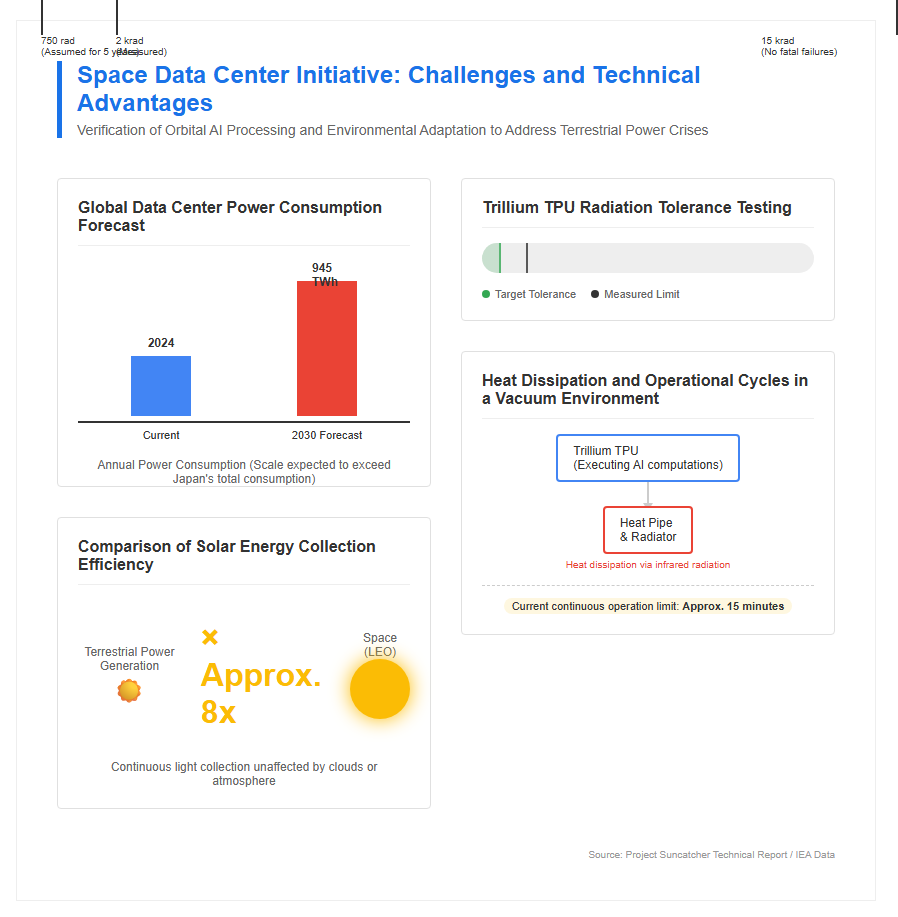
The primary reason Google is pursuing research to relocate AI infrastructure to outer space is the severe shortage of terrestrial power caused by the explosive global demand for AI. According to projections by the International Energy Agency (IEA), annual power consumption by global data centers is expected to increase at an average annual rate of about 15% from 2024 to 2030, reaching approximately 945 terawatt-hours—a scale exceeding the total annual power consumption of all of Japan. Google itself saw its data center power demand increase by 27% year-over-year in 2024, raising concerns that even with accelerated procurement of renewable energy, the expansion of power plants and transmission grids alone will not keep pace. To address these challenges, placing satellites in a sun-synchronous orbit in low Earth orbit (at an altitude of approximately 650 kilometers) allows them to receive sunlight almost constantly without being blocked by clouds or the atmosphere, making it possible to collect up to about eight times more solar energy compared to terrestrial solar power facilities. This paradigm shift of performing AI computation right where power is generated in space is anticipated as a solution to alleviate the burden on terrestrial power grids and water resources.
Adaptation to the Space Environment and Verification of Element Technologies
Technical Approaches to Vibration, Radiation, and Heat Dissipation Issues
To safely operate AI chips in outer space, they must overcome the physical stresses of launch and harsh environmental loads. During rocket launch, the spacecraft experiences maximum accelerations of up to 10G, and the onboard components 50 to 100G, but the hardware cleared pre-launch 3-axis vibration testing on the ground. Additionally, as a countermeasure against intense space radiation outside the atmosphere, proton beam testing on the TPUs was conducted at the accelerator facility of the University of California, Davis. As a result, the Trillium TPU withstood a cumulative dose of over 2 kilorads—far exceeding the estimated 5-year radiation dose of 750 rads—and suffered no fatal hardware failures even when reaching 15 kilorads. Furthermore, because convective cooling using air is not available in the vacuum of space, a heat rejection system was developed that transfers heat via heat pipes and radiates it as infrared rays from radiator plates. In the current prototype, the continuous operating time of the chip is limited to approximately 15 minutes, and verification is proceeding with repeated cycles of cooling and power-on. Please refer to the figure below for the configuration of the technical verification.
Inter-Satellite Laser Communication and the 81-Satellite Formation-Flying Concept
The ultimate system design of Project Suncatcher is not a single large satellite, but rather building “a single supercomputer” by coordinating numerous small satellites. In the model proposed by Google, the plan is to densely deploy and fly in formation 81 satellites within a radius of approximately 1 kilometer in a sun-synchronous orbit at an altitude of about 650 kilometers. To exchange large volumes of data between satellites, high-bandwidth “Free-Space Optical Link” laser communication technology is being studied, requiring ultra-precise control capable of hitting a coin-sized target several kilometers away while moving at high speeds relative to one another. Achieving processing capabilities equivalent to a terrestrial data center requires a communication bandwidth in the multi-terabit-per-second class, and Google plans to launch two experimental satellites in 2027 to conduct orbital testing of inter-satellite laser communications.
Economic Feasibility, Future Outlook, and Challenges
Launch Cost Tipping Point and Major Contract with Blue Origin
Ensuring not only technical feasibility but also economic rationality is essential for the practical implementation of the space data center initiative. According to a Google research paper, if the launch cost to low Earth orbit decreases to $200 per kilogram or less in the future, it is analyzed that it will reach a level competitive with terrestrial AI data centers in terms of annual power costs. Toward this goal, Google partnered with Bezos-led Blue Origin in November 2026, signing an exclusive launch contract using the company’s heavy-lift rocket, New Glenn. In this mission scheduled for the first quarter of 2029, a demonstration spacecraft equipped with computing power equivalent to one terrestrial data center rack per satellite is scheduled to be transported into orbit. If launch costs decrease due to advancements in rocket reusability and large-scale transport capacity, the economic hurdles for orbital computing are projected to drop significantly.
Intensifying Space Infrastructure Competition and Future Challenges
Regarding the construction of data centers in space, movement among competitors other than Google is also becoming active. SpaceX has applied to the U.S. Federal Communications Commission (FCC) for a concept involving up to 1 million AI data center satellites, and startups conducting model operation tests in space using satellites equipped with NVIDIA AI chips have also emerged. On the other hand, a researcher at University College London has pointed out concerns that if SpaceX’s 1 million-satellite plan is realized, annual rocket launch emissions would reach approximately 34 million tons—154 times the total launches in 2025—impacting the ozone layer and the global environment. Furthermore, the risk of collisions with space debris and the rapid pace of semiconductor generation shifts are also cited as challenges. James Manyika, Google’s Head of Research, has stated that long-term research of about 15 years will be necessary before this initiative becomes practical, and trial and error similar to autonomous driving and quantum computing is expected to continue going forward.
References
- 【Google Blog】Behind Project Suncatcher, our moonshot to put AI in space
 Behind Project Suncatcher, our moonshot to put AI in spaceLearn about Project Suncatcher, how we’re testing hardware survival for space, designing cooling systems for AI chips, a...blog.google
- 【Google Research】Exploring a space-based, scalable AI infrastructure system design
 Exploring a space-based, scalable AI infrastructure system designresearch.google
- 【Google Blog】We’re partnering with Blue Origin on our first heavy-lift Project Suncatcher launch
 We’re partnering with Blue Origin on our first heavy-lift Project Suncatcher launch.We’re partnering with Blue Origin on the first heavy-lift launch for Project Suncatcher, our long-term moonshot to scale...blog.google
【#Google #AIDataCenter #ProjectSuncatcher #SpaceDevelopment #TPU #ArtificialSatellite #SolarPower】

コメント