On October 23, 2026, the government approved at a Cabinet meeting amendment bills to the Commercial Code and other related laws that enable the digitalization of bills of lading used in international maritime transport. Behind this is the aim to dramatically streamline trade procedures through paperless operations and to enhance Japan’s international competitiveness by resolving logistics bottlenecks caused by delays in paper documents.
- Overview of the Cabinet-Approved Commercial Code Amendment Bill and the Path to Legislation
- The Structural Challenges Facing Paper Bills of Lading (B/L) and the “B/L Crisis”
- Dramatic Efficiency Gains and Cost Reduction Effects in Trade Operations
- Supply Chain DX and Strengthening International Competitiveness
- UNCITRAL Model Law (MLETR) and Global Digitalization Trends
- Future developments and points of attention toward the 2027 enforcement
Overview of the Cabinet-Approved Commercial Code Amendment Bill and the Path to Legislation
At a Cabinet meeting on October 23, 2026, the Japanese government officially approved a bill to amend related laws, including the Commercial Code, to promote the digitalization of bills of lading. The bill designates digitalized securities as “electronic bill of lading records” and grants them the same legal validity as conventional paper securities, aiming to simplify and expedite trade procedures. The scope is not limited to bills of lading; it has also been expanded to warehouse receipts issued by warehouse operators and multimodal transport documents combining multiple modes of transportation. The bill will be submitted to the extraordinary session of the Diet currently underway, and if enacted, it aims to come into effect during fiscal year 2027. Behind the legislation was strong lobbying from the private sector, such as a request for early legal reform submitted to the Ministry of Justice on August 31, 2026, by the Japan Trade DX Association, an industry organization. In addition, taking into consideration the persistent use of paper in business practices, the law includes provisions allowing the mutual conversion between paper securities and electronic records. The figure below shows the overall picture for the legal revision.
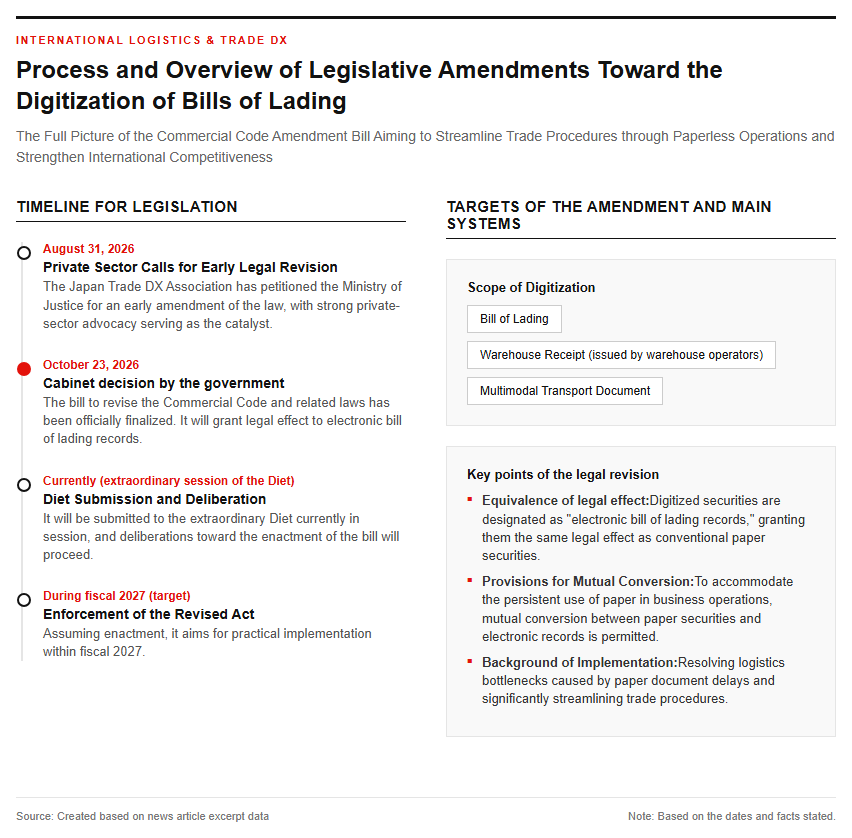
- October 23, 2026: Government approves amendment bill for the Commercial Code and other laws at a Cabinet meeting
- Mid-fiscal 2027: Target timing for the enforcement of the amended bill
- Target scope: Bills of lading, warehouse receipts, multimodal transport documents
The Structural Challenges Facing Paper Bills of Lading (B/L) and the “B/L Crisis”
The Bill of Lading (B/L) fulfills four important functions: evidence of the contract of carriage, a receipt for the goods, a document of exchange, and a negotiable instrument whose ownership can be transferred by endorsement. However, transactions reliant on traditional paper originals have become a major bottleneck in modern international logistics. Particularly on intra-Asia short-haul routes, while high-speed container ships arrive at their destinations in three to four days, paper B/Ls take one to two weeks to arrive via international mail or similar means. Consequently, a situation known as the “B/L crisis”—where cargo cannot be claimed upon arrival at the port because the documents have not yet arrived—frequently occurs. As a workaround, the practice of issuing a Bank Letter of Guarantee (Bank L/G) to take delivery of the cargo has become commonplace, but this entails heavy burdens such as substantial guarantee fees and manual administrative costs. Furthermore, paper originals constantly carry the risk of ownership transfer complications due to loss, misdelivery, or theft during international mailing, and the necessity of re-entering the same data more than ten times across the entire trade transaction process has long been recognized as a significant challenge.
- The 4 Main Functions of a B/L: Evidence of contract of carriage, receipt of goods, document of title, and negotiable instrument.
- Mail Delays: Concerns That Documents Won’t Arrive After Cargo Arrival on Short-Haul Asian Routes
- Operational risks: Risk of loss or theft, and inflated administrative costs due to excessive manual entry
The Economic and Industrial Impact of Electronic Bill of Lading (eB/L) Adoption
Dramatic Efficiency Gains and Cost Reduction Effects in Trade Operations
The digitalization of bills of lading (eB/L) will bring revolutionary changes to the speed and cost structure of trade operations. The handover of original documents, which previously took weeks through mailing and manual endorsement or confirmation, can now be completed in just a few minutes via the sending and reception of digital data. According to estimates by major shipping company MSC, the full achievement of paperless trade is expected to reduce direct costs by approximately $6.5 billion (approx. 975 billion yen) globally per year. In Japan as well, the Ministry of Economy, Trade and Industry aims to create cost benefits of approximately 300 billion yen annually by raising the proportion of transactions via trade platforms to 10% by around 2028. Furthermore, in addition to environmental benefits such as reducing CO2 emissions associated with physical paper printing, international transport, and incineration disposal, the elimination of the need to go to the office to sign and stamp paper will accelerate the transition of trade operations to remote work and the standardization of tasks.
- Time Reduction: Dramatic reduction in the time required from issuance to delivery, from weeks to minutes.
- Cost Reduction: Target of $6.5 billion annually worldwide and approximately 300 billion yen annually in Japan in economic impact.
- Environment & Work Style: Promoting Remote Work through CO2 Emission Reduction and the Elimination of Office-Based Stamping Requirements
Supply Chain DX and Strengthening International Competitiveness
The widespread adoption of electronic bills of lading goes beyond merely improving the administrative efficiency of individual companies, serving as a core driver to promote the digital transformation (DX) of the entire global supply chain. In current international trade, logistics platforms such as BOLERO and CargoX are fragmented from trade and financial platforms such as KOMGO and CONTOUR. However, advancements in data integration using APIs and other means will enable the centralized management of cargo movement and ownership information. Japanese manufacturing and distribution industries form multi-layered structures spanning multiple countries from raw material procurement to final sales, making inventory stagnation and line stoppages caused by delayed trade documents a critical risk in the operation of Just-In-Time (JIT) logistics. If the introduction of eB/Ls provides real-time visibility into transportation and customs clearance statuses, it will enable the securing of alternative routes and prompt decision-making in unforeseen circumstances, directly translating to stronger supply chains and enhanced industrial competitiveness for Japan.
- Platform Integration: Unified management through data integration between logistics, trade, and finance systems
- Real-Time Visualization: Mitigating Delay Risks through Tracking Customs Clearance and Shipping Status
- Supply Chain Strengthening: Preventing Inventory Stagnation and Building Resilience in Just-in-Time Operations
Progress of International Standards and Challenges in the Japanese Market
UNCITRAL Model Law (MLETR) and Global Digitalization Trends
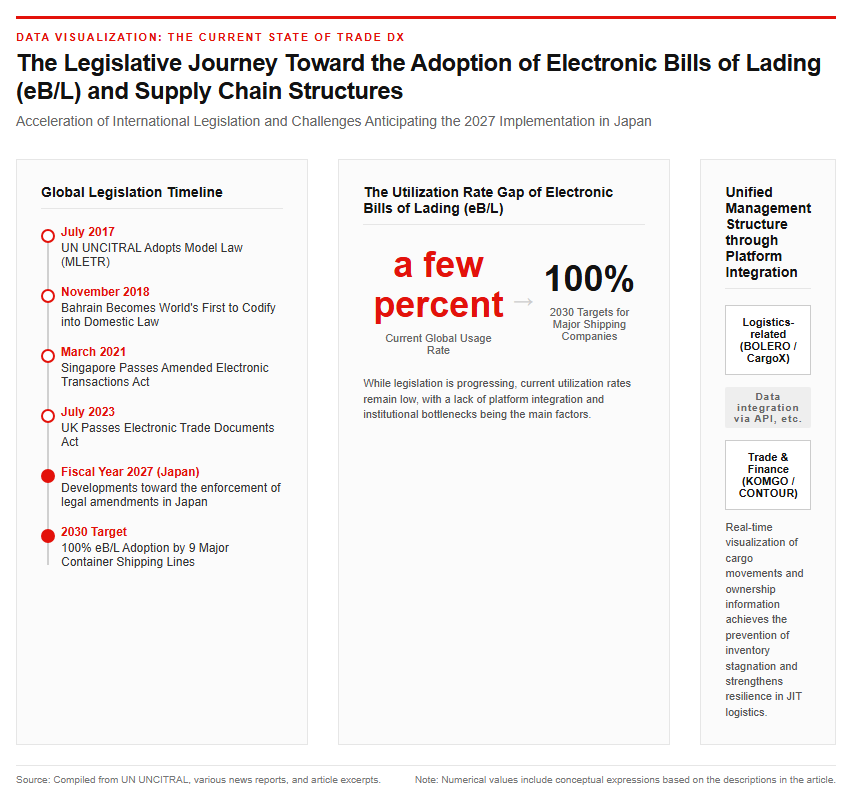
Legal reforms around the world are accelerating, centered on the Model Law on Electronic Transferable Records (MLETR) adopted by the United Nations Commission on International Trade Law (UNCITRAL) in July 2017. Starting with Bahrain becoming the world’s first country to codify it into domestic law in November 2018, Singapore enacted its amended Electronic Transactions Act in March 2021. Furthermore, in July 2023, the United Kingdom—a cornerstone of the English common law system—passed the Electronic Trade Documents Act 2023, granting digital trade documents the same legal validity as paper. Legislation and proofs of concept are also progressing in countries such as France and China, and nine major container shipping lines have set a goal of 100% eB/L adoption by 2030. As major overseas trading partners move ahead to establish legal frameworks, delays in legal reforms in Japan have been a source of concern as an “institutional bottleneck” that hinders digital investment by domestic businesses and leaves them behind in international trade practices.
- July 2017: UNCITRAL adopts the Model Law on Electronic Transferable Records (MLETR)
- Leading major countries: Bahrain, Singapore, United Kingdom, France, China
- 2030 Target: 100% Electronic Bill of Lading by Major Global Container Shipping Lines
Future developments and points of attention toward the 2027 enforcement
Toward the enforcement of the legal revision in fiscal year 2027, domestic companies and trade-related stakeholders need to proceed with a phased transition and the development of a concrete operational infrastructure. Currently, the global adoption rate of electronic bills of lading remains at only a few percent. Behind the slow progress of digitization are a lack of technical integration among multiple different trade platforms and delays in adoption by business partners and financial institutions. While institutional barriers will be eliminated as the legal revision guarantees the legal validity of electronic records, ensuring the interoperability of platforms that serve as the de facto standard will be essential to accelerating widespread adoption. Companies are encouraged to anticipate the timing of the legislation and begin reviewing their own and their business partners’ operational workflows as well as gathering information. Going forward, the establishment of a data-sharing infrastructure through public-private partnerships and support for adoption among small and medium-sized enterprises will be the key focal points that determine the success of trade DX. The perspectives for digitization are outlined below.
- Establishing a Legal Framework: Ensuring the legal security of electronic records through implementation by fiscal 2027
- Technical and Operational Challenges: Interoperability Between Platforms and Stakeholder Mindset Reform
- Corporate Response Guidelines: Inspection of Internal Workflows and Establishment of Cooperative Frameworks with Business Partners
Reference Page
- [Ministry of Foreign Affairs] Japan’s Initiatives on Economic Partnership Agreements (EPAs/FTAs), etc.
Free Trade Agreements (FTAs) and Economic Partnership Agreements (EPAs)
[#BillOfLading #ElectronicBillOfLading #CommercialCodeRevision #TradeDX #SupplyChain]


コメント