
In the Autumn Budget, the UK government has decided to provide a total of £20.4 billion in additional funding over the next approximately five years to two state-owned financial institutions: the National Wealth Fund and the British Business Bank. This is aimed at attracting private capital into growth sectors such as clean energy and artificial intelligence, while creating investment capacity through the introduction of a new fiscal framework that uses net financial liabilities as an indicator.
- Details of Capital Injection and Fund Allocation for Two State-Owned Financial Institutions
- Creation of Investment and Financing Capacity Brought About by Fiscal Rule Reforms
- Strategic Allocation to Clean Energy and Critical Infrastructure
- The Catalytic Function for Private Investment via the Crowding-In Effect
- Deployment of Growth Capital and Guarantee Schemes by the British Business Bank
- Decentralized Regional Investment and Strengthening Innovation Infrastructure
- Impact on the UK Gilt Market and Responses to Rising Interest Rate Risks
- Investment Governance and Evaluation Criteria under Financial Transaction Management Frameworks
Details of Capital Injection and Fund Allocation for Two State-Owned Financial Institutions
The UK Treasury has decided to supply a total of £20.4 billion (approximately $27.3 billion) in substantial additional capital to two state-owned financial institutions, the National Wealth Fund (NWF) and the British Business Bank (BBB), over the next approximately five years. This fiscal measure is positioned as a key initiative to advance structural reforms in the UK economy, which is struggling with slowing growth, and to boost productivity.
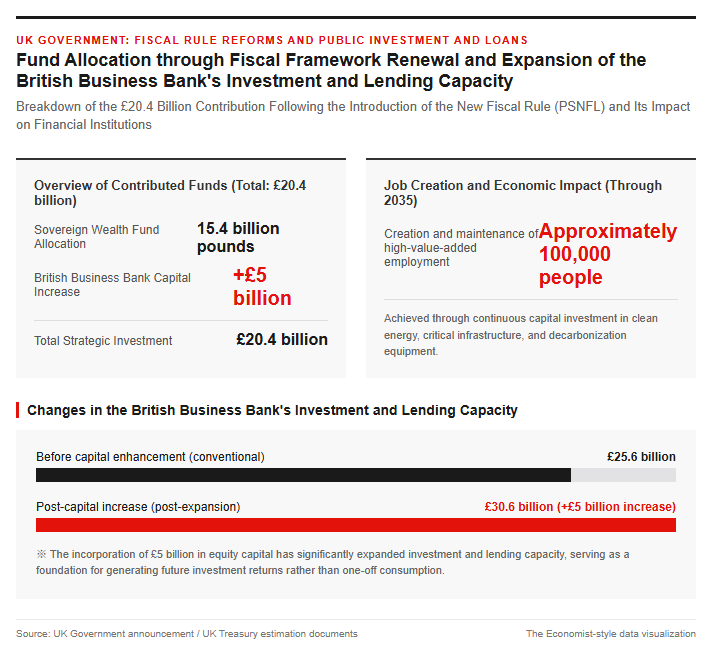
As for the breakdown of the fund allocation, £15.4 billion (approximately $20.6 billion) will be allocated to the National Wealth Fund, and £5 billion (approximately $7 billion) to the British Business Bank. Of the allocation to the National Wealth Fund, £2 billion is planned to be specifically invested in the “Energy Wealth Fund,” which supports renewable energy-related businesses. New borrowing associated with this additional support is expected to begin in the 2028-29 fiscal year, with the amount raised to be gradually increased through the 2031-32 fiscal year. This will enable the fund to maintain its current pace of investment until the 2030-31 fiscal year.
Meanwhile, the £5 billion capital injection into the British Business Bank will significantly expand the institution’s investment and financing capacity from its previous £25.6 billion to £30.6 billion. A major feature of this initiative is that, rather than distributing public spending as mere one-off consumption, the funds are incorporated into the capital of a financial institution designed to generate future investment returns.
Creation of Investment and Financing Capacity Brought About by Fiscal Rule Reforms
The primary institutional factor that made this massive funding contribution possible lies in the new fiscal framework revamped by the British government in October 2024. The UK government adopted a new investment rule targeting Public Sector Net Financial Liabilities (PSNFL, commonly known as net financial debt), replacing the traditional debt metric of Public Sector Net Debt (PSND).
Under the conventional PSND, there was a drawback that even when funds raised by the government through the issuance of government bonds were allocated to loans or investments in corporations, only the increase in liabilities on hand was recorded, which was regarded as an expansion of the fiscal deficit. In contrast, under the PSNFL, which complies with international statistical standards, not only liabilities but also the value of financial assets acquired by the government, such as loans and equities, is recorded on the asset side. As a result, for investment projects that can be expected to yield future principal and interest repayments or dividends, liabilities and assets are offset, making it possible to secure a massive framework for public investment and loans without worsening net financial liabilities.
Please refer to the figure below.
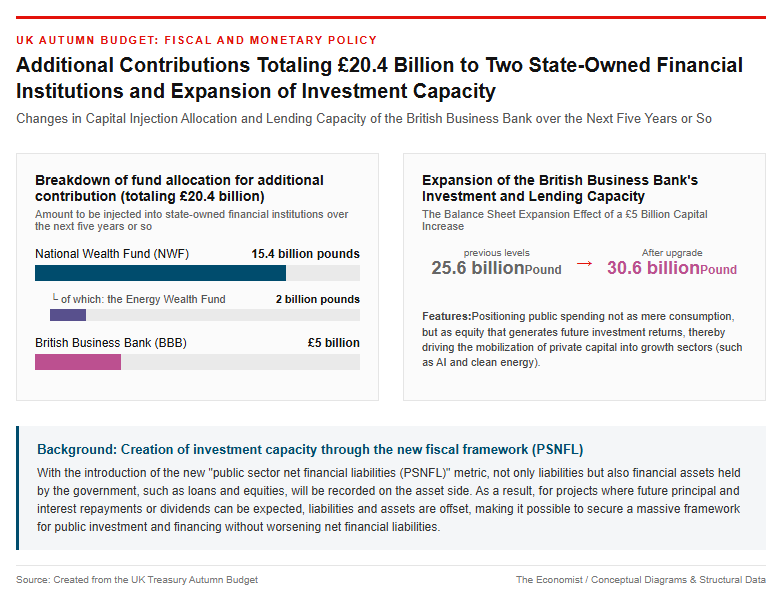
While strictly maintaining the stable rule that routine administrative expenses are covered by recurrent revenues such as tax revenue, the dual-track approach of flexibly permitting borrowing by evaluating asset value for investments that contribute to future growth serves as the logical basis for this £20.4 billion contribution.
Fostering Strategic Industries and the Private Capital Mobilization Mechanism
Strategic Allocation to Clean Energy and Critical Infrastructure
The £15.4 billion allocated to the National Wealth Fund will be intensively directed toward core infrastructure that serves as the intersection of the UK’s goals for decarbonization and the strengthening of industrial competitiveness. The fund originated from the UK Infrastructure Bank, which was established in June 2021, and was reorganized and launched in October 2024 as an organization to promote industrial transition.
The following key sectors have been designated as specific targets for investment and financing.
– Carbon Capture and Storage (CCS) and Green Hydrogen Production Projects
– Development of port infrastructure supporting offshore wind power generation and supply chains
– The construction of battery gigafactories, which is essential for the widespread adoption of electric vehicles
– Modernization of Green Steel Manufacturing Facilities Driving Steel Industry Decarbonization
– Expansion of clean power grids, including the Sizewell C nuclear power plant
According to estimates by the Ministry of Finance, continuous capital investment in these strategic sectors is expected to create or sustain approximately 100,000 high-value-added jobs domestically by 2035. As a core engine of green industrial policy that balances climate change countermeasures and economic growth, the role played by the sovereign wealth fund has become exceptionally significant.
The Catalytic Function for Private Investment via the Crowding-In Effect
The essence of investment and financing by state-owned financial institutions lies not in the government funding the entirety, but in the crowding-in effect of using public funds as a catalyst to draw in private capital. Decarbonization technologies and large-scale infrastructure development involve massive initial investments and high business risks, resulting in market failures where private financial institutions alone struggle to provide long-term funds.
The sovereign wealth fund plays a role in reducing the risk profile to a level acceptable to private investors by utilizing a variety of financial instruments, such as equity co-investments, subordinated loans, credit guarantees, and loans to local governments.
Please refer to the figure below.
By having public institutions absorb initial losses or share long-term risks, an environment is created where massive amounts of dry powder from commercial banks, pension funds, sovereign wealth funds, and other sources can co-invest in the same project. Building a leveraged structure that mobilizes multiples of private money compared to public funds is the key to achieving sustainable infrastructure renewal in the UK under fiscal constraints.
Expansion of Support for Small and Medium-Sized Enterprises and Boosting the Regional Economy
Deployment of Growth Capital and Guarantee Schemes by the British Business Bank
The £5 billion to be invested in the British Business Bank will be allocated to fundamentally improve the funding environment for small and medium-sized enterprises (SMEs), mid-sized businesses, and fast-growing scale-ups in the UK. Since its launch in November 2014, the bank has adopted a unique model that avoids direct lending to businesses, instead supplying funds indirectly through accredited financial institutions and private venture capital firms.
Here are some of the major programs currently underway:
– Growth Guarantee Program in which the government guarantees 70 percent of the loan amount (launched in July 2024)
– The ENABLE Program, which reduces the capital adequacy ratio regulatory burden for partner financial institutions
– The Startup Loans Program Supporting Early-Stage Ventures
– UK Patient Capital Supporting Deep Tech and Advanced Research
With the British Business Bank’s lending capacity expanded to £30.6 billion, the risk appetite of private lenders will be boosted, maintaining the supply of risk capital to growth companies struggling with cash flow in a high-interest-rate environment. In particular, it has become essential infrastructure for providing the long-term funding that R&D-intensive companies in fields like artificial intelligence and biotechnology need to cross the “valley of death.”
Decentralized Regional Investment and Strengthening Innovation Infrastructure
One of the long-standing structural challenges facing the UK economy is the excessive concentration of financial and investment activities in London and South East England, alongside the entrenchment of regional disparities. The British Business Bank is headquartered in Sheffield, in the North of England, and has a strong mandate to deliberately encourage the flow of capital into regional cities and local economies.
The bank has deployed regional investment funds targeting Scotland, Wales, Northern Ireland, and various regions of England in collaboration with regional partners. Through public guarantees and fund-of-funds approaches, it invigorates locally based commercial banks and alternative investors, strongly supporting business startups and capital investments outside the capital region.
Fostering new seeds of innovation in regional manufacturing hubs and former industrial zones is vitally important not only for transforming the industrial structure, but also for achieving inclusive economic growth. The expansion of public finance serves as an indispensable policy instrument to support the maintenance of local employment and the decentralized deployment of advanced industries.
Future Market Impact and Governance Toward Sustainability
Impact on the UK Gilt Market and Responses to Rising Interest Rate Risks
The massive expansion of public investment and lending frameworks will have multifaceted impacts on the macroeconomy and financial markets. Since the government will ultimately fund capital injections into state-owned financial institutions through borrowing, the market remains wary of the additional issuance of medium- and long-term British government bonds (gilts).
Since the fiscal turmoil in the autumn of 2022, market participants have become extremely sensitive to the UK’s fiscal sustainability and moves to increase government bond issuance. Following this announcement, yields on long-term government bonds showed a modest upward trend against the backdrop of increased issuance prospects, but remained within an orderly range. This is because reassurance was provided by the fact that these measures were not reckless pork-barrel spending, but asset-backed investments presented alongside stability rules to balance day-to-day expenditures with tax revenues.
However, amid persistent global high-interest-rate environments and geopolitical tensions, the trajectory of borrowing costs remains unpredictable. Should government funding costs surge beyond expectations, there is a risk that the profitability of overall investment and financing projects will be squeezed, requiring close coordination with the monetary policy of the Bank of England.
Investment Governance and Evaluation Criteria under Financial Transaction Management Frameworks
To prevent investment and financing using public funds from degenerating into loose fiscal management, the UK government has formulated a financial transaction management framework with strict discipline. Under the new rules, extremely high transparency and accountability are imposed on the financial transactions carried out by each institution.
Specifically, the following strict governance standards apply:
– As a general rule, the obligation to achieve risk-adjusted returns that exceed the funding rates and operational costs of UK government bonds
– Proactive provisioning for credit risk and expected losses using an economic capital model comparable to that of commercial banks
– Objective audit by the National Audit Office (NAO) and submission of annual reports to Parliament
– Suitability Review for Market Failures Without Crowding Out Private Investment
– Regular monitoring of investment efficiency by the newly established Value for Money Office
Historically, bank bailouts during past financial crises and emergency guaranteed loans during the COVID-19 pandemic have occasionally resulted in massive public costs and defaults. Whether state-owned financial institutions can maintain independent and professional investment decisions while simultaneously minimizing the public burden and ensuring reliable returns will determine the long-term success or failure of this policy.
Reference page
- 【A strong fiscal framework – GOV.UK】[suspicious link removed]
- 【National Wealth Fund: Mobilising Private Investment – GOV.UK】https://www.gov.uk/government/publications/national-wealth-fund-mobilising-private-investment
- [British Business Bank – Official Website] https://www.british-business-bank.co.uk/
- 【Bank rescues of 2007-09: outcomes and cost – House of Commons Library】https://commonslibrary.parliament.uk/research-briefings/sn05748/
【#UKEconomy #FiscalPolicy #NationalWealthFund #BritishBusinessBank #InfrastructureInvestment #GreenEnergy #Macroeconomics】


コメント