
Rheos Capital Works has announced the launch of a new publicly offered investment trust, “Hifumi Business Investor pro,” which focuses on Japanese companies aiming to grow their corporate value through active investment activities. This launch is driven by two structural changes in the Japanese market: market reforms by the Tokyo Stock Exchange and growth investment guidelines promoted by the Ministry of Economy, Trade and Industry.
- 1-1. Rheos Launches New “Hifumi Business Investor pro”
- 1-2. Basic Concept of the Fund Focusing on “Business Investors”
- 1-3. Fund Management Structure, Costs, and Product Design Mechanism
- 2-1. Tailwinds from TSE Market Reforms and METI’s “Growth Investment Guidelines”
- 2-2. Undervalued Japanese equities and re-evaluation by overseas investors
- 3-1. The role of the “pro” series for individual investors and the expansion of choices
- 3-2. Challenges for revitalizing capital markets and key points to watch going forward
1-1. Rheos Launches New “Hifumi Business Investor pro”
On November 20, 2026, independent asset management company Rheos Capital Works Inc. announced the launch of “Hifumi Business Investor pro,” a new publicly offered investment trust focusing on Japanese companies engaged in active investment activities, and submitted a securities registration statement to the Director of the Kanto Local Finance Bureau on the same day. The initial subscription period is scheduled from December 7 to December 17, 2026, with the launch and commencement of operations planned for December 18, 2026. The fund will be available for purchase through Rheos’ direct sales channel as well as via its distribution partner, SBI SECURITIES Co., Ltd. The defining feature of this fund is that its primary investment targets are a group of companies known as “business investors,” which actively grow their corporate value by executing M&A and business investments using their own cash or external funds. As the Japanese economy undergoes a historic transition from deflation to inflation, the fund was created to support companies that are seriously committed to improving capital efficiency and shareholder value, and to return the fruits of this growth to investors.
1-2. Basic Concept of the Fund Focusing on “Business Investors”
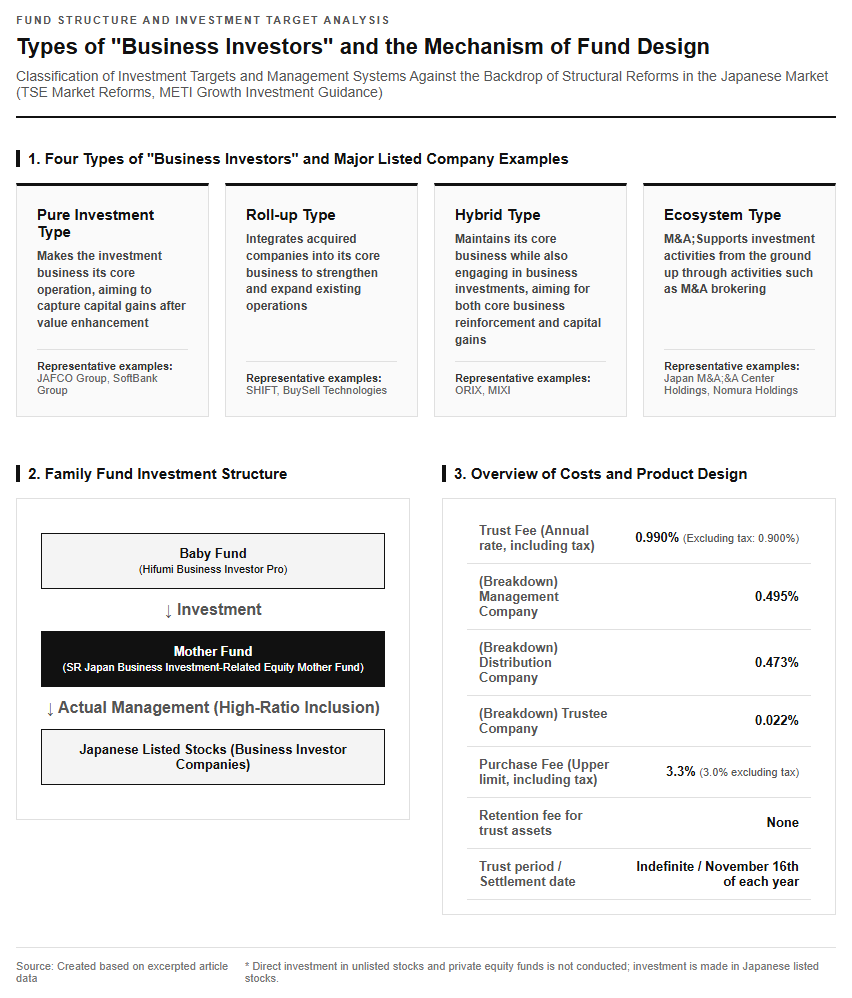
The “business investors” defined by this fund are a group of companies that accelerate their growth through unique investment activities. Specifically, they are classified into the following four types:
- Pure Investment Type: Companies whose core business is investment activities such as fund operations, aiming to generate gains on sale after enhancing value (e.g., JAFCO Group, SoftBank Group).
- Roll-up Type: Companies that incorporate acquired businesses into their own core operations to strengthen and expand their existing business (e.g., SHIFT, BuySell Technologies).
- Hybrid Type: Companies that maintain their core business while also engaging in business investments, aiming for both core business reinforcement and capital gains from sales (e.g., ORIX, MIXI).
- Ecosystem Type: Companies that support the investment activities of business investors from the ground up through services such as M&A intermediaries (e.g., Japan M&A Center Holdings, Nomura Holdings).
While the fund makes selective investments in these groups of companies, it is designed not to make direct investments in unlisted stocks or private equity funds, but rather to incorporate Japanese listed stocks and other assets that invest in unlisted companies.
1-3. Fund Management Structure, Costs, and Product Design Mechanism
“Hifumi Business Investor pro” adopts a family fund structure, in which funds from a baby fund are invested in the “SR Japan Business Investment Related Stock Mother Fund” for practical management. The policy is to maintain a high ratio of actual stock investments in principle. The trust fee, which serves as the operational management cost, is set at 0.990% annually (0.900% excluding tax) of the total net assets, allocated as 0.495% annually to the management company, 0.473% annually to the distribution company, and 0.022% annually to the trustee company. The purchase fee is determined by the distribution company up to a limit of 3.3% (3.0% excluding tax) of the application amount, and there are no retention fees for trust property. The trust period is indefinite, and the settlement date is November 16 of each year (the first settlement date is November 16, 2027). Shota Watanabe, a veteran fund manager with approximately 30 years of experience in Japanese stock research and management, has been appointed as the investment manager, utilizing his expertise in small- and medium-cap growth stocks.
2. Background of the Launch and Structural Changes in the Japanese Market
2-1. Tailwinds from TSE Market Reforms and METI’s “Growth Investment Guidelines”
The launch of this fund is underpinned by two major reforms surrounding Japan’s capital markets and corporate management. The first is market reform driven by the Tokyo Stock Exchange’s request for “management conscious of capital costs and stock prices.” Prompted by the TSE’s request, listed companies have begun shifting toward improving capital efficiency, enhancing shareholder returns, and making proactive growth investments. The second is the “Growth Investment Guidelines” published by the Ministry of Economy, Trade and Industry in July 2026. These guidelines clearly outline the promotion of new business development and M&A, in addition to capital expenditures, R&D, and investments in human capital. These public-private structural reforms serve as a powerful tailwind for companies that effectively allocate their management resources and cash to M&A and business investments. Please refer to the figure below for an illustration of the synergistic effects between market reforms and corporate reforms.
Under this environment, the presence of business investors who enhance their own corporate value through investment activities is growing ever more prominent.
2-2. Undervalued Japanese equities and re-evaluation by overseas investors
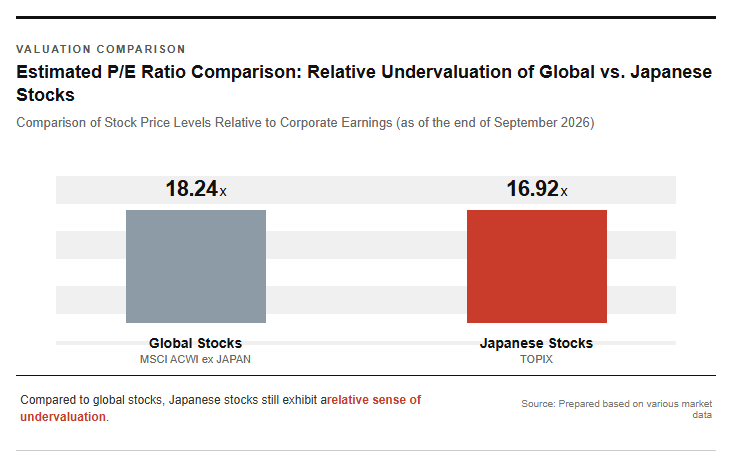
In the current Japanese stock market, net buying by overseas investors—who have evaluated initiatives such as the Tokyo Stock Exchange reforms—has continued since 2023, showing an upward trend in stock prices. However, compared with global equities, Japanese stocks still retain a relative sense of being undervalued. Comparing the projected P/E ratios as of the end of September 2026, global stocks (MSCI ACWI ex JAPAN) stand at 18.24x, whereas Japanese stocks (TOPIX) remain at 16.92x, presenting an abundance of attractive investment opportunities. Furthermore, it is a crucial factor that the Japanese economy has broken free from its prolonged deflation and transitioned into an inflationary economy. As corporate capital investment and business restructuring through M&A accelerate, leading to a widening polarization between growth-oriented and stagnant companies, investing in business investors with superior investment judgment serves as an effective means to ride the wave of the overall revitalization of Japanese equities. In addition, a new ecosystem blending the abundant management resources of large corporations with startup innovation is also emerging, supporting the revitalization of the Japanese market.
3. Impact on investors and mid- to long-term outlook
3-1. The role of the “pro” series for individual investors and the expansion of choices
Rheos Capital Works has organized its lineup of funds into a “basic” series aimed at beginners and a “pro” series designed to pursue the deeper appeal and rewarding experience of investing. While flagship offerings such as “Hifumi Tohshin” and “Hifumi World” serve as core investments forming the axis of asset formation, the “pro” series is positioned for satellite investments seeking high returns or distinct thematic focus. To date, the company has deployed “Hifumi Crossover pro” (launched in September 2024), which invests across both unlisted and listed stocks, and “Hifumi Policy Drive pro” (launched in July 2026), which focuses on the government’s priority investment areas. With the addition of the new “Hifumi Business Investor pro,” individual investors will have access to more diverse and active investment options tailored to their own risk tolerance and interests. Please refer to the figure below for an example of a portfolio showing the balance between risk and return.
3-2. Challenges for revitalizing capital markets and key points to watch going forward
Meanwhile, Rheos Capital Works has decided to change its trade name to “SBI Rheos Capital Works Co., Ltd.” effective December 1, 2026, with a policy of further strengthening collaboration with its parent company, the SBI Group. Following the commencement of fund management on December 18, 2026, the primary focus going forward will be on what kinds of stocks the fund incorporates and whether it can achieve performance that outpaces the market average. Challenges include the M&A success rate of each business investor, the execution capability of post-merger integration (PMI), and the impact of funding costs associated with changes in the interest rate environment. Even so, the fund’s efforts to enhance the growth potential of Japanese companies as a whole through the efficient allocation of capital are expected to help create a virtuous cycle between household asset formation and corporate growth. For investors, this will be a valuable opportunity to participate—through investment—not merely in stock trading, but in the transformation and re-growth of Japanese companies.
Reference Pages
- [Focusing on “Business Investors,” Corporate Investors Capturing Japan’s Structural Changes! Notice of New Fund Launch for “Hifumi Business Investor pro” – PR TIMES] https://prtimes.jp/main/html/rd/p/000000182.000049166.html
- [Rheos Capital Works Co., Ltd. Official Website] https://www.rheos.jp/
[#RheosCapitalWorks #HifumiBusinessInvestorPro #InvestmentTrust #JapaneseStocks #BusinessInvestor #NewFund #AssetManagement #MA]


コメント