
In July 2026, the U.S. Bitcoin and Ethereum spot ETFs curbed eight weeks of outflows, turning to excess inflows. This is due to a fading in expectations of interest rate hikes due to weak U.S. labor market data, as well as tactical asset reshuffling by institutional investors.
- 0 million in inflows over three days that curbed serious outflows
- Tactical rotation and asset diversification by institutional investors
- New liquidity brought in by a softening labor market
- Price adjustments due to geopolitical tensions and soaring crude oil prices
- Consumer Price Index (CPI) and FOMC Trends
- Expectations for U.S. SEC regulatory deregulation of ‘crypto regulation’
0 million in inflows over three days that curbed serious outflows
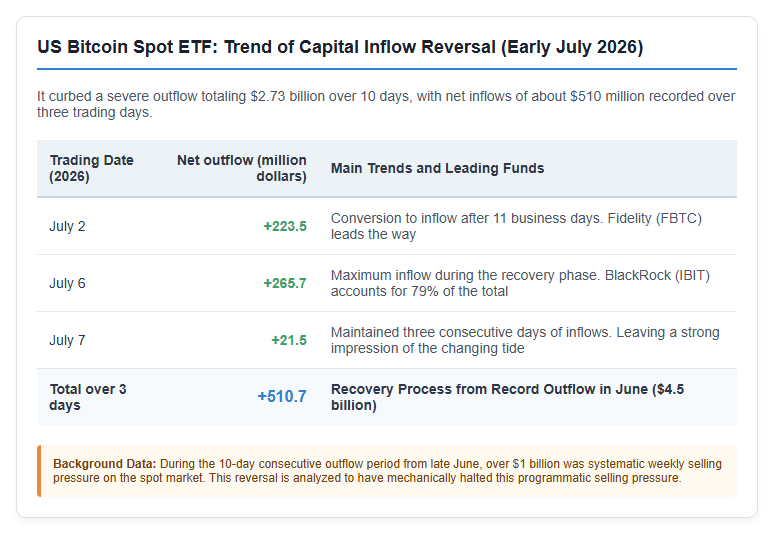
In July 2026, the severe outflow trend that had lasted for 10 days in the U.S. spot Bitcoin ETF market has finally reversed. According to data from Farside Investors, a total net inflow of approximately $510 million was recorded over the three trading days from July 2 to July 7. Notably, on July 2, Fidelity’s FBTC recorded inflows of $166 million and ARK’s ARKB recorded $91.8 million, halting the chain of outflows. With a record-high outflow of $4.5 billion in a single month in June, this reversal marked a major turning point for the market. Year-to-date net outflows have reached approximately $5.4 billion, but this move suggests that institutional investor demand may be beginning to recover again. Among them, BlackRock’s IBIT recorded an inflow of $209.4 million on July 6, which is regarded as an important signal of increased confidence among major investors. Please refer to the diagram below.
Tactical rotation and asset diversification by institutional investors
Ethereum ETFs are also showing signs of breaking free from eight weeks of continuous outflows. Notably, on July 8, the market outflow of $84.9 million from Bitcoin ETFs was confirmed, while net inflows of $70.5 million were confirmed to Ethereum ETFs. Most of this inflow came from Fidelity’s FETH, with single-day inflows reaching $69.2 million. This highlighted a “tactical rotation” where institutional investor interest diversified beyond Bitcoin into other major assets. Also, even during periods of Bitcoin outflows, funds were selectively flowing into altcoin ETFs such as XRP and Solana (SOL). XRP ETFs will record the highest monthly inflows in May 2026, and Solana ETFs will also exceed $1 billion in assets, reflecting persistent demand for certain protocols. The current ETF market is less a broad recovery and more a fragmented structure where investors carefully select and reallocate specific assets.
[Impact on Markets and Economy] Changes in Macro Indicators and Geopolitical Risks
New liquidity brought in by a softening labor market
The resumption of capital inflows was supported by weak U.S. macroeconomic indicators. Nonfarm payrolls (NFP) for June 2026 increased by only 57,000, significantly below market expectations. Additionally, the unemployment rate has risen to 4.2%. Following this disappointing labor indicator, concerns about continued rate hikes by the U.S. Federal Reserve (FRB) have sharply diminished. As a result, U.S. Treasury yields have declined, and the dollar has weakened, effectively reducing the holding costs of crypto assets, which do not generate interest. Market attention has already shifted to the September FOMC, and risk-appetite anticipating easing financial conditions is once again injecting liquidity and vitality into the crypto ecosystem. Institutional investors expect that a softening labor market will lead to easing inflationary pressures and are looking for opportunities to strategically restructure exposure to risk assets, including Bitcoin.
Price adjustments due to geopolitical tensions and soaring crude oil prices
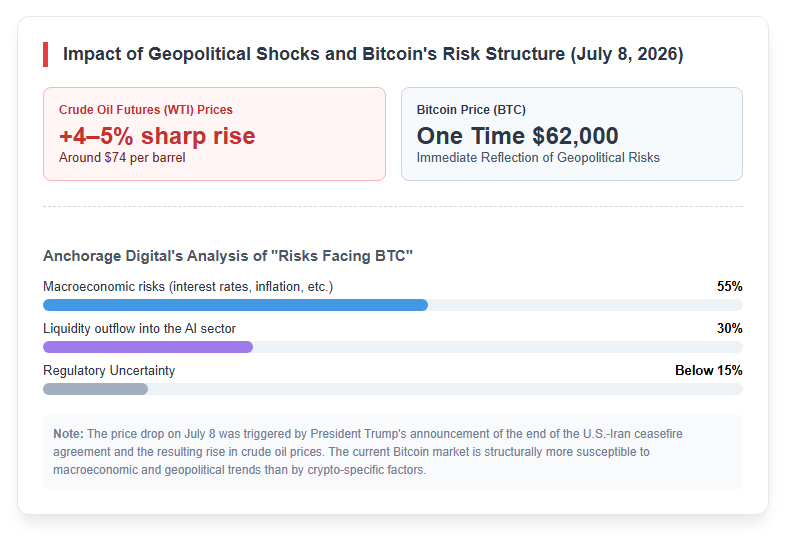
Although the market is on a recovery trend, geopolitical uncertainties weigh on the market. On July 8, reports of airstrike exchanges between the United States and Iran surfaced, and tensions rose sharply after President Trump declared the end of the ceasefire agreement. Following this report, WTI crude oil futures prices surged by about 4–5%, rising to around $74 per barrel. Since the crypto asset market operates 24 hours a day, this geopolitical risk was immediately priced in, causing Bitcoin’s price to plummet to around $62,000 at one point. According to analysis by Anchorage Digital, about 55% of the risks currently facing Bitcoin stem from macroeconomic factors. The resurgence of inflation concerns arising from rising oil prices could once again cast uncertainty into expectations for rate hikes, which are just beginning to calm down. Amid a complex mix of tailwinds of expectations for slowing inflation and headwinds of geopolitical pressure, investors remain cautious. Please refer to the diagram below.
[Future Developments & Key Points] An important milestone toward trend confirmation
Consumer Price Index (CPI) and FOMC Trends
To confirm a sustained trend reversal, the release of key upcoming economic indicators will be key. The first to watch is the Consumer Price Index (CPI) for June, to be released on July 14. If this results are weaker than market expectations, it could reinforce the employment data signals and solidify expectations for the Fed to hold rates steady. Conversely, if strong figures appear, concerns about rate hikes could reignite, potentially causing the momentum of this capital inflow to be lost. Furthermore, from July 28 to 29, the FOMC will be held under the new Chair Walsh. With many members supporting additional rate hikes within the year, the forward guidance the chair provides will greatly influence the sustainability of future capital inflows. Analysts point out that maintaining daily inflows exceeding $150 million for several consecutive days is a condition for a full-fledged trend reversal.
Expectations for U.S. SEC regulatory deregulation of ‘crypto regulation’
Establishing a regulatory environment is also a key factor accelerating institutional investor adoption going forward. In July 2026, the U.S. Securities and Exchange Commission (SEC) indicated plans to propose new rules for crypto assets, called “Regulation Crypto,” within this month. This is centered on temporary exemptions for crypto developers from securities registration and the creation of safe harbors for issuers, which are expected to bring greater certainty to the market. In Europe, the transitional measures for the comprehensive crypto asset regulation “MiCA” ended on July 1, clarifying the legal framework. In the U.S., the CLARITY bill, which enjoys bipartisan support, is estimated to have a 53% chance of passage within this year, and if these regulations progress, they could lead to the restoration of institutional investor confidence and full-scale market entry. In the current market structure, where ETF capital outflows account for about 45% of price fluctuations, regulatory reassurance will be essential infrastructure supporting sustained capital inflows.
[#ビットコイン #イーサリアム #仮想通貨ETF #機関投資家 #金融政策 #米経済指標 #資産運用 #暗号資産]


コメント