
Honda has announced the world premiere of its new large SUV, the “Avancier,” with a scheduled release in Japan in the spring of 2027. Amid a review of its four-wheel electrification strategy following a slowdown in EV demand primarily in North America, this flagship model symbolizes a business structure shift centered on next-generation hybrid vehicles as its main pillar.
- Born as the first of the new-generation hybrid series, this is one of Japan’s largest SUVs.
- Unlocking the “Blank Space” in the Domestic SUV Market and Revamping the Brand Image
- Freezing North American EVs and Steering Back toward Hybrids
- Footsteps of the Hybrid Shift as Seen in Upwardly Revised Earnings Forecasts
- Modular Structure Achieving 70% Parts Sharing and “DualPower eAWD”
- Next-Generation Cabin Space Created by Google Gemini and OTA
Born as the first of the new-generation hybrid series, this is one of Japan’s largest SUVs.
On November 20, 2026, Honda Motor Co., Ltd. announced the world premiere of the new large SUV “Avancier,” equipped with a next-generation hybrid system, and slated for release in the Japanese market in the spring of 2027. Produced at a manufacturing base in Thailand, the model will be launched locally before rolling out sequentially across the Asia-Pacific region, including Japan, China, and Australia. The vehicle reaches an overall length of approximately 5 meters and adopts a 3-row, 6-seater layout (2+2+2). It takes the helm as the ultimate flagship in Honda’s domestic SUV lineup, surpassing its bestselling “CR-V” in sheer vehicle class. The front fascia features a revamped “H-mark” applied for the first time to a next-generation hybrid vehicle, incorporating slim multi-function lights and a “subtractive design” with a narrowed-down grille opening. The vehicle body structure utilizes a newly developed modular platform, and the estimated price range is projected to exceed 7 million yen. The figure below illustrates the exterior design and vehicle packaging of the Avancier.
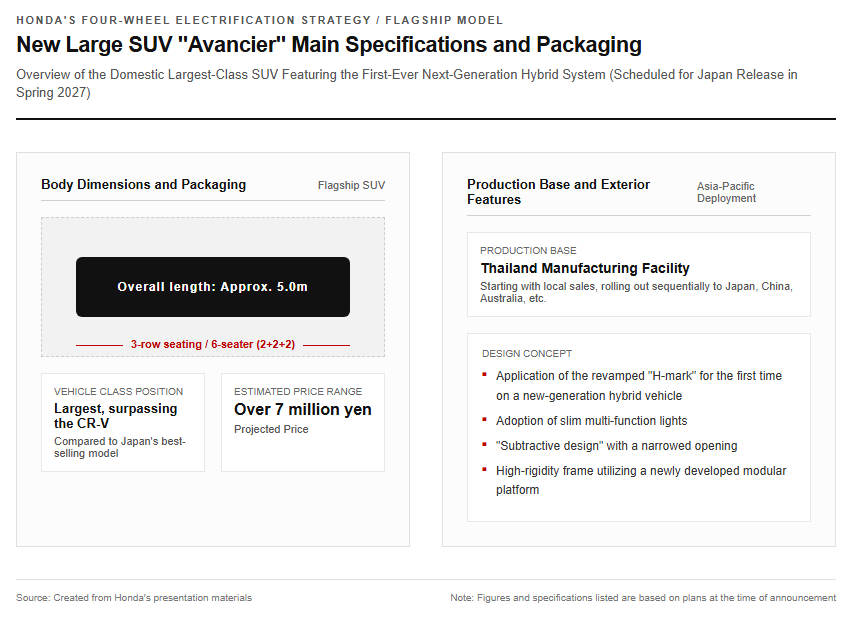
Pursuing high interior/exterior quality and quietness, this vehicle presents a new vision of premium mobility envisioned by Honda.
Unlocking the “Blank Space” in the Domestic SUV Market and Revamping the Brand Image
Behind Honda’s introduction of a top-tier model exceeding 7 million yen to the Japanese market lies the strategic intent to eliminate gaps in its domestic SUV product lineup and rebuild its brand image. Currently, Honda’s share of the domestic SUV market stands at a mere 9.8%, significantly trailing the 14.4% share it holds across its overall four-wheel vehicle business. Meanwhile, large-size SUVs represent a growing segment accounting to 15.8% of the entire domestic SUV market, and the lack of a stepping-stone option for existing customers in their 40s and 50s seeking a vehicle class above the CR-V had long been identified as an issue. Furthermore, while the historic blockbuster success of the “N-BOX” mini-vehicle introduced in 2011 supported the company’s financial performance, it also had the side effect of reinforcing the stereotype among consumers that “Honda equals a low-price brand.” Introducing the refined Avancier into the high-priced segment crowded by rival models such as the Mazda “CX-80” and Mitsubishi “Outlander PHEV” plays a crucial role not merely in securing sales volume, but in elevating the brand’s overall premium value and profitability.
A Major Pivot Away from the EV Stall and the Economic Background of the Next-Gen HV Strategy
Freezing North American EVs and Steering Back toward Hybrids
The arrival of the Avancier symbolizes a dramatic course correction in Honda’s pursued four-wheel electrification strategy. In response to sluggish EV demand and a review of environmental regulations in North America, the company made the decision to freeze plans to introduce next-generation EVs for North America (such as the “0 Saloon” and “0 SUV”), into which it had poured massive development costs. Along with this, it has clarified its policy of reallocating management resources from electric vehicles to next-generation hybrid vehicles (HVs). Under the new plan, 15 models equipped with next-generation “Honda Hybrid” technology—which reduces system costs by over 30% and improves fuel efficiency by over 10% compared to 2023 levels—will be launched globally by fiscal 2029. The Avancier serves as the first model in this series, followed by a new HV-only North American “CR-V” model in 2027, and horizontal deployment to the compact SUV “Vezel” planned for 2028 and beyond. To counter Toyota Motor’s hybrid offensive and the rise of Chinese manufacturers in its main battlegrounds of North America and Asia, Honda is pushing back with the cost competitiveness and product appeal of its hybrid technology at the forefront.
Footsteps of the Hybrid Shift as Seen in Upwardly Revised Earnings Forecasts
Despite going through the recording of impairment losses in its EV business, Honda’s current financial performance is showing a strong recovery driven by strong sales in hybrid vehicles and the motorcycle business. In an upward revision of consolidated earnings forecasts for the fiscal year ending March 2027 announced on November 10, 2026, net sales were raised from the previous forecast of 24.15 trillion yen to 24.4 trillion yen (an 11.9% increase year-over-year), while operating income was lifted from 650.0 billion yen to 780.0 billion yen. Driving this earnings improvement are the motorcycle business, which is recording record-breaking sales paces in India and Brazil, alongside increasing demand for compact cars and hybrid vehicles in the North American market. The four-wheel sales outlook in North America was revised upward from 1.705 million units to 1.735 million units. The figure below is an image representing the company’s revenue structure by business segment and investment allocation toward the HV shift.
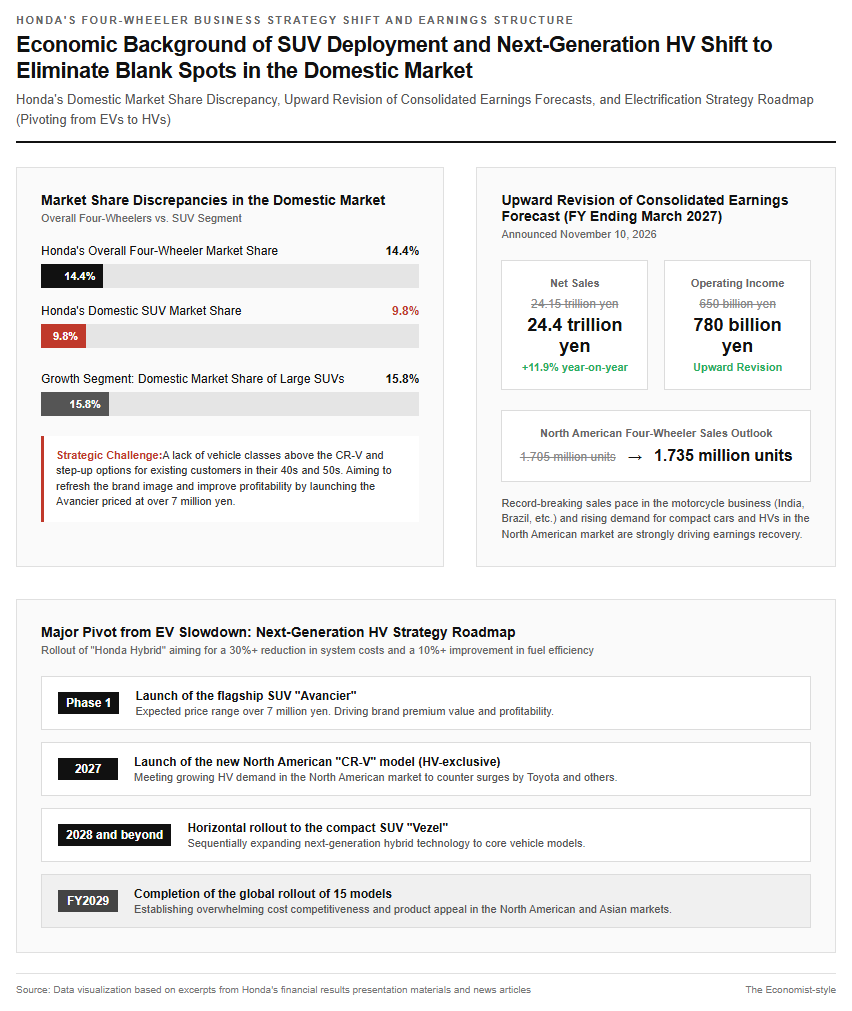
A virtuous cycle is being established in which abundant cash generated from the motorcycle business and solid earnings from North American hybrids serve as the capital source to drive investments in next-generation platforms and software, giving the introduction of the Avancier the significance of a demonstration project for this business turnaround scenario.
Competitiveness Brought by Modular Foundations and Digital Technology
Modular Structure Achieving 70% Parts Sharing and “DualPower eAWD”
The Avancier condenses the latest technologies that will form the backbone of future Honda vehicle development. The body platform adopts a newly developed modular architecture consisting of five total modules, including the engine room and cockpit underbody. Whereas parts sharing in conventional platforms remained at under 40%, this foundation achieves a dramatic sharing rate of approximately 70%. This reduces vehicle weight by about 90 kg and cuts manufacturing costs by roughly 10%, while enabling flexible vehicle deployment ranging from sedans to large SUVs. The powertrain combines a 2.0-liter inline 4-cylinder engine with a newly developed high-output motor utilizing heavy rare-earth-free magnets, while the drive system features the world’s first deployment of “DualPower eAWD,” an electric four-wheel-drive system with independent front and rear motor control that eliminates the propeller shaft. By controlling front and rear driving force distribution in real time according to road surface conditions and steering, it delivers “silky dynamics”—a smooth, powerful ride that prevents the vehicle from pitching forward.
Next-Generation Cabin Space Created by Google Gemini and OTA
Evolution as a next-generation software-defined vehicle (SDV) is also a major feature of the Avancier. A large 15.4-inch display is positioned in the center of the instrument panel, building a minimalist interface that eliminates physical switches as much as possible. Adopting Google built-in, the vehicle comes standard with the conversational generative AI “Google Gemini” as an in-vehicle AI assistant. It provides an intelligent mobility experience that goes beyond natural voice-based destination searches and air conditioning controls, handling tasks such as suggesting restaurants at travel destinations and acting as an English conversation partner. Furthermore, it introduces a mechanism where in-vehicle software and connected functions are sequentially updated via over-the-air (OTA) communication even after purchase, adding new features. The second-row seats feature limousine-class legroom, seat ventilation, and armrests with built-in touch panels, creating a hospitable cabin space called “MyCabin.” The results of this model, which fuses technological innovation and intelligence, will serve as an indicator for Honda’s future global deployment.
Reference Pages
- [World Premiere of the All-New “AVANCIER” SUV – Featuring the Next-Generation Honda Hybrid System and New H-Mark –] https://global.honda/jp/news/2026/4261120.html
- [AVANCIER Advance Information Site | Honda Official Website] https://www.honda.co.jp/AVANCIER/new/
[#Honda #Avancier #NextGenHybrid #SUV #AutomotiveBusiness #EarningsUpwardRevision #ModularPlatform #Gemini]


コメント