Driven by a wave of new “semiconductor high school” openings and curriculum overhauls, South Korea is experiencing a massive rush of applicants. Behind this trend lies the generative AI boom, record corporate profits, and lucrative performance bonuses at major semiconductor firms, sparking a structural shift in student choices from traditional academic credentials toward practical career pathways.
- The Rush to Open Semiconductor High Schools and the Applicant Surge
- Changing Priorities in an Academic-Driven Society Attract The New York Times’ Spotlight
- The AI Boom and Sky-High Compensation at Semiconductor Giants
- The Government’s Semiconductor Special Act and the 150,000 Talent Strategy
- Capital-Intensive Challenges and the Trickle-Down Gap for Suppliers
- Silicon Cycles and Key Considerations for Future Workforce Policy
The Rush to Open Semiconductor High Schools and the Applicant Surge
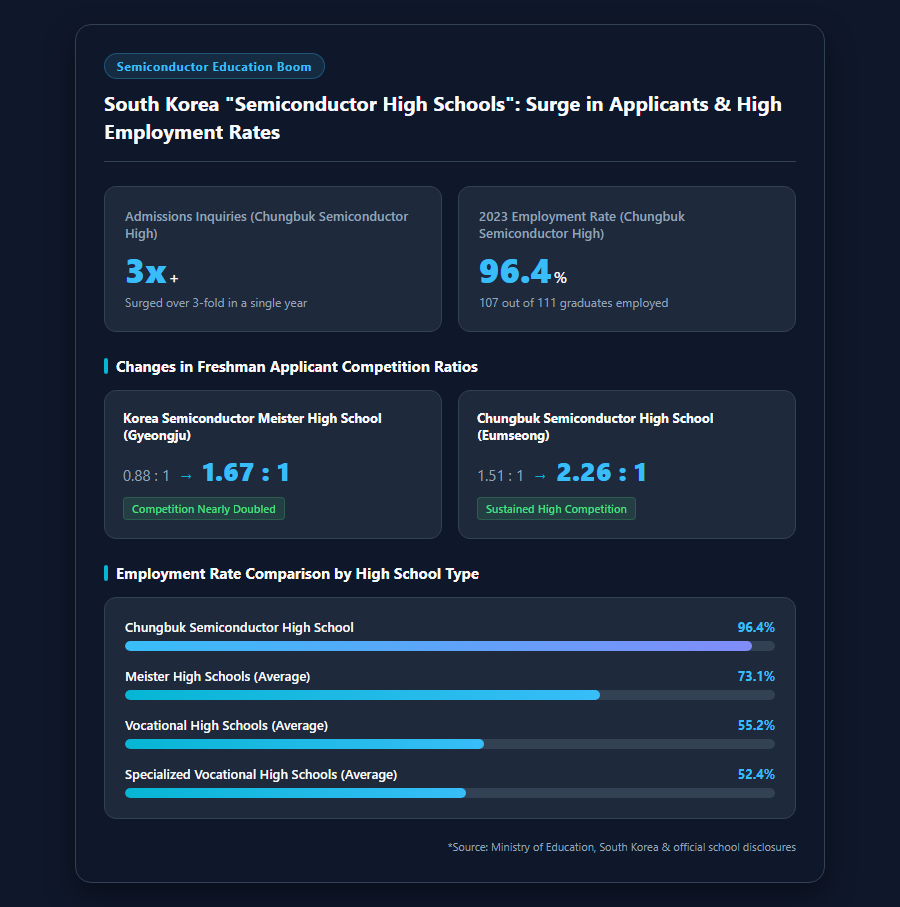
Across South Korea, the establishment of high schools specialized in training semiconductor technicians and the restructuring of existing vocational departments are surging. Chungbuk Semiconductor High School, located in Eumseong County, North Chungcheong Province, is the nation’s oldest semiconductor Meister high school. Equipped with dormitories for all 300 students and six simulated practical training facilities, it recorded an extraordinary employment rate of 96.4% among its 2023 graduates. Admissions inquiries to the school have more than tripled in a single year, leaving administrators overwhelmed. Meanwhile, in Yongin, Gyeonggi Province, construction is underway for Yongin Semiconductor High School, targeting an opening in March 2027. Featuring an initial capacity of 96 students across departments in semiconductor manufacturing and maintenance, the school plans to transition into an official Meister high school starting in academic year 2028. The Yongin Educational Support Office receives over 20 inquiry calls daily, prompting the creation of a dedicated FAQ board on its official website. Similarly, the applicant competition ratio at Korea Semiconductor Meister High School in Gyeongju, North Gyeongsang Province, nearly doubled from 0.88:1 to 1.67:1 year-over-year. In Seoul, Seoul Semiconductor High School—formerly Hwigyeong Technical High School—is also preparing to open in March 2027. Generous state support, including tuition-free education and fully subsidized dormitories, alongside direct partnership programs with major chipmakers, are key drivers attracting middle school students and parents alike.
Changing Priorities in an Academic-Driven Society Attract The New York Times’ Spotlight
On June 27, 2026, the prominent U.S. daily The New York Times featured Chungbuk Semiconductor High School in a detailed report highlighting how the unprecedented semiconductor boom is reshaping South Korean education. In South Korea’s traditionally degree-obsessed society, graduating from a prestigious four-year university and landing a corporate job was long considered the standard path to success. In recent years, however, specialized vocational and Meister high schools have gained rapid recognition as pragmatic, express routes to corporate employment without requiring a college degree. In an interview with the newspaper, Principal Seo Eun-seok noted, “Our school seems to have become the hottest school in Korea right now.” Students prepare intensely for corporate recruitment exams, studying from 9 a.m. to 9 p.m. daily for a month in advance, with top academic performers securing corporate scholarships and internship qualifications while still in school. Returning young alumni who visit their alma mater to share stories of earning hundreds of millions of won in performance bonuses—often generously picking up the tab for their juniors—serve as powerful motivators. Conversely, the principal candidly confessed to mixed emotions upon hearing former students describe earning bonuses in a single year that exceed a veteran teacher’s annual salary. The image below shows students engaged in hands-on training using state-of-the-art facilities.
Drivers of the Industry Boom and the Battle for Talent
The AI Boom and Sky-High Compensation at Semiconductor Giants
The primary driver focusing student and parental attention on semiconductor high schools is the explosive demand for High Bandwidth Memory (HBM) spurred by the generative AI boom, along with the extraordinary compensation packages offered by semiconductor giants. South Korean chipmakers, led by Samsung Electronics and SK Hynix, are posting record-breaking earnings. Notably, at SK Hynix, recruits under the age of 30 accounted for 80% of new hires, with starting monthly salaries reaching 4.505 million won (approximately \$3,300), equivalent to 215% of the national minimum wage. Annual performance bonuses per employee are projected to reach 600 million to 700 million won (\$440,000 to \$510,000), keeping the voluntary turnover rate among employees in their 20s at a remarkably low 0.5%. Landing a position with such lucrative compensation is widely likened to “winning the lottery.” The ripple effects of this industry prosperity are even reshaping higher education admissions. In the 2027 academic year early admissions, applications to semiconductor contract departments at Yonsei University and Korea University increased by 5.2% year-over-year. Conversely, medical school applications across Seoul National University, Yonsei University, and Korea University dropped by 11.3%. This suggests a subtle easing of the nation’s chronic obsession with medical school, as top-tier science and engineering talent shifts toward semiconductor programs that offer guaranteed corporate placement and high compensation.
The Government’s Semiconductor Special Act and the 150,000 Talent Strategy
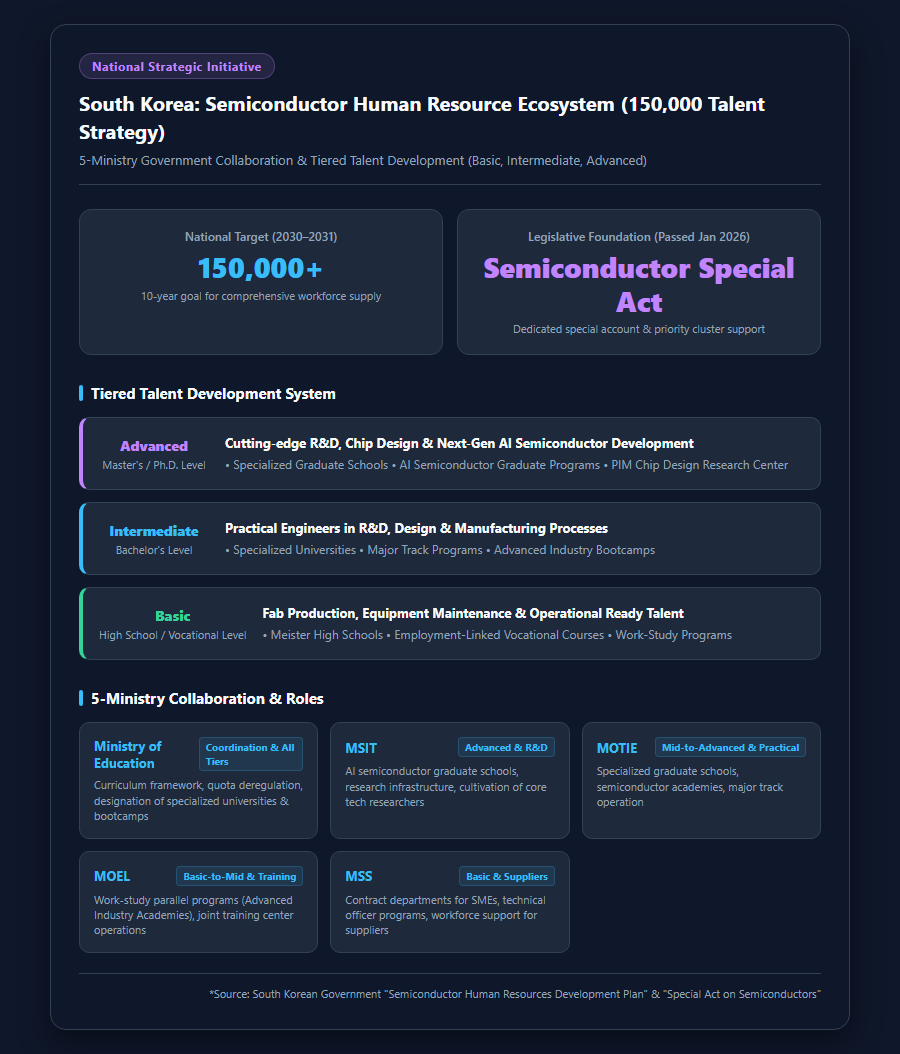
Underpinning the fervor in educational institutions is robust state-level policy support. In July 2022, the South Korean government announced its “Semiconductor Human Resources Development Plan,” setting a national goal to train over 150,000 semiconductor specialists over a 10-year period through 2030–2031. Furthermore, on January 29, 2026, the National Assembly passed the “Special Act on Semiconductors,” establishing an institutional framework that includes a Presidential Special Committee on Semiconductor Competitiveness, a dedicated 10-year special account, and prioritized infrastructure support—such as electricity, water, and road networks—for the Yongin Semiconductor Cluster. Led by the government, five key ministries—the Ministry of Education, the Ministry of Science and ICT, the Ministry of Trade, Industry and Energy, the Ministry of Employment and Labor, and the Ministry of SMEs and Startups—are collaborating to deploy tiered talent development initiatives spanning basic, intermediate, and advanced levels. At the high school level, practical field talent is cultivated through employment-linked vocational courses and work-study programs, while university-level support targets advanced research talent through specialized semiconductor universities, bootcamps, and graduate school grants. The diagram below illustrates an overview of the talent development ecosystem spearheaded jointly by the government and industry.
Structural Uncertainties and the Outlook Ahead
Capital-Intensive Challenges and the Trickle-Down Gap for Suppliers
Behind the glittering prosperity of the semiconductor boom lie structural challenges and uncertain long-term employment prospects. Under its vision for the world-leading Yongin Semiconductor Cluster, the South Korean government announced that Samsung Electronics would create 60,000 new jobs over five years, while SK Hynix would add up to 20,000 jobs annually. However, industry experts express skepticism regarding the feasibility of these hiring targets. Semiconductor manufacturing is a capital-intensive rather than a labor-intensive industry; as automation, AI, and robotics advance across fabrication lines, overall labor requirements per facility may actually decline. Furthermore, the trickle-down benefits of record corporate earnings have largely failed to reach secondary suppliers and subcontractors. An executive at XT, an equipment maintenance supplier for Samsung Electronics, expressed anxiety over future job security, noting that the introduction of advanced equipment with automated self-cleaning features could eliminate existing maintenance roles. Coupled with a stark wage disparity between major chipmakers paying massive bonuses and small-to-medium suppliers, a dual structure is emerging, marked by uneven talent distribution and acute hiring shortages among subcontractors.
Silicon Cycles and Key Considerations for Future Workforce Policy
The most critical variable shaping the industry’s future is the cyclical nature of the memory market (the “silicon cycle”) alongside intensifying global competition. While high-value memory chips are selling rapidly to meet AI data center demands, the market remains vulnerable to sharp price collapses whenever supply overtakes demand. Simultaneously, Chinese chipmakers such as ChangXin Memory Technologies (CXMT) are aggressively expanding legacy memory production and pursuing IPO-funded investments backed by massive government subsidies, driving down prices for commodity DRAM. If a cyclical downturn coincides with the graduation of students currently entering semiconductor programs, a structural mismatch and oversupply of specialized labor could occur. Moreover, concerns exist that if high school vocational education remains limited to training basic fab operators rather than advancing students toward high-value design and R&D capabilities utilizing AI and CAD tools, graduates may struggle to adapt to future technological shifts. Whether South Korea’s semiconductor high school surge proves to be a temporary bubble or a sustainable engine for national competitiveness will depend on closing the gap between primary manufacturers and suppliers, alongside developing flexible educational curricula resilient to market fluctuations.
References
-
[Status and Realities of Semiconductor Human Resource Development Measures in South Korea – Science Portal Asia Pacific] https://spap.jst.go.jp/investigation/report.html
-
[Enactment of the Special Act on Semiconductors to Establish Institutional Foundations for Systematic Support (South Korea) – JETRO] https://www.jetro.go.jp/biznews/2026/02/9c41bd500c4d4b21.html
[#SouthKorea #SemiconductorHighSchool #MeisterHighSchool #AIBoom #TalentDevelopment #SKhynix #SamsungElectronics]

コメント