
US semiconductor giant Nvidia announced the return of CEO Jensen Huang, causing its stock price to briefly surge by 33%. The move was driven by the easing of national security risk concerns through discussions with high-ranking US government officials, as well as strong demands for his return from investors and the industry.
- Announcement of Jensen Huang’s Return and the Dramatic Stock Market Reaction
- Background of the Resignation and Sequence of Events Surrounding National Security Allegations
- Unanimous Approval by the Board of Directors and Involvement of the US Administration
- Governance Strengthening Measures and Newly Established Compliance Framework
- Record-High Revenue and Rapid Growth in the Data Center Business
- Corporate Organizational Transformation and Key Points to Watch in the Future AI Market
Announcement of Jensen Huang’s Return and the Dramatic Stock Market Reaction
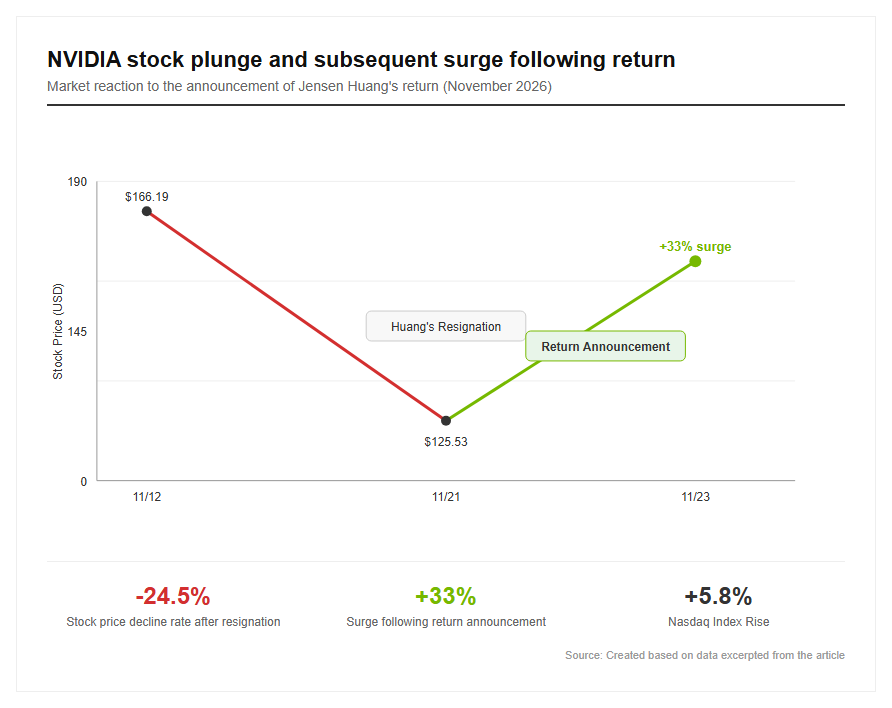
On November 23, 2026, US semiconductor giant Nvidia announced that co-founder Jensen Huang would return as President, Chief Executive Officer, and Director, effective immediately. Following this blitz announcement of his return just 11 days after his abrupt resignation on November 12, the company’s stock experienced a temporary surge of over 33% compared to the previous day on the US stock market, sending massive shockwaves through the market. Since Huang’s resignation, Nvidia’s stock had plummeted from a closing price of $166.19 on November 12 to $125.53 on November 21, wiping out hundreds of billions of dollars in market capitalization and spreading turmoil caused by the absence of top leadership throughout the entire stock market.
In the wake of this return, the US Nasdaq Composite Index, which had temporarily declined, rose by 5.8%, and the S&P 500 Index rose by 3.9%, spreading strong buying momentum across the broader market, centered on tech stocks and AI infrastructure-related shares. Chief Financial Officer Colette Kress, who served as interim CEO during his absence, returned to her original financial oversight role, and Harvey Jones will continue to serve as Chairman of the Board of Directors. The market is feeling reassured that the founder’s return will put the growth story of the entire generative AI ecosystem—which the company has spearheaded—back on track. As shown in the image placeholder below, the market has demonstrated a rapid stock price recovery.
Background of the Resignation and Sequence of Events Surrounding National Security Allegations
The immediate catalyst for Huang’s resignation was news coverage surrounding his personal life and the resulting national security concerns. In early November, it was reported that Huang had extramarital affairs with a female businesswoman and a corporate executive suspected of having ties to a foreign intelligence agency, raising doubts about corporate governance and the handling of confidential information. On November 8, Nvidia’s board of directors established a special investigation committee consisting of independent directors, engaging former Acting US Attorney June Kim and a law firm to launch an independent investigation.
Furthermore, investigations by US government authorities were underway regarding suspected illicit resales of advanced semiconductors to China and circular exports via shell companies, creating a situation where the US Securities and Exchange Commission and the Department of Justice were closely monitoring the company’s compliance system. Concerns regarding the lack of a successor surfaced following Huang’s resignation, bringing to light the risk of the company’s long-standing over-reliance on its CEO. However, Huang’s active cooperation with the investigation, alongside his expressions of remorse and apologies after resigning and his willingness to return, served as stepping stones for this early comeback.
Board of Directors’ Decision and Developments Involving the US Government and Industry
Unanimous Approval by the Board of Directors and Involvement of the US Administration
Following multiple discussions with Huang and hearing opinions from high-ranking US government officials, Nvidia’s board of directors unanimously approved his return. In an official statement, the board re-evaluated Huang’s candid attitude and management capabilities, explaining that, based on the results of discussions with the US government, they concluded his return does not pose any national security risks. Initially, Chairman Jones had stated that there was no intention to bring Huang back, but a dramatic shift in policy occurred in a short period.
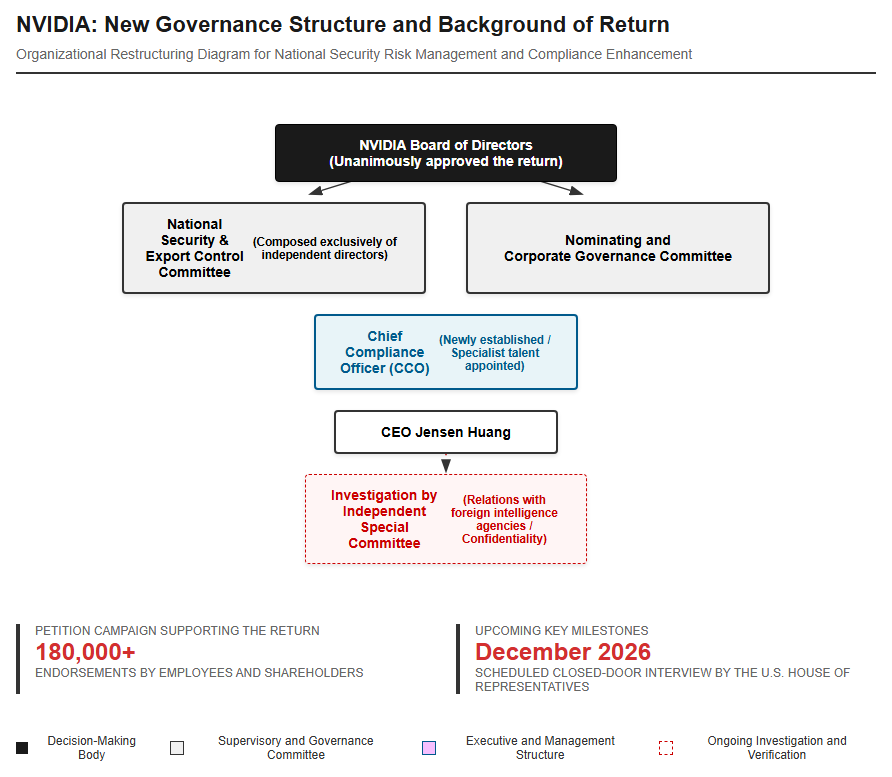
This was backed by strong political and social momentum. US President Donald Trump strongly supported Huang’s return on social media, commenting that it was “the best decision for both the company and the United States.” Additionally, calls for his return grew across the stock market and the technology industry, with over 180,000 employees and shareholders endorsing an online petition. Industry leaders, including Elon Musk, also expressed their support for Huang, strongly backing the resumption of the founder’s leadership.
Governance Strengthening Measures and Newly Established Compliance Framework
Although Huang’s return has been decided, the regulatory and legal challenges surrounding the company have not been completely resolved. Nvidia’s board of directors will continue to advance the independent special committee’s investigation into allegations of foreign intelligence operations, and Huang has pledged to maintain his full cooperation with the investigation. Additionally, the company newly established a “National Security and Export Control Committee” composed exclusively of independent directors to ensure thorough compliance with security issues and export control regulations targeting China.
Furthermore, to restructure the company-wide governance system, a new Chief Compliance Officer (CCO) position has been established, and the appointment of specialized personnel has begun. The newly established CCO will operate under a structure that reports directly to the Nominating and Corporate Governance Committee, and the company intends to respond sincerely to ongoing investigations and inquiries from government agencies. Mr. Huang is scheduled to attend a closed-door interview with a committee of the U.S. House of Representatives in early December 2026, where he will be required to demonstrate strict governance regarding compliance with export control regulations and the protection of confidential information. The construction of a new governance system, as shown in the organizational chart below, is currently underway.
Performance Trends and Mid-to-Long-Term Outlook in the AI Market
Record-High Revenue and Rapid Growth in the Data Center Business
Even during this period of management upheaval, demand for AI semiconductors—NVIDIA’s core business—has shown extremely robust trends. According to the third-quarter fiscal year 2027 results announced on November 17, 2026, the company’s quarterly revenue reached $115.8 billion, a 103% increase year-over-year, setting a new record. In particular, revenue from the data center business, which supports the construction of AI infrastructure, reached $107.6 billion, a 110% increase year-over-year, continuing its rapid growth as a mainstay business accounting for 92.9% of total revenue.
The revenue forecast for the upcoming fourth quarter is also projected to be approximately $130 billion, corroborating the continued expansion of demand from major cloud service providers and AI development companies. However, due to the transition to new products and changes in product mix, gross margins are expected to settle around 71% to 72%, down from 74.8% in the previous quarter. Analysts at major investment banks maintain a bullish view on the company’s long-term growth prospects, citing the introduction of the next-generation AI platform, Vera Rubin, and robust demand.
Corporate Organizational Transformation and Key Points to Watch in the Future AI Market
According to research on the laws of corporate transformation, strategic foresight and leadership that respond to future market environments—without being tethered to past successes—are essential for a company’s sustained growth and successful transformation. NVIDIA is a classic example of a company that has undergone a proactive transformation from a conventional graphics semiconductor manufacturer to a global leader in AI computing infrastructure. This recent drama surrounding the CEO’s return has highlighted the critical challenge of how to maintain a balance between reliance on individual leadership and organizational governance.
Key points to watch moving forward include the strengthening of export controls on AI semiconductors by major nations, compliance with trade regulations, and the competitive environment involving the development of in-house chips by competitors and major cloud service providers. The focus will be on whether the company can achieve sustainable growth under its newly established compliance structure while maintaining strong customer relationships and its technology roadmap. Market participants are closely monitoring the congressional testimony in December, the investigation reports from independent committees, and the pace of adoption of next-generation AI infrastructure.
Reference Pages
- NVIDIA Newsroom: NVIDIA Board Reinstates Jensen Huang as President, CEO and Board Director
- U.S. Securities and Exchange Commission: NVIDIA Corporation Form 8-K
- NVIDIA Newsroom: NVIDIA Announces CEO Transition
- NVIDIA Newsroom: Statement from NVIDIA Board of Directors
【#NVIDIA #JensenHuang #CEOreturn #StockPriceSurge #AISemiconductors #Governance #USStocks】


コメント