
On November 23, 2026, the China Meteorological Administration and the Shanghai AI Laboratory unveiled “ZHU・GE,” an Earth-system AI research platform. Behind this platform, which autonomously conducts meteorological research based on natural language, lie the state-led “AI for Science” policy and the rapid evolution of weather forecasting.
- Background of the Launch and the Scientific Significance Embedded in the Name
- Autonomous Experimentation Capability via Natural Language Research Goal Instructions
- Scale of Over 10 PB of Massive Data and Integrated Toolsets
- Digital Innovation in Meteorological Science Boosted by the “AI+” National Strategy
- Collaboration with Existing Meteorological AI Models and Achievements in Improving Forecast Accuracy
- Opening to Meteorological Departments and Educational Institutions, and Potential for International Expansion
- Increase in Extreme Weather and Challenges for Integrating AI and Physics Models
Background of the Launch and the Scientific Significance Embedded in the Name
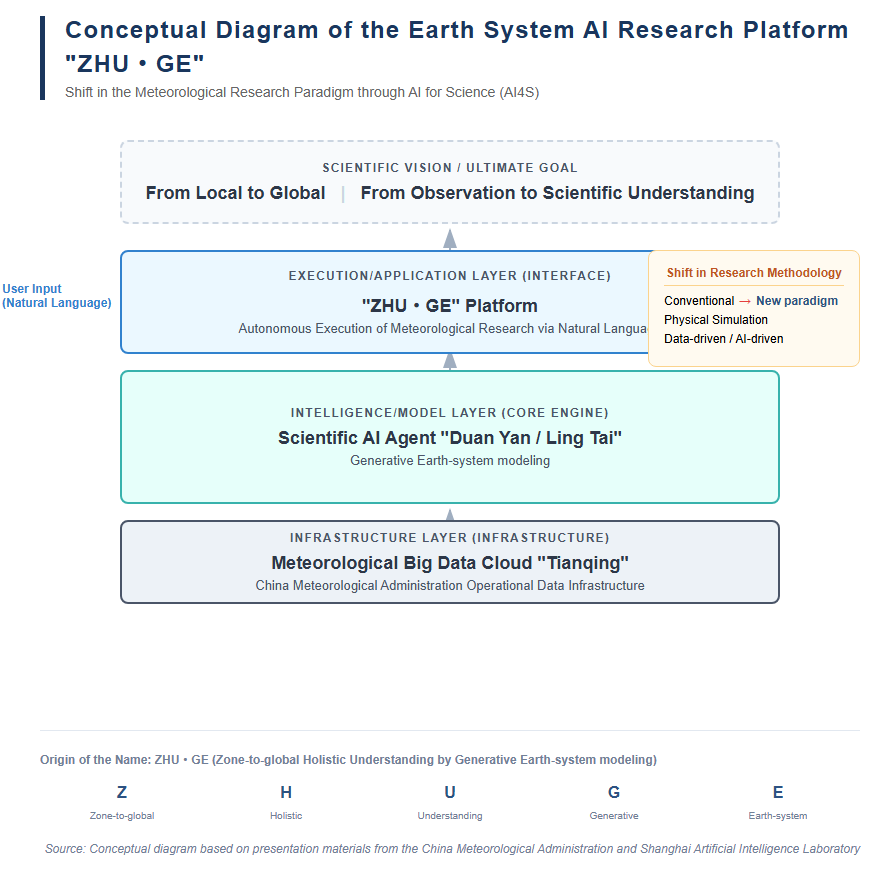
On November 23, 2026, the Earth-system AI research platform “ZHU・GE” was officially unveiled at the 2026 Xiong’an International Symposium on Meteorological Artificial Intelligence held in China’s Xiong’an New Area. The name “ZHU・GE” is derived from the acronym for “Zone-to-global Holistic Understanding by Generative Earth-system modeling.” This naming embodies a profound scientific vision of “from local to global, from observational facts to scientific understanding.” Co-developed under the leadership of the China Meteorological Administration and the Shanghai AI Laboratory, the platform was built to powerfully promote “AI for Science” (AI4S) across meteorological and Earth sciences. It serves as a foundational infrastructure that uses AI to analyze meteorological observation data and simulation results, rapidly and reliably connecting researchers’ ideas to scientific conclusions. The development is underpinned by the China Meteorological Administration’s meteorological big data cloud platform “Tianqing” and the advanced scientific research AI agents “Danyan-Lingtai.” Through this, the aim is to transition from traditional research methodologies centered on physical simulations using supercomputers to a new data-driven, AI-led research paradigm. The figure below illustrates the conceptual structure of the platform.
Autonomous Experimentation Capability via Natural Language Research Goal Instructions
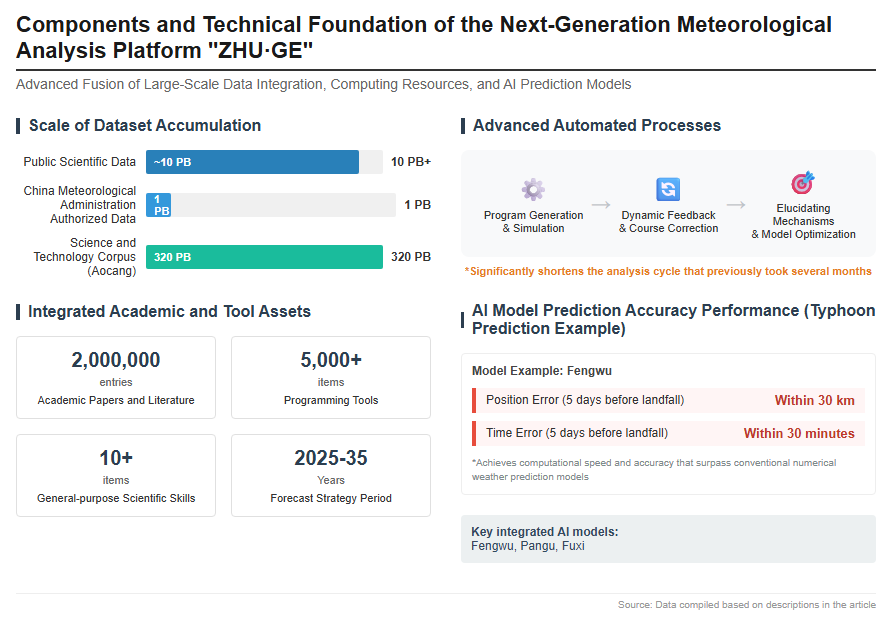
The most distinctive feature of “ZHU・GE” is that researchers simply input their objectives in natural language, and the AI autonomously completes the entire research process. When a researcher uses natural language to specify a concrete research target, the platform autonomously searches for and analyzes related resources such as literature data and numerical models, and formulates research plans and writes programming code on its own. Furthermore, it uses the generated programs to run computational simulations and experiments, and even automatically performs the statistics and analysis of the obtained results. It is capable of dynamically adjusting the research direction based on intermediate execution results and feedback to elucidate meteorological mechanisms and optimize prediction models. This highly advanced automation process drastically shortens the cycles of meteorological analysis and model verification that previously took months. Researchers are freed from routine data processing and can concentrate on formulating more creative hypotheses and discussing results.
Scale of Over 10 PB of Massive Data and Integrated Toolsets
The overwhelming capability boasted by “ZHU・GE” is supported by the massive scale of data and scientific tools standing behind it. Connected to the platform are approximately 10 petabytes (PB) of public scientific data and the first batch of 1 PB of meteorological operational data specially authorized by the China Meteorological Administration. In addition, approximately 2 million academic papers and technical literature records have been databased. Built into the system in advance are over 5,000 programming code tools and more than 10 general-purpose scientific research skills. Data held by the China Meteorological Administration is scheduled to be continuously added and expanded going forward, promoting the integration of data for the entire Earth system—including not only the atmosphere, but also oceans, land surfaces, and the water cycle. Through the fusion of massive datasets and cutting-edge AI, a foundation has been completed for accurately reproducing and predicting everything from global-scale atmospheric fluctuations to localized weather phenomena.
China’s “AI for Science” Policy and the Technological Evolution of Weather Forecasting Models
Digital Innovation in Meteorological Science Boosted by the “AI+” National Strategy
The birth of “ZHU・GE” is closely linked to the national-level AI policies promoted by the Chinese government. In August 2025, the State Council of China issued the “Opinions on Deepening the Implementation of the ‘AI+’ (Artificial Intelligence Plus) Action,” positioning “AI + Science and Technology” as the foremost priority among key fields. Furthermore, the China Meteorological Administration formulated the “Earth System Forecasting Development Strategy (2025–2035),” setting forth a “dual-wheel drive” policy that deeply integrates physics-based numerical forecasting with AI-driven machine learning. The goal is to build a seamless, high-precision forecasting system with global kilometer-scale and regional 100-meter-scale resolutions by 2035. Additionally, the Chinese Academy of Sciences has been advancing the intelligence of national scientific research infrastructure by developing the scientific foundation model “Panshi 2.0” and “Aocang,” a science and technology corpus exceeding 320 PB. Such strong national policies and infrastructure development form the background that strongly supported the development of “ZHU・GE.”
Collaboration with Existing Meteorological AI Models and Achievements in Improving Forecast Accuracy
In China, independently developed meteorological AI models had already gained global acclaim even before the advent of “ZHU・GE.” Deep learning models such as “Fengwu” developed by the Shanghai AI Laboratory, Huawei’s “Pangu,” and Fudan University’s “Fuxi” have demonstrated calculation speeds and prediction accuracies that surpass traditional supercomputer-based numerical weather prediction models. For example, when Typhoon Dolphin approached, Fengwu predicted its landfall location and time five days in advance with astonishing precision—a position error of within 30 km and a time error of within 30 minutes. Insights from these cutting-edge meteorological AI models and data algorithms have been integrated into the “ZHU・GE” platform, dramatically enhancing its ability to analyze complex global environmental interactions in real-time—something that was difficult with conventional methods. The figure below illustrates an advanced typhoon prediction by a meteorological AI model.
“ZHU・GE” Deployment Plans and the Future of Earth System Research
Opening to Meteorological Departments and Educational Institutions, and Potential for International Expansion
Going forward, “ZHU・GE” is planned to be rapidly deployed across domestic meteorological research institutions and universities in China. It will first be fully introduced to all research and operational departments under the China Meteorological Administration, putting it into practical use in operational weather forecasting. At the same time, the platform will be progressively opened to universities and research institutions that are members of the “National Meteorological Science and Education Integration Innovation Alliance.” Researchers within the alliance will gain access to the platform’s computing resources and data through a dedicated “scientific research token” service. Furthermore, looking to the future, the provision of services to international research organizations and developing countries is also under consideration to address global meteorological challenges. Through the open-sourcing of meteorological data and the sharing of AI research environments, global-scale meteorological innovation is anticipated.
Increase in Extreme Weather and Challenges for Integrating AI and Physics Models
As extreme weather and the intensification of heavy rain and typhoons accompanying global warming become worldwide issues, the role of AI platforms like “ZHU・GE” is immensely significant. However, meteorological AI still has challenges that need to be resolved. Because AI models rely on pattern learning from past reanalysis data, limitations have been pointed out in predicting the intensity of unprecedented extreme events or long-term climate variations (such as El Niño events). Moreover, since it is difficult to completely guarantee physical constraints such as the conservation of mass and energy, advanced integration with traditional physics-based numerical forecasting is indispensable. Moving forward, through the mutual complementation of physical simulations and AI agents, the generation of reliable scientific knowledge that aids in climate change adaptation and disaster prevention planning will be required.
Reference Pages
[#China #AIforScience #ZHUGE #WeatherForecasting #EarthSystemAI #ChinaMeteorologicalAdministration #GenerativeAI]


コメント