Mitsubishi Research Institute, Inc. has developed and demonstrated a technology that uses AI to estimate and visualize supply chains down to the product level, including tier-2 suppliers and beyond. Against a backdrop of increasing geopolitical risks and natural disasters, the company aims to improve corporate resilience by expanding supply chain management—which has traditionally been limited to tier-1 suppliers—to the deeper layers of the network.
- Announcement of New Technology for Estimating and Visualizing Tier-2 and Beyond Supply Chains at the Product Level
- Challenges in Conventional Supply Chain Management and the Uncertainty of “Invisible” Upstream Layers
- A Three-Step Process for Constructing Product-Specific Supply Chains
- Separated management of confirmed data and AI estimations, and traceability of evidence
- Understanding structural risks during normal operations and accelerating initial responses during emergencies
- Future Outlook and Points of Interest
Announcement of New Technology for Estimating and Visualizing Tier-2 and Beyond Supply Chains at the Product Level
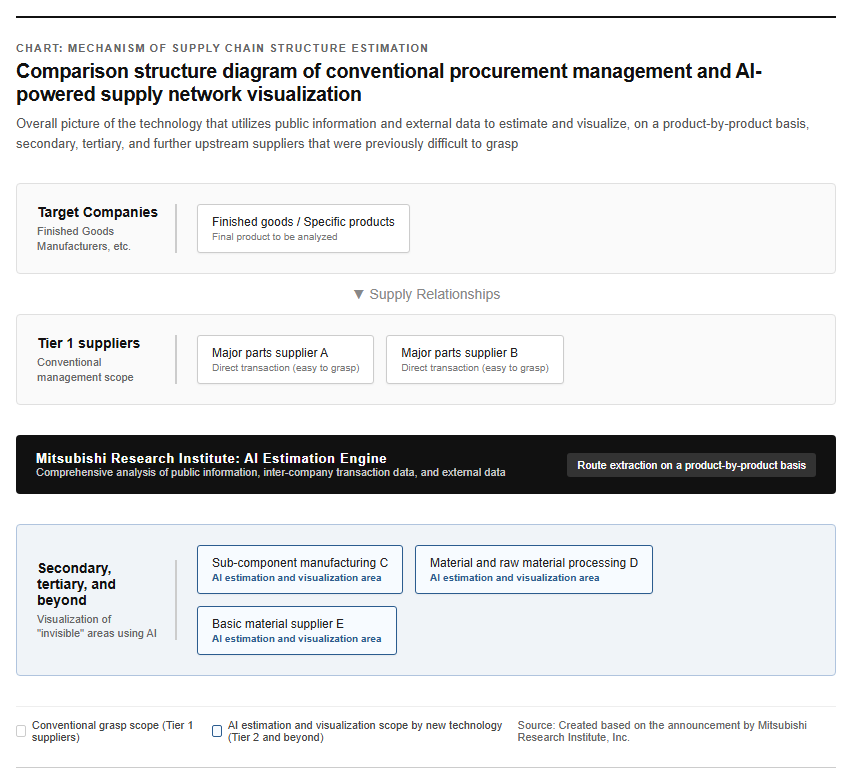
On November 24, 2026, Mitsubishi Research Institute, Inc. (President and CEO: Kenji Yabuta) announced that it has developed and demonstrated a technology that utilizes public information, external data, and AI to estimate and visualize supply chains (tier-2 suppliers and beyond) at the product level—a task that was previously difficult to achieve. In conventional procurement management, companies could only track their direct tier-1 suppliers, leaving the structure of tier-2, tier-3, and further upstream suppliers in an “invisible” state. The newly developed technology uses AI to extract upstream transaction routes related to specific products from complex inter-company transaction data, clarifying the entire supply chain structure for each product. By utilizing this technology, the goal is to contribute to the improvement of corporate supply chain resilience by accelerating the identification of supply chain risks during normal operations and enabling rapid impact assessments during emergencies. As natural disasters intensify and international situations shift abruptly, this technology is highly anticipated as an advanced solution to support corporate management foundations. The following figure shows the overall picture of supply chain structure estimation using AI technology.
Challenges in Conventional Supply Chain Management and the Uncertainty of “Invisible” Upstream Layers
In recent years, uncertainty in the external environment surrounding companies has expanded rapidly due to rising geopolitical risks, intensifying natural disasters, and regulatory changes. Because these external events have a massive impact on the procurement of components and production activities of various companies through the supply chain, strengthening the entire supply chain has become a top management priority. However, in many operational settings, while companies can manage the status and location information of their direct tier-1 suppliers, they face the problem of being unable to comprehensively grasp the procurement routes and dependencies of tier-2 and tier-3 suppliers extending beyond them. Consequently, when a disruption occurs in a specific region or a factory of a specific manufacturer stops operating, companies risk being unable to immediately determine which of their products will be affected and to what extent, leading to delays in initial response. Against these challenges of the “invisible upstream,” there has been a growing need for technology that focuses on the relationship between inter-company transaction items and target products to structurally visualize upstream supply relationships.
Mechanism and Features of AI-Based Supply Chain Estimation Technology
A Three-Step Process for Constructing Product-Specific Supply Chains
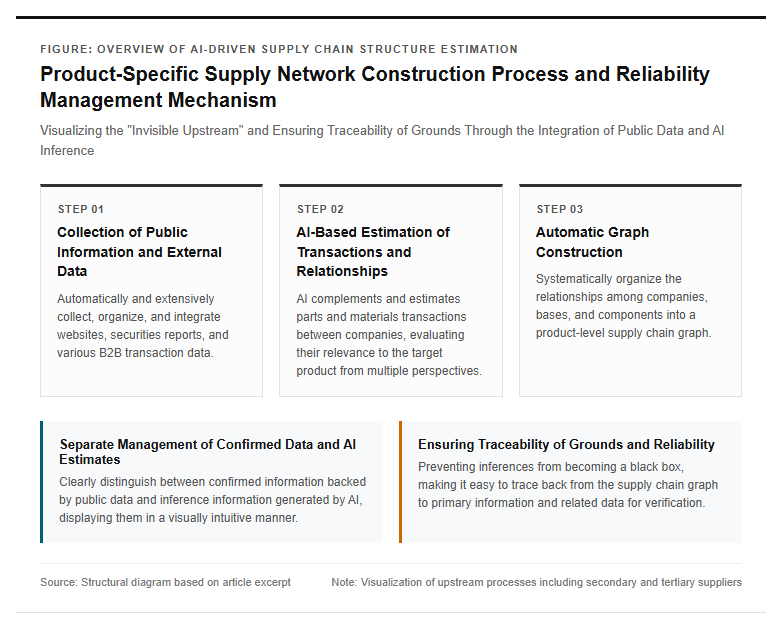
To reproduce the supply chain for each target product from vast amounts of inter-company transaction data, this technology operates through a mechanism involving three main steps. In the first step, public information such as websites and securities reports, as well as inter-company transaction data, are broadly collected and organized. In the second step, based on the collected data, the AI complements and estimates what kind of parts and materials are being traded between companies and evaluates their relevance to the target product. In the third step, the upstream transaction routes related to that product are extracted, and the relationships between companies, locations, and components are organized and constructed as a supply chain graph. A major strength is that it does not merely follow connections between companies but can trace back the supply chain by the unit of specific traded items. The overview of the process is as follows.
- Automatic collection and organization of public information and external data
- AI-driven complementation and estimation of transaction items and their relevance to target products
- Automatic construction of supply chain graphs at the product level
Separated management of confirmed data and AI estimations, and traceability of evidence
A major feature of this technology is that it clearly distinguishes, manages, and displays confirmed information verified through public information or official data from estimated information based on AI reasoning. A common challenge in AI-based reasoning technology is that the prediction process becomes a “black box,” making it difficult to adopt as a basis for decision-making in practical business operations. In response, this technology features a mechanism that allows users to trace back through the supply chain graph to the primary information and related data that served as the basis for the estimation. This enables management and procurement personnel to personally verify the reliability of the visualized supply chain before performing risk analysis or fact-checking with suppliers. The technology also achieves operability that allows for the visual grasp of complex interrelationships between companies, locations, components, and materials. In the system interface currently under development, an interface is being built that allows for the intuitive grasping of structural risks.
Significance of Practical Application and Future Outlook
Understanding structural risks during normal operations and accelerating initial responses during emergencies
The practical application of this technology enables companies to dramatically improve the quality of procurement management in both normal and emergency times. In normal times, by understanding upstream suppliers and dependencies related to critical products and components, it becomes possible to narrow down in advance the business partners whose status should be monitored with priority. Furthermore, structural risks—such as dependency on specific upstream suppliers or the concentration of components—can be identified during normal times, leading to proactive planning measures such as exploring alternative procurement sources. On the other hand, in emergencies such as large-scale disasters or export restrictions, AI quickly narrows down the business partners that may be affected. This makes it possible to instantly assess potential impacts on component procurement and significantly streamline initial response efforts. The specific expected effects are as follows.
- Efficiently narrowing down priority monitoring targets by understanding upstream supply structures
- Rapid identification of affected targets and streamlining of initial responses in the event of disasters or regulatory changes
- Formulating actionable alternative measures based on a prior understanding of structural risks
Future Outlook and Points of Interest
Mitsubishi Research Institute, Inc. has announced its policy to integrate this technology with the supply chain visualization service and impact assessment AI agent functions of the strategic decision support infrastructure “MRI AI Intelligence Infrastructure,” announced in July 2026. Going forward, the company aims to provide services that consistently support everything from identifying supply chain risks to assessing business impacts and examining countermeasures, while also beginning to accept consultations for Proof of Concept (PoC) targeting specific products and critical components. In the future, it plans to deepen integration with various existing systems related to the supply chain and expand functions to realize autonomous supply chain risk management using AI. As disruption risks due to fluid international situations and climate change become commonplace, significant attention is focused on the results of this initiative, which builds a resilient and sustainable industrial base utilizing advanced AI technology.
Reference Pages
- [Preparing for Supply Chain Disruptions: Estimating and Visualizing “Invisible Upstream” with AI – Mitsubishi Research Institute] https://www.mri.co.jp/news/press/20261124.html
- [Supply Chain Risk Assessment by AI Intelligence – Mitsubishi Research Institute] https://dx.mri.co.jp/service/supply-chain-risk/
[#MitsubishiResearchInstitute #SupplyChain #AI #RiskAssessment #Resilience #GeopoliticalRisk #SupplyChainVisualization]
コメント