
German AI company Aleph Alpha has released “Kolibri,” a large language model specialized in German and English, as open weights. Behind this is a strong imperative to establish digital sovereignty in government agencies and regulated industries while complying with Europe’s strict data protection regulations.
- Key Takeaway: The emergence of a large open model specialized in German and English
- Data Sovereignty Through Open-Weight Licenses and On-Premises Operations
- Computational efficiency with 78.1 billion parameters and 3.46 billion active parameters
- Unified German-English Tokenizer and Long-Context Processing of Up to 1 Million Tokens
- Benchmark Results and the Cost-Effectiveness Pareto Frontier
- Halucination Suppression Technology and Phased Control of Inference Load
- Expansion into the European Public Sector and Industrial Sectors, and Future Key Points to Watch
Key Takeaway: The emergence of a large open model specialized in German and English
German AI company Aleph Alpha released its new large language model, Kolibri, to coincide with German Unity Day on October 3, 2026. Kolibri is a large language model highly specialized in bilingual processing for German and English, and its full weights have been released as open weights on Hugging Face under the Apache 2.0 license. It was developed with the aim of supporting mission-critical operations in the public sector, government agencies, and heavily regulated industries. Unlike traditional general-purpose model development, the development team built a unique infrastructure called Model Factory, which manages the entire development process as code. On this infrastructure, they pre-verified a 30-billion-parameter experimental model, Kolibri Origin, and successfully completed the production-ready Kolibri in a short period of time. The figure below shows an overview of the model.
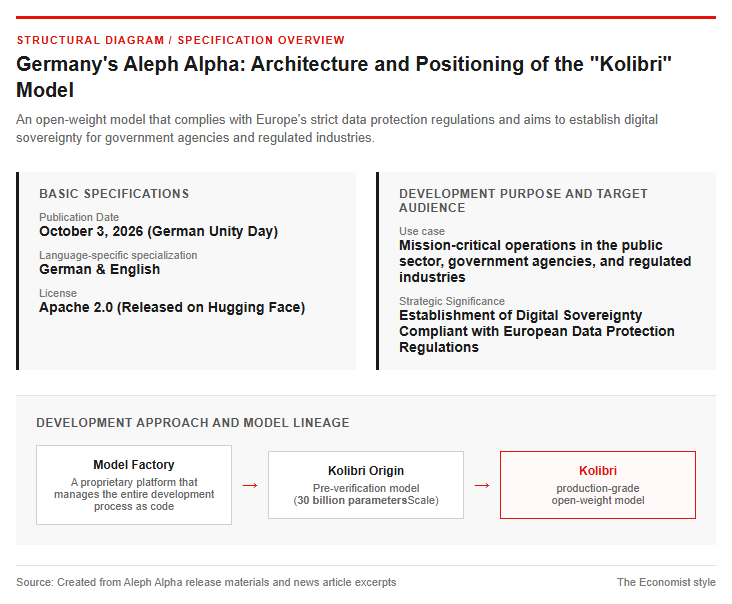
The model’s defining characteristic is that it was designed from the development stage with compliance to its home country’s linguistic culture and regulatory requirements set as its highest priority.
Data Sovereignty Through Open-Weight Licenses and On-Premises Operations
In recent years, government agencies and enterprises in Europe have been facing growing concerns about security risks and data breaches associated with transmitting sensitive data to external cloud infrastructures such as those in the United States. To address this challenge, Kolibri is designed to be fully deployable and operable within an organization’s own on-premises environment. Because inference processing can be completed entirely on the customer’s private infrastructure, it completely eliminates the risk of transferring internal data to external AI service providers. Furthermore, this model has been rigorously trained to meet the requirements of strict regulatory frameworks, such as the European Union Artificial Intelligence Act (EU AI Act), the code of practice for general-purpose AI models, and the EU General Data Protection Regulation (GDPR). Ensuring “AI sovereignty” by maintaining independent technological infrastructure holds immense social significance, particularly in specific sectors such as public administration, defense and aerospace, healthcare, and finance.
Ultra-Efficient MoE Architecture and Technological Innovation Specialized in German and English
Computational efficiency with 78.1 billion parameters and 3.46 billion active parameters
The architecture of Kolibri adopts a Mixture-of-Experts (MoE) transformer that dynamically switches between multiple expert networks. While the total number of parameters across the entire model reaches 78.1 billion (78.1B), the number of parameters actually activated per token processed is kept to approximately 3.46 billion (3.46B). This accounts for about 4.4% of the total parameters, a design that significantly reduces computational load and inference costs during token generation while retaining the model’s massive knowledge capacity. The pre-training process utilized 768 NVIDIA B200 GPUs and was completed in 21 days, processing large-scale data totaling 20 trillion (20T) tokens. The model weights are provided in FP8 and BF16 formats, and when operating at FP8 precision, it can run with a memory capacity of approximately 78GB. This achieves high flexibility, allowing it to be deployed in standard server environments such as NVIDIA H200 or B200, or a dual-GPU configuration of A100/H100.
Unified German-English Tokenizer and Long-Context Processing of Up to 1 Million Tokens
German has the morphological characteristic of frequently forming long, single words by combining multiple words, which has posed a problem where standard English-based tokenizers tend to split characters inefficiently. To solve this problem, Kolibri developed a dedicated tokenizer with a 128,000 vocabulary trained using a method called UniBPE. As a result, the token split ratio aligned with German morpheme boundaries improved to 65%, successfully reducing the number of tokens required when processing German text by 11.2% compared to existing models. In addition, the context window supports up to 1,048,576 tokens (1 million tokens), equipping it with the ability to process vast, long-form contexts. This has made it possible to directly input entire long legal documents or lengthy technical manuals to perform advanced context tracking and information extraction.
Performance Verification for Practical Application and Future Prospects
Benchmark Results and the Cost-Effectiveness Pareto Frontier
In testing Kolibri’s performance, Aleph Alpha emphasizes the achievement of the “Pareto frontier,” which demonstrates a balance between high-quality reasoning capabilities and low operational costs. According to official test results, it recorded a score of 96.0% in the mathematical reasoning evaluation AIME 2026, and achieved an exceptionally high accuracy of 90.0% in the German version of the same evaluation. Furthermore, it obtained 84.3% (81.3% for the German version) on GPQA Diamond, which tests advanced specialized knowledge, and 85.9% on LiveCodeBench v6, which measures programming capabilities. The graph below is an image of the performance comparison.
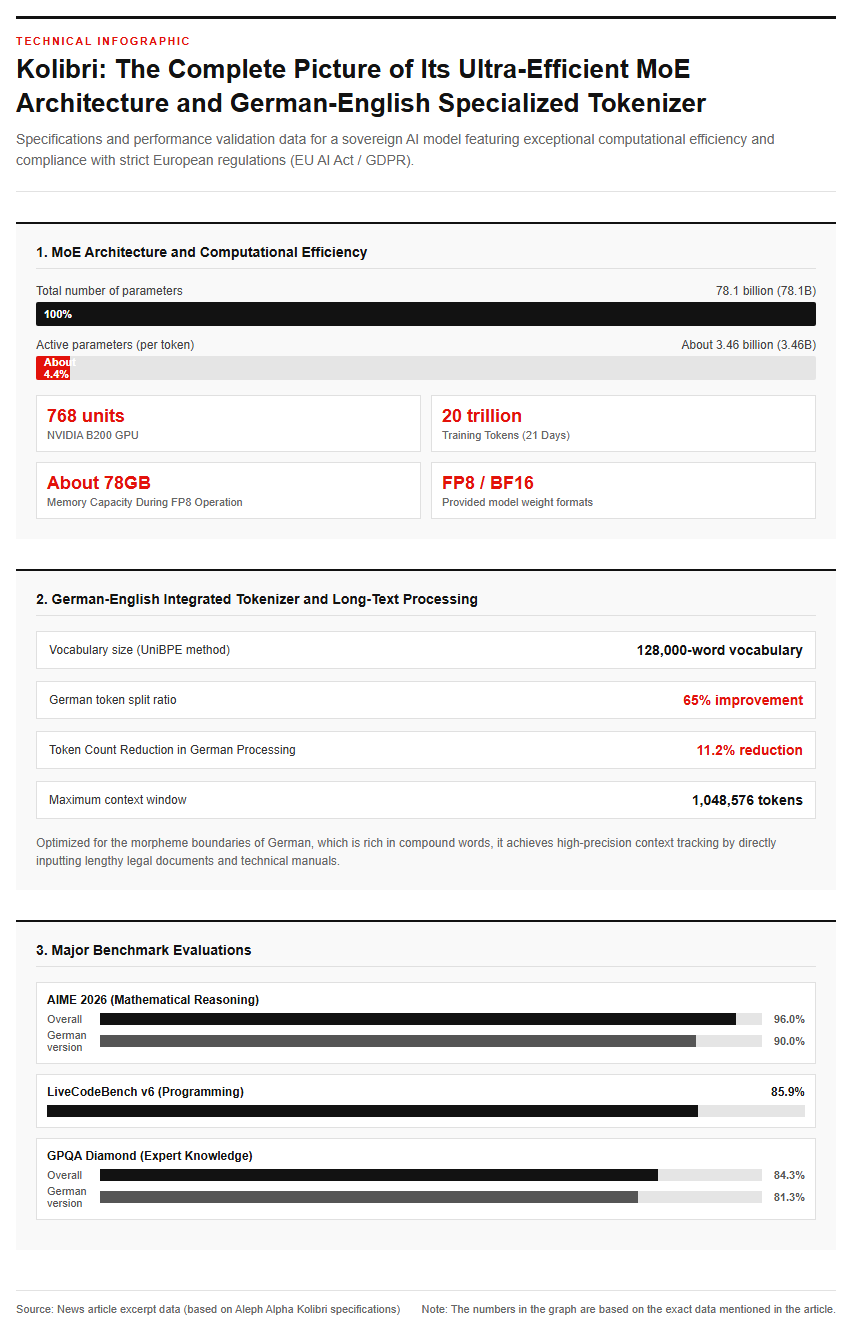
It delivers performance on par with or exceeding that of large-scale competing models from other companies, whose active parameter counts are approximately four times as large as its own. By keeping the number of active parameters low, it maximizes throughput per server, enabling enterprises and public institutions to clearly and continuously enhance the return on investment (ROI) of their AI operations.
Halucination Suppression Technology and Phased Control of Inference Load
To counter factual errors and hallucinations—major challenges for AI models in real-world deployment—Kolibri employs a proprietary mitigation algorithm called the Merlin-Arthur approach. Through this method, when the provided context contains insufficient information to properly verify an answer, the model is trained to deliberately withhold (abstain from) responding rather than forcefully generating a false answer. Furthermore, to control the depth of reasoning according to task difficulty and required speed, it is equipped with a feature that allows users to explicitly select the reasoning mode (Reasoning effort) from four levels: none, low, medium, and high. By responding instantly without spending thinking time for simple queries and allocating numerous thinking tokens to tasks requiring advanced logical reasoning, the design allows users to freely adjust the optimal balance between response accuracy, processing time, and response latency.
Expansion into the European Public Sector and Industrial Sectors, and Future Key Points to Watch
With the emergence of Kolibri, the social implementation of sovereign AI in Europe has entered a new phase. Beyond adoption in public administrative agencies centered on Germany, application is progressing in Europe’s core industrial sectors such as the automotive industry, precision manufacturing, semiconductors, and aerospace. Custom evaluation environments tailored to the specialized terminology and legal procedures unique to each industry are being built in parallel, with plans to continuously provide tuning aligned with actual on-the-ground needs. Looking ahead, the main points of focus will be how the ecosystem expands through the global researcher and developer community as an open-weight model, and to what extent Europe’s unique safe and high-performance AI model can expand its market share in the global market led by US and Chinese AI giants.
Reference Page
- [Aleph Alpha Official Announcement] https://aleph-alpha.com/en/blog/kolibri-has-landed-a-sovereign-open-weight-model/
- [Hugging Face Model Repository] https://huggingface.co/Aleph-Alpha/Kolibri-1
[#AlephAlpha #Kolibri #LLM #ArtificialIntelligence #SovereignAI #OpenWeights]

コメント