
Major industrial electrical equipment manufacturer ABB has announced “ABB Intelleqt™,” the world’s first low-voltage motor with built-in intelligence. This was developed against the backdrop of solving the collection of reliable equipment-level data—the greatest barrier to utilizing AI on manufacturing floors—and supporting the expanded application of industrial AI.
- Overview and Key Specifications of the World’s First Intelligent Low-Voltage Motor
- 50% Reduction in Unplanned Downtime and Massive Cost Avoidance Effects
- The Reality and Challenges of AI Scaling Sticking at Just 20%
- The 300-Million-Unit Existing Motor Market and Its Impact on Power Consumption
- Edge AI Technology Supported by .3 Billion in Annual R&D Investment
- From the Co-Creation Phase to Full-Scale Market Launch in 2027
Overview and Key Specifications of the World’s First Intelligent Low-Voltage Motor
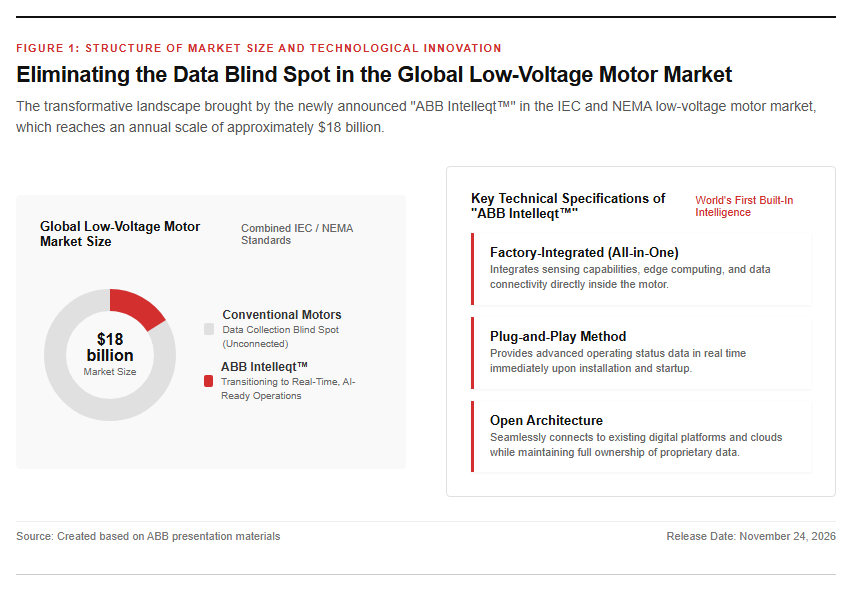
On November 24, 2026, ABB announced “ABB Intelleqt™,” the world’s first low-voltage motor equipped with factory-integrated intelligence (built-in intelligence) as a standard feature. This product is an innovative device that directly integrates sensing functions, edge computing, and data connectivity into a conventional electric motor right from the factory. Utilizing a plug-and-play approach, it can provide advanced data on the motor’s operating status in real time immediately after installation and startup. Furthermore, built on an open architecture, it enables adopting companies to seamlessly connect to existing digital platforms and clouds while maintaining complete ownership of their data. The global low-voltage motor market reaches a scale of approximately $18 billion combined across IEC and NEMA standards, but many conventional motors are not digitally connected, serving as a blind spot for data collection. This product fundamentally resolves this issue.
Please refer to the image below.
50% Reduction in Unplanned Downtime and Massive Cost Avoidance Effects
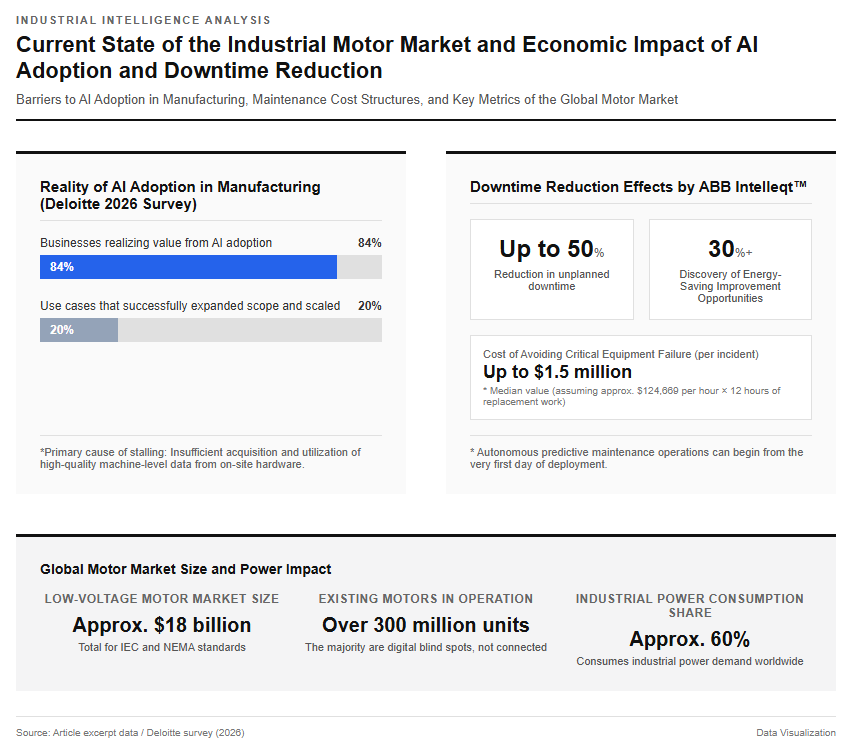
With the adoption of ABB Intelleqt™, manufacturing operators can achieve sophisticated maintenance operations and dramatic cost reductions. By utilizing the data generated by this motor for AI analysis, it is not only possible to discover improvement opportunities leading to energy savings of over 30%, but also to reduce unplanned downtime by up to 50% through early anomaly detection of operating states. In particular, failures in critical plant equipment cause severe economic losses, and the introduction of this technology helps avoid failure costs of up to $1.5 million per incident. This estimate is based on the global median downtime loss of approximately $124,669 per hour, assuming a 12-hour replacement and recommissioning operation associated with a 110 kW motor failure. Its strength lies in the fact that the equipment itself autonomously provides insights, enabling the operation of predictive maintenance from day one.
Background of Development and the “Data Wall” in Industrial AI Adoption
The Reality and Challenges of AI Scaling Sticking at Just 20%
Although numerous manufacturing operators are embarking on the introduction of AI technology, significant barriers exist to scaling operations at a practical level. According to a 2026 research report by Deloitte, while 84% of manufacturers responded that they realize value from AI adoption, AI use cases that successfully expanded their scope or scaled reached only 20% of the total. The primary cause of this stalling is said to be a lack of quality and availability of data required for training and inference of AI models. Despite massive amounts of operational data lurking in critical infrastructure such as data centers, water infrastructure, and food plants, methods to directly acquire reliable machine-level data from on-site hardware have been limited. ABB’s technology breaks through this data challenge by transforming the motor itself into a source of information.
The 300-Million-Unit Existing Motor Market and Its Impact on Power Consumption
It is estimated that over 300 million motor-driven systems are currently operating in factories and infrastructure facilities around the world, consuming approximately 60% of global industrial power demand. However, the majority of these existing facilities are not digitally connected and have continued to operate as “invisible entities” not visualized by higher-level intelligence platforms. Amid the rapid advancement of electrification, automation, and the introduction of industrial AI, extracting real-time operating data from this massive volume of motors has become an urgent task for improving energy efficiency and reducing CO2 emissions. Redefining motors from mere machinery that generates power into infrastructure that generates real-time intelligence on its own strongly supports the digital transformation of the entire manufacturing industry.
Please refer to the image below.
ABB’s R&D Structure and Roadmap for Global Market Expansion
Edge AI Technology Supported by .3 Billion in Annual R&D Investment
ABB’s promotion of intelligent motor development is supported by the company’s long-standing, robust investment in research and development. ABB consistently allocates 4.5% to 5.0% of its total group revenue to R&D, investing $1.3 billion in research and development activities during 2025 alone. Furthermore, since 2022, the company has increased its R&D investment by approximately 30%, employing approximately 7,800 engineers across research centers in over 30 countries spanning six continents. About half of these specialized personnel are engaged in digital technology and software development, enabling the integration of motor structures with advanced algorithms. By integrating edge analysis technology using machine learning models and technology that automatically diagnoses bearing faults and structural looseness directly inside the motor, an environment has been established where the causes of abnormalities can be identified immediately even without advanced technical expertise.
From the Co-Creation Phase to Full-Scale Market Launch in 2027
Officially announced on November 24, 2026, at the SPS 2026 exhibition held in Germany, ABB Intelleqt™ has now entered the customer co-creation phase. ABB is closely collaborating with major OEMs (Original Equipment Manufacturers) and end-user companies to drive optimization tailored to actual site environments and diverse operational needs. Full-scale market deployment is scheduled for 2027, with a focus on Europe, Japan, China, and India as lead markets. The demand to make existing plant facilities smart is growing on a global scale, and an open-architecture design that respects customer data ownership is expected to become the standard for AI-driven operations in key markets.
Reference Page
- [ABB Intelleqt™ Motor Official Announcement Page] https://www.abb.com/global/en/areas/motion/campaigns/abb-intelleqt-motor-intelligence-built-in
[#ABB #IndustrialAI #IntelligentMotor #LowVoltageMotor #PredictiveMaintenance #EdgeComputing #ManufacturingDX]


コメント