On June 29, 2026, the ComfyUI team announced the public beta version of “Comfy MCP,” which allows AI agents to manipulate image and video generation workflows in natural language. This is driven by the widespread adoption of Anthropic’s Model Context Protocol (MCP) and the expansion of ecosystems aimed at making advanced generative AI environments more accessible.
Public Beta Release and Key Features
On June 29, 2026, the ComfyUI development team released the official MCP server, “Comfy MCP,” as a public beta version. This tool leverages Model Context Protocol (MCP), an open standard proposed by Anthropic, enabling direct connection between AI agents such as Claude Code and Claude Desktop with the entire ComfyUI engine. Through the chat interface, users can search for models, select nodes, build templates, and generate diverse content such as images, videos, audio, and 3D all using natural language only. The diagram below shows the demo at the time of the announcement.
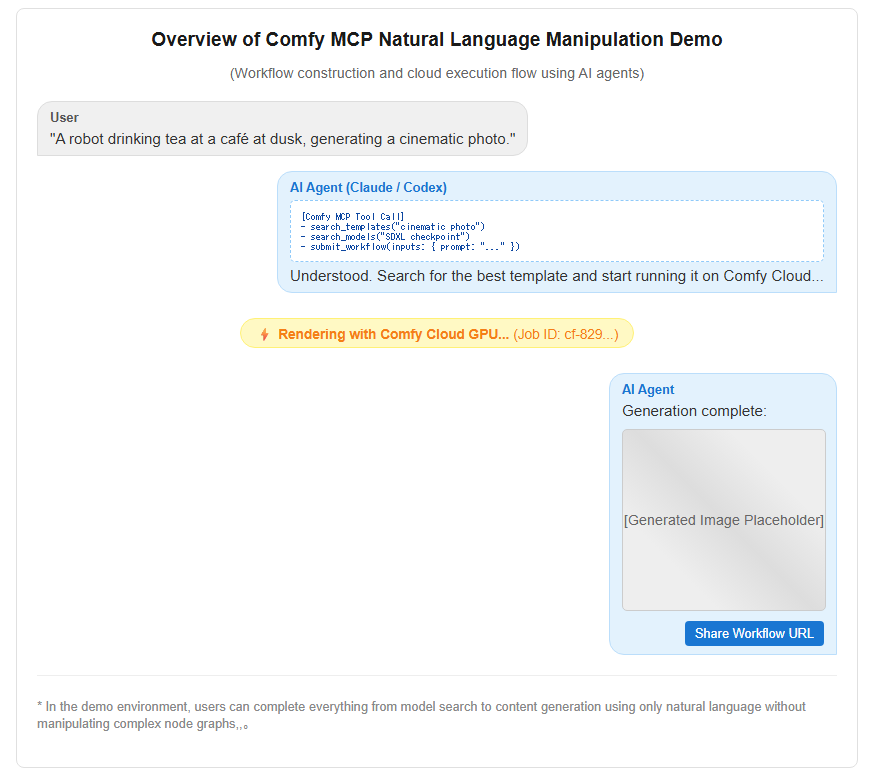
At the time of writing, processing uses Comfy Cloud’s GPU resources, so a high-performance GPU is not required for the user’s local environment, and advanced generation pipelines can be run even from low-spec PCs.
Automation of complex workflow operations
ComfyUI is one of the most powerful open-source generative AI execution environments in the world, but its operation requires complex graph construction by connecting numerous nodes with lines, posing a high learning curve for beginners. Comfy MCP was developed to overcome this high barrier to entry. AI agents interpret user intent and automatically execute the appropriate node routing behind the scenes—from loading checkpoints to sampling and decoding. This allows users to empower agents as “creative technologists” without being conscious of the node graph structure, enabling them to manage the generation process in an interactive manner. The development team positions this as a crucial step toward popularizing complex generative AI technology.
Diversity of technical mechanisms and operations
Execution Platform Utilizing Comfy Cloud
A technical feature of Comfy MCP is its comprehensive adoption of the cloud service “Comfy Cloud” as the execution platform. The system is broadly divided into four parts: the ComfyUI engine, Comfy Cloud, MCP server, and AI agent. The process flow follows a one-way structure: instructions from the agent are sent via HTTPS to a remote MCP server, from where actual rendering is performed on GPUs on Comfy Cloud. The diagram below visualizes this component configuration.
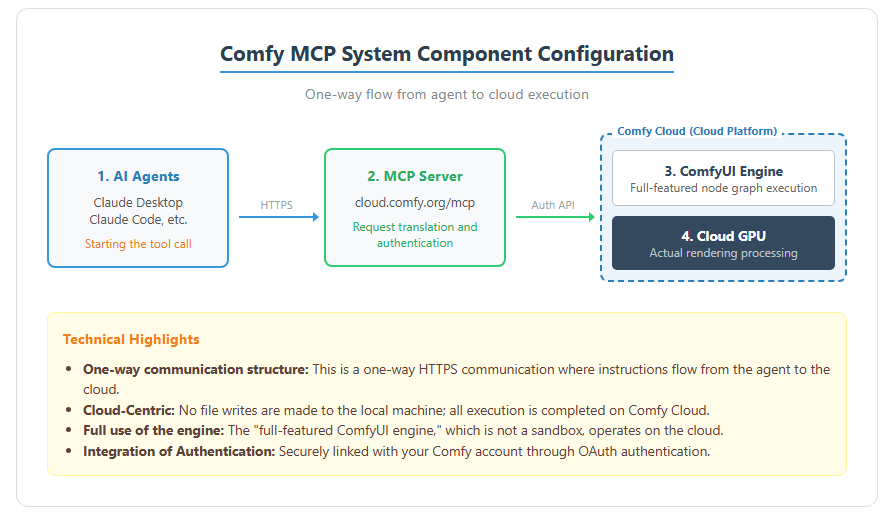
This eliminates the need to download models to local machines or set up environments, allowing users to instantly use the latest AI models simply by signing in. Additionally, running on the cloud is well-suited for batch processing, allowing efficient parallel processing such as generating 20 different advertising variation images simultaneously.
Flexible integration with 16 dedicated tools
Comfy MCP offers 16 dedicated tools available to AI agents. These tools are categorized into four groups: “Discover,” “Execute,” “Save,” and “Share.” For example, by using search_templates and search_models, agents can autonomously find the optimal resources from ComfyUI’s vast catalog. On the execution side, submit_workflow initiates generation and monitors progress with get_job_status. Particularly noteworthy is the tool called use_previous_output, which allows you to continuously execute multi-stage pipelines such as “generation→ upscaling→ and background removal” in conversational flow without re-uploading files. This design enables advanced automated workflows for production environments, going beyond one-off generation.
Significance of Practical Application and Future Prospects
Workflow sharing features that enhance reproducibility
One of the highlights of this update is the URL sharing function for workflows. Graphs saved in save_workflow can be issued as unique URLs by share_workflow, and by sharing this with others, recipients can reproduce the generation with exactly the same settings. The diagram below shows an example interface of this sharing feature.
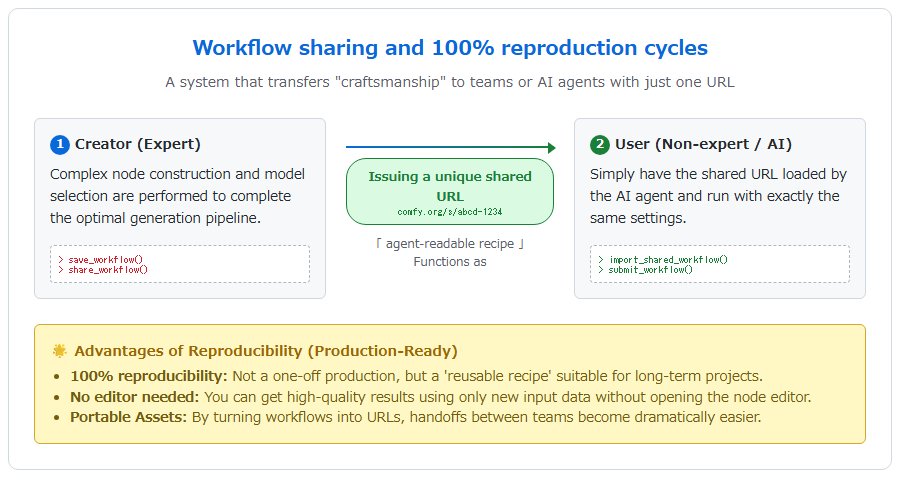
Traditional image generation required manually sharing complex settings to achieve the same results, but because a single URL ensures reproducibility, it is highly practical for collaboration between teams and long-term projects. Additionally, since shared URLs can be directly loaded by AI agents through import_shared_workflow, new forms of collaboration have emerged, such as workflows similar to “craftsmanship” built by professionals, which non-experts can load into their own agents for reuse.
Security, Legal Considerations, and Future Developments
While it offers powerful features, implementing MCP also requires attention to security. In 2025, a serious vulnerability (CVE-2025-49596) was discovered in the MCP Inspector project that allowed remote code execution (RCE), but this was fixed in version 0.14.1. Additionally, when handling confidential corporate data or personal information through MCPs, compliance with data protection regulations such as GDPR and CCPA is required. Looking ahead, the development team is outlining a roadmap to support Comfy MCP, which is currently cloud-only, with ComfyUI running in local environments. Furthermore, plans include multi-agent support where multiple AI agents can interact with MCP servers, as well as multimodal support that flexibly handles image and audio input beyond text. MCP is expected to evolve beyond a mere standard into a critical infrastructure that will determine a company’s competitiveness.
[#ComfyUI #MCP #生成AI #Claude #AIエージェント #技術革新 #画像生成 #動画生成]


コメント