KASHIKA Co., Ltd. has announced a new feature for its AI production platform, “Pro ai,” enabling users to automatically generate storyboards from URLs and reference images to produce videos up to 30 seconds long. This launch is driven by the rapid evolution of multimodal AI—exemplified by ByteDance’s latest model, Seedance 2.5—and the pressing demand in video production to significantly shorten lead times.
- Overview and Announcement of New Features by KASHIKA Co., Ltd.
- Technological Breakthroughs of the Latest AI Video Model, Seedance 2.5
- Tectonic Shifts Driven by an 80% Reduction in Production Time and a 50% Cut in Costs
- Strategic Reinvestment from Short-Form Content to Long-Form and Original IP Development
- Latest Trends in IP Protection and Compliance with the “Principle Code”
- AI as the Video Production OS and the Future Role of Human Creators
Overview and Announcement of New Features by KASHIKA Co., Ltd.
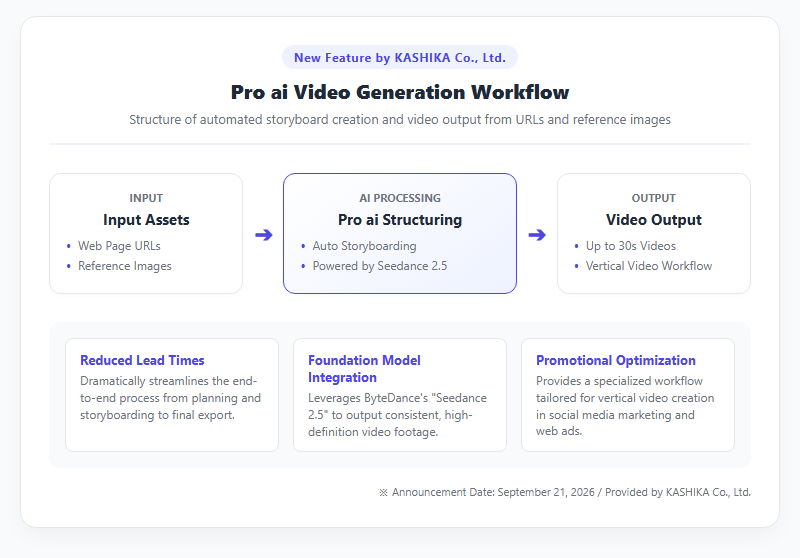
On September 21, 2026, KASHIKA Co., Ltd. announced a major enhancement to its AI production platform, “Pro ai,” introducing a feature that automatically generates storyboards simply from a URL and reference images, creating videos up to 30 seconds long within an integrated workflow. Unlike traditional methods centered on text prompts, this feature directly ingests existing web pages and visual assets to automatically structure a storyboard, seamlessly progressing to final video rendering. Additionally, KASHIKA published a specific workflow on its official website for producing vertical videos using ByteDance’s latest video generation model, Seedance 2.5. This advancement drastically reduces lead times from planning and storyboarding to final video export for social media marketing and web ad creatives. By streamlining production burdens while preserving visual consistency, Pro ai provides businesses and creators with an empowering new tool for promotional campaigns and creative workflows.
Technological Breakthroughs of the Latest AI Video Model, Seedance 2.5
Backing this functional expansion of “Pro ai” is ByteDance’s next-generation AI video generation model, Seedance 2.5. In the 2026 AI video landscape, the industry-wide transition from traditional 3D U-Net architectures to Diffusion Transformers (DiT) has significantly improved resolution and physical consistency through spatiotemporal patch processing. Seedance 2.5 can generate high-definition video up to 30 seconds in a single generation pass, maintaining character consistency, composition, and camera angles with exceptional precision. Furthermore, supporting quad-modal inputs—text, images, video, and audio—it enables precise in-frame text rendering, multilingual lip-syncing, and native voice synthesis within a single pass. Served through major cloud APIs such as Atlas Cloud, this advanced inference engine provides the technical foundation for generating production-ready 30-second videos directly from storyboards.
Hybrid Production Frameworks and the Productivity Revolution in Video Production
Tectonic Shifts Driven by an 80% Reduction in Production Time and a 50% Cut in Costs
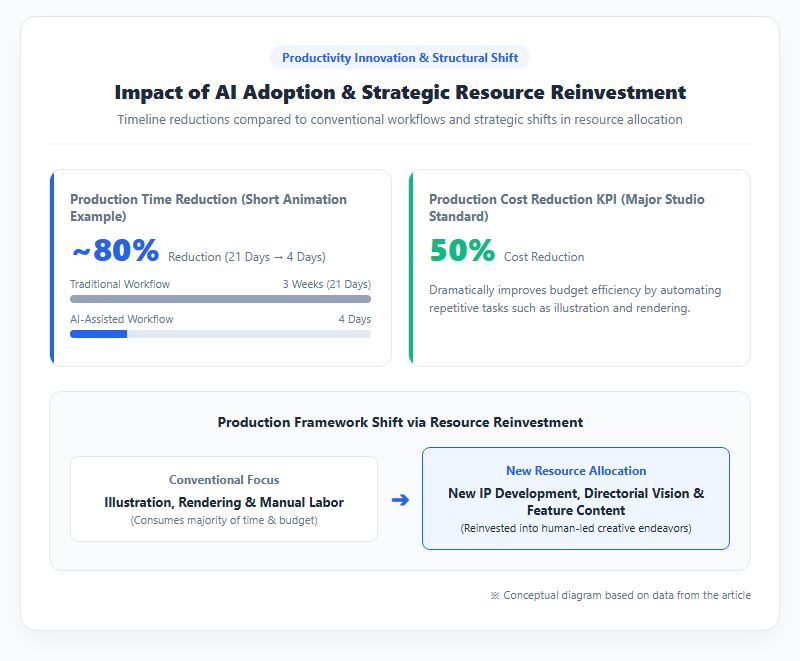
The rapid evolution of video generation AI is fundamentally reshaping production timelines and cost structures across the film and media industries. For instance, creating a short three-minute animation previously required approximately three weeks (21 days), but case studies demonstrate that AI tools can compress this workflow to just 4 days—an 80% reduction in production time. Furthermore, major production studios have adopted a 50% cost reduction as a standard Key Performance Indicator (KPI) by automating repetitive illustration and rendering tasks. Liberated from manual labor, creative teams can now redirect their energy toward distinctly human endeavors: storytelling, directorial vision, and strategic concept design. As boundaries between live-action and animation blur, the barrier to entry continues to fall, enabling even non-veterans to take on directorial roles in video production.
Strategic Reinvestment from Short-Form Content to Long-Form and Original IP Development
Resources freed up by reduced production costs and shorter timelines are being aggressively reinvested into developing new Intellectual Property (IP) and elevating directorial sophistication. In the short-form video market—dominated by platforms like TikTok and YouTube Shorts—the mass production of high-quality AI videos has led to market saturation and algorithmic homogenization. When technical perfection becomes effortless, visual polish alone ceases to be a competitive differentiator. Consequently, in 2026, video production companies are accelerating a “dual-track strategy”: automating high-volume short-form content while shifting freed-up capital toward human-led feature films and high-context original productions. Building a hybrid production model—deploying AI as an efficient backend tool while foregrounding human nuance and authenticity—has become essential to securing a sustainable competitive advantage in the market.
Governance, Ethical Guidelines, and Future Outlook
Latest Trends in IP Protection and Compliance with the “Principle Code”
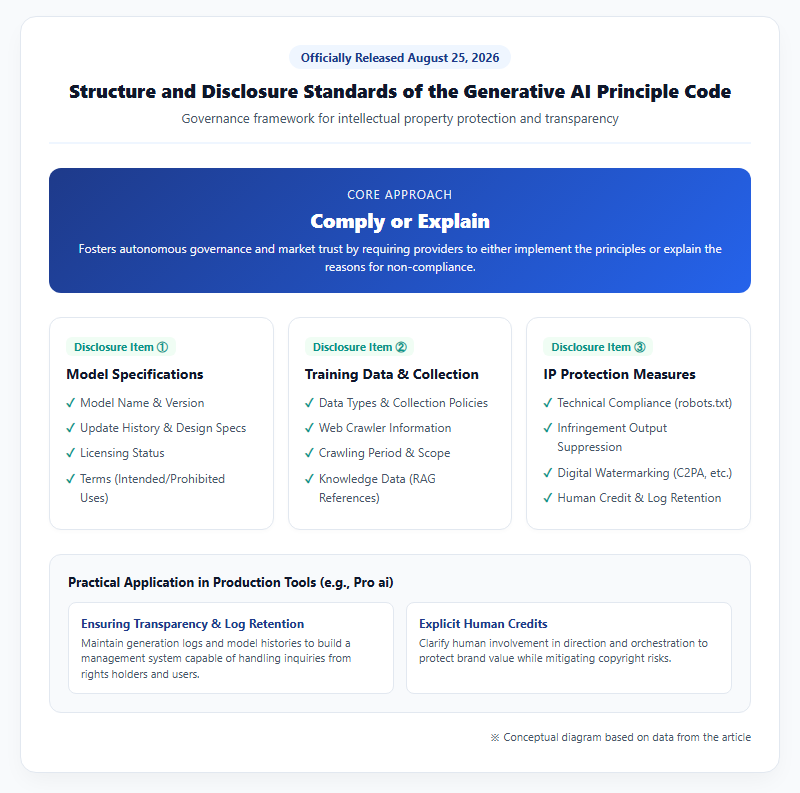
As AI-driven video production expands rapidly, establishing robust governance frameworks for intellectual property (IP) protection and training data transparency has become an urgent priority. On August 25, 2026, the Japanese government officially released the “Principle Code on Intellectual Property Protection and Transparency for the Appropriate Utilization of Generative AI.” Operating under a “Comply or Explain” framework, the Code requires developers and providers to disclose model specifications, data collection policies, and copyright infringement mitigation measures (such as respecting robots.txt and adopting C2PA digital watermarking). Additionally, production workflows are encouraged to log and explicitly state human contributions (such as direction and editing) as “Human Credits.” For commercial tools like Pro ai, establishing transparent, copyright-compliant workflows is directly tied to preserving brand value and earning market trust.
AI as the Video Production OS and the Future Role of Human Creators
The integration of storyboard-to-video generation in Pro ai marks a paradigm shift from “cutting and editing scenes” to “orchestrating AI via prompts and storyboards.” Moving forward, AI is expected to evolve into a comprehensive video production operating system that seamlessly handles everything from ideation and visual generation to audio synchronization and multilingual localization. As a result, the skill set required of creators and producers is undergoing a profound transformation. Technical drawing skills or editing software proficiency are giving way to conceptual thinking, prompt engineering, core narrative aesthetics, and curation capabilities to audit rights and quality. Mastering AI as a sophisticated physics simulator guided by human aesthetic vision—and grounding it in deep human emotion—will define success in the modern creative marketplace.
References
- [PR TIMES Official Site] https://prtimes.jp/
- [Atlas Cloud Official Site] https://www.atlascloud.ai/
- [Ministry of Internal Affairs and Communications Official Site] https://www.soumu.go.jp/
【#Proai #VideoGenAI #GenerativeAI #Seedance #AIVideoProduction #KASHIKA #VideoProduction #AIImageGeneration】

コメント