Mitsubishi Heavy Industries announced that it has received an order for vehicle inspection and repair equipment and equipment for the Yanchao General Rolling Stock Factory of Taiwan High Speed Rail. The background includes strengthening the maintenance system following the introduction of the new train “N700ST” and the urgent need to modernize facilities that have been in operation for 20 years.
- Details and Role of Equipment Orders for Yanchao General Rolling Stock Factory
- Introduction Plan for the New Vehicle “N700ST” Behind the Order
- Frequent transportation disruptions and a strong sense of crisis over aging
- The full picture of the large-scale capital investment plan exceeding 1 trillion yen
- Breaking away from the Japanese-European mixed system and returning to the ‘Japanese style’
- The Yilan Extension Plan and the Future of Eastern Taiwan
Details and Role of Equipment Orders for Yanchao General Rolling Stock Factory
On July 2, 2026, Mitsubishi Heavy Industries announced that it had received an order from Taiwan High Speed Rail Corporation (Taiwan High Speed Rail), which operates the Taiwan High-Speed Rail business, for vehicle inspection and repair equipment and equipment for the Yanchao General Rolling Stock Factory located in southern Taiwan. The Yanchao General Rolling Stock Factory is an extremely important base for maintenance and inspection of all vehicles owned by Taiwan High Speed Rail, and this contract includes not only equipment delivery but also installation and commissioning.
This order focuses on strengthening the maintenance system in line with the introduction of Taiwan High Speed Railway’s planned new train “N700ST.” Specifically, by equipping advanced maintenance equipment compatible with the latest vehicles, we aim to further enhance transportation services and ensure safety. The diagram below relates to the local system where this equipment installation will take place.
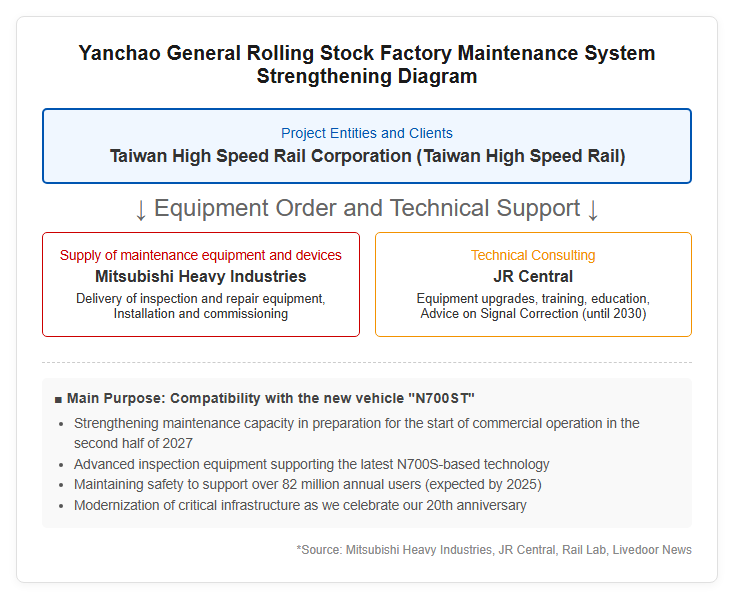
Since winning the Taiwan High-Speed Rail project in 2000 as a consortium of seven Japanese companies, Mitsubishi Heavy Industries has been involved in the Nangang extension and train depot renovations even after its opening in 2007. This order is the result of Taiwan High Speed Rail’s high regard for its long-standing track record and technological capabilities.
Introduction Plan for the New Vehicle “N700ST” Behind the Order
The biggest trigger for this maintenance equipment update is the introduction of the next-generation vehicle, the “N700ST.” This train is based on the latest model of the Tokaido Shinkansen developed by JR Central, the “N700S,” and the “T” at the end of the model code stands for “Taiwan.” In May 2023, a consortium of Hitachi, Ltd. and Toshiba ordered 12 trainsets (144 cars) for approximately 124 billion yen.
The N700ST is scheduled to be delivered sequentially from 2026, with a goal of commercial operation starting in the second half of 2027. With the introduction of the new vehicles, peak transport capacity is expected to increase by about 25%, and the design significantly enhances passenger comfort, including charging ports at all seats and noise and vibration reduction.
To safely operate these state-of-the-art vehicles, precise inspections and maintenance that conventional equipment cannot handle are essential. Therefore, the latest inspection and repair equipment provided by Mitsubishi Heavy Industries plays an extremely important role as the infrastructure supporting the stable operation of the N700ST.
Accelerating capital investment behind management and strategy
Frequent transportation disruptions and a strong sense of crisis over aging
The background behind Taiwan High-Speed Rail’s large-scale investment, including placing orders with Mitsubishi Heavy Industries, lies in measures against recent transportation disruptions and serious concerns over the aging system. On May 25, 2026, a major transportation disruption occurred in central and Miaoli prefectures due to a failure of point control equipment, forcing operations on temporary timetables for almost the entire day.
This outage was related to the power module replacement work that had been progressing sequentially since 2024, but Mr. Shi Zhe, Chairman of Taiwan High Speed Rail, emphasized the need for a comprehensive system inspection. The Taiwan High-Speed Rail system is expected to have a service life of 35 years, but more than 20 years have passed since operation began, and it is time for critical equipment upgrades.
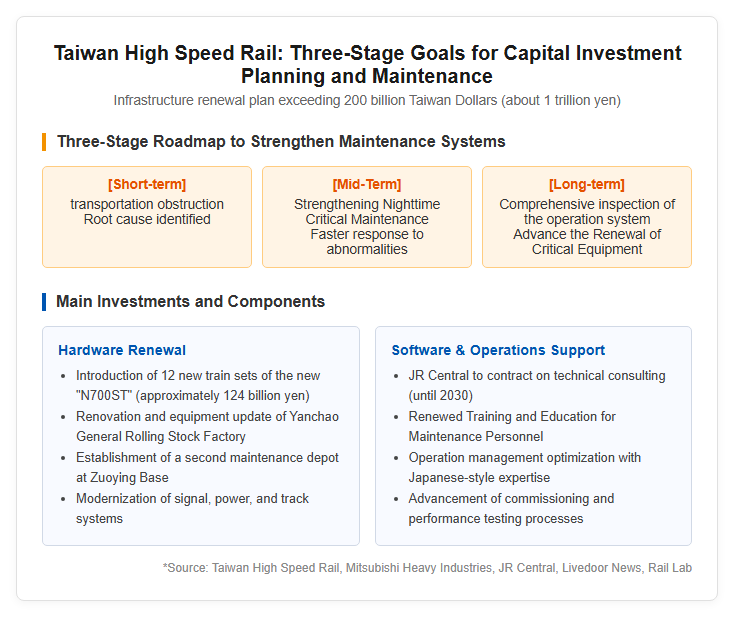
In response to these circumstances, Taiwan High Speed Rail has set maintenance system enhancement targets in three stages: short-, medium-, and long-term. In addition to short-term root cause investigation, we have decided to strengthen critical nighttime maintenance, improve response speed in case of abnormalities, and carry out inspections of the entire operation system—including power, signals, and tracks—ahead of schedule.
The full picture of the large-scale capital investment plan exceeding 1 trillion yen
To prevent recurrence of transportation disruptions and modernize the system, Taiwan High-Speed Rail announced that it is considering a massive capital investment exceeding 200 billion Taiwan dollars (approximately 1 trillion yen). This investment plan aims not only to maintain existing equipment but also to comprehensively revamp infrastructure with an eye toward future network expansion and the introduction of new technologies.
As part of this large-scale investment, improving vehicle maintenance capabilities has become one of the top priorities. Plans include renovating the Yanchao General Rolling Stock Factory and establishing a second maintenance shed at Zuoying Base, and the newly announced maintenance equipment order from Mitsubishi Heavy Industries forms a key piece of this massive project.
Moreover, investments extend beyond hardware to software aspects such as training and education for staff responsible for operations and maintenance. The signing of a technical consulting contract with JR Central is part of this effort, and by fully incorporating advanced Japanese-style operational and maintenance know-how, we aim to maintain world-class safety and reliability. The diagram below conceptualizes the components of an investment plan.
Technological Advancements and Future Developments
Breaking away from the Japanese-European mixed system and returning to the ‘Japanese style’
Since its opening, Taiwan High-Speed Rail has adopted a unique system called the “Best Mix,” where the rolling stock and signaling systems are Japanese-style, while European specifications are mixed in civil engineering structures and some equipment. However, this mixing has led to increased complexity in maintenance and management, and there have been a history of operational limitations, such as frequent troubles with German-made switches.
The introduction of the N700ST and the order for maintenance equipment by Mitsubishi Heavy Industries are efforts to resolve the drawbacks caused by such hybrid systems and to optimize for a purer Japanese-style system. JR Central has signed a long-term technical consulting contract from May 2024 to 2030, providing comprehensive advice from new train test drives and staff training to modifications to signal systems.
This is expected to integrate vehicles, maintenance equipment, and operational know-how at a high level, establishing an efficient and safe maintenance system. By leveraging the lessons learned from the past “Japan-Europe coexistence” and evolving it into a consistent system, the aim is to reduce the risk of sudden failures and achieve stable operations.
The Yilan Extension Plan and the Future of Eastern Taiwan
The evolution of Taiwan’s high-speed rail is not limited to rolling stock and equipment, but is heading toward a new stage of line extension. Currently, a plan is underway to extend approximately 60.6 km from Taipei’s Nangang Station to Yilan (Gilan) in the east, with the project aiming for opening in 2036. If this plan is realized, Taipei and Yilan will be connected in as little as 28 minutes.
With the expansion of this network, the number of users is expected to increase even further in the future. The number of users in fiscal year 2024 was about 78.25 million, and it is expected to reach about 82 million by 2025, indicating that infrastructure development to meet the growing demand is urgently needed.
The maintenance equipment provided by Mitsubishi Heavy Industries this time, along with the newly introduced N700ST, will form the backbone of supporting the massive railway network after this extension. With the advancement of maintenance technologies supporting safe operations, increased transport capacity, and route extensions, Taiwan’s transportation infrastructure is entering a new era where day-trip hot springs and tourism are becoming more accessible.
[#三菱重工業 #台湾高速鉄道 #N700ST #インフラ投資 #鉄道ビジネス #台湾経済 #JR東海 #メンテナンス]


コメント