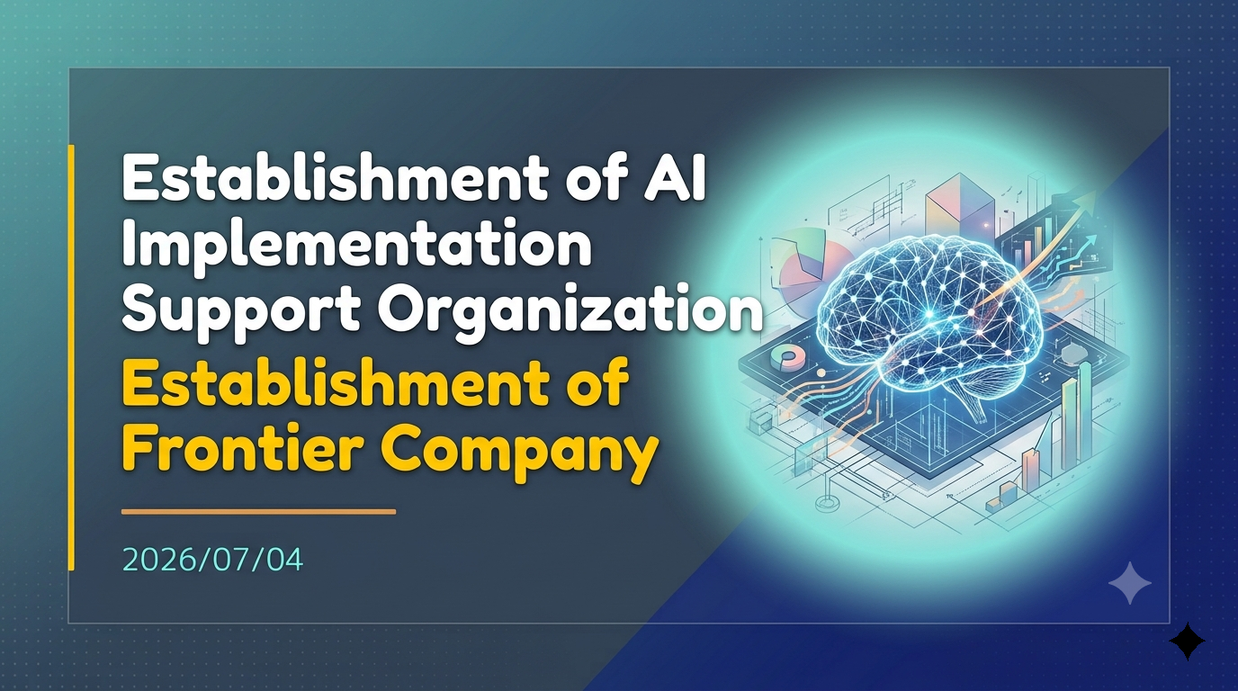
On July 2, 2026, Microsoft announced the establishment of a new organization, the Microsoft Frontier Company, to directly support customer companies in adopting AI on the ground. With a massive investment of $2.5 billion (about 400 billion yen) and 6,000 experts, the shift from selling AI model licenses to “AI implementation support” that generates tangible business outcomes (ROI) is due to the current stagnation of corporate AI utilization at the validation stage (PoC).
- The shock of a massive .5 billion investment and a 6,000-person workforce
- A new weapon: “FDE (Frontline Deployment Engineering)”
- Urgent reasons to break through PoC barriers and pursue ROI
- Breaking Away from OpenAI Dependence and Shifting to a Multi-Model Strategy
- Differentiating Points from Competitors Like Amazon and OpenAI
- Impact on existing SI and consulting partners and ecosystem restructuring
- Expectations and Risks as a Solution to Stock Price Slumps
- Timeline for Expanding Capital Investment (CapEx) and Monetization
- Protecting customers’ “IQ” and building trust
- Toward In-house Production and Completion of Vertical Integration After 2027
The shock of a massive .5 billion investment and a 6,000-person workforce
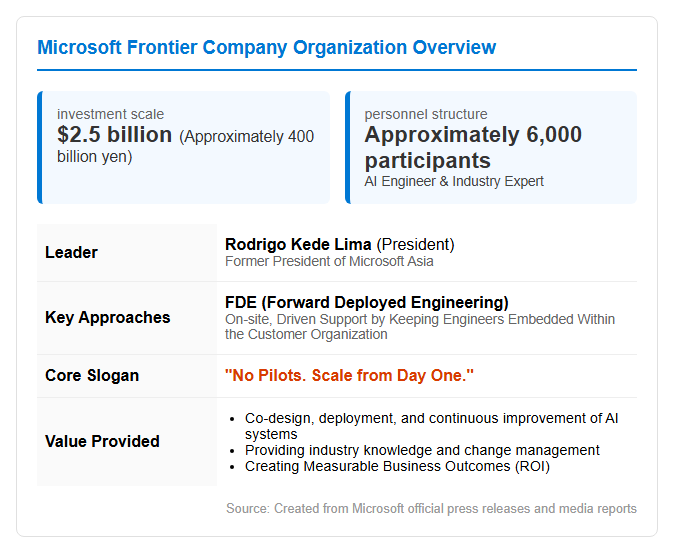
On July 2, 2026, Microsoft established a new organization, the Microsoft Frontier Company, to accelerate AI adoption. This organization will receive an investment of $2.5 billion (approximately 400 billion yen) and deploy approximately 6,000 experts with deep industry knowledge and enterprise-grade AI engineering expertise. The leader of this organization is Rodrigo Kede Lima, who has 30 years of industry experience and most recently led sales departments in Asia Pacific and other regions, serving as president.
Structurally, it is not an independent entity but an internal business unit within Microsoft, but it operates as a “purpose-driven company” with unique leadership and financial accountability. The main features are as follows:
-
Industry-Largest and Highest Level of Engineering Expertise Concentrated
-
A system for embedding engineers internally within client companies
-
Co-design, deployment, and continuous improvement of AI systems based on measurable business outcomes
The diagram below summarizes the organization’s scale and structure.
A new weapon: “FDE (Frontline Deployment Engineering)”
The core methodology of the new organization is called “FDE (Forward Deployed Engineering).” This approach involves sending engineers to customer sites and building and operating AI tailored to business processes—a model pioneered by data analytics company Palantir. Microsoft aims to be a “results-driven engineering organization” that goes beyond the scope of FDE, emphasizing deep involvement that goes beyond mere technology provision.
Microsoft has jumped beyond the “pilot” stage of AI experiments and aims for large-scale “No Pilots.” from day one. Scale from Day One.” Specifically, in collaboration with early clients such as the London Stock Exchange Group (LSEG), Unilever, and Novo Nordisk, it has been reported that they have achieved solid results through iterative improvements through real-time user testing. This approach aims to prevent AI from becoming just a “trial” and to continuously enhance corporate intelligence.
[Background of Management and Strategy] From a company that sells AI to a company that delivers results
Urgent reasons to break through PoC barriers and pursue ROI
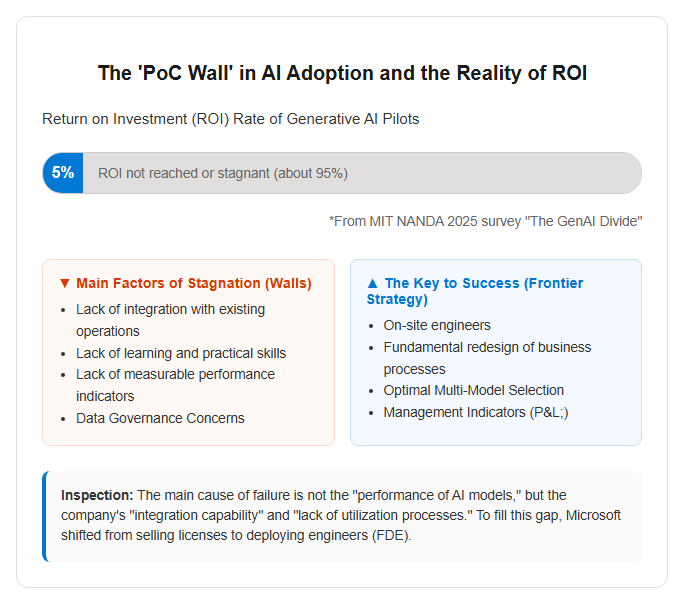
The background to the establishment of this organization lies the “PoC Stagnation Problem” faced by enterprise AI. According to a 2025 survey (MIT NANDA), data shows that only about 5% of generative AI pilot deployments have achieved a measurable return on investment (ROI), leaving the vast majority of companies stagnant because they cannot turn AI into profit. Microsoft decided that simply selling excellent “reference books (AI models)” was not enough; it was necessary to have a “tutor (engineer)” sitting next to them and accompany them until they improved their performance (results).
Microsoft’s own financial situation is not unaffected. Entering 2026, the company’s stock price has fallen by 21%, struggling even within the megacap. With the revenue growth commensurate with massive AI infrastructure investments being hard to see, building a system for customers to actually profit using AI has become a matter of life and death for the company. Only when AI adoption is successfully implemented and deeply integrated into operations will Microsoft generate sustained revenue in the form of Azure and Copilot usage fees.
For the relationship between success rate and ROI in AI implementation, please refer to the diagram below.
Breaking Away from OpenAI Dependence and Shifting to a Multi-Model Strategy
Microsoft has led the market through massive investments in OpenAI, but the new organization emphasizes a “multi-model platform” that is not tied to a specific model. Customers are given the flexibility to freely select and run the optimal model for their application, cost, and accuracy, not only OpenAI’s models, but also Anthropic, open-source models, or industry-specific dedicated models. This is based on the idea that “customers should not be locked into a single vendor or model.”
Furthermore, in the long term, we are also considering in-house AI development. By 2027, we have set a policy to develop our own industry-leading proprietary models and reduce dependence on external partners. Proprietary models such as “MAI-Transcribe-1” have already been released through the development platform “Microsoft Foundry,” and by vertically integrating the cloud from AI models to applications, we aim to optimize costs and strengthen collaboration between products. Through this, the aim is to avoid supply risks and further establish a competitive advantage.
[Industry Structure & Competition] Intensifying “$8 Billion” Competition for AI Implementation Support
Differentiating Points from Competitors Like Amazon and OpenAI
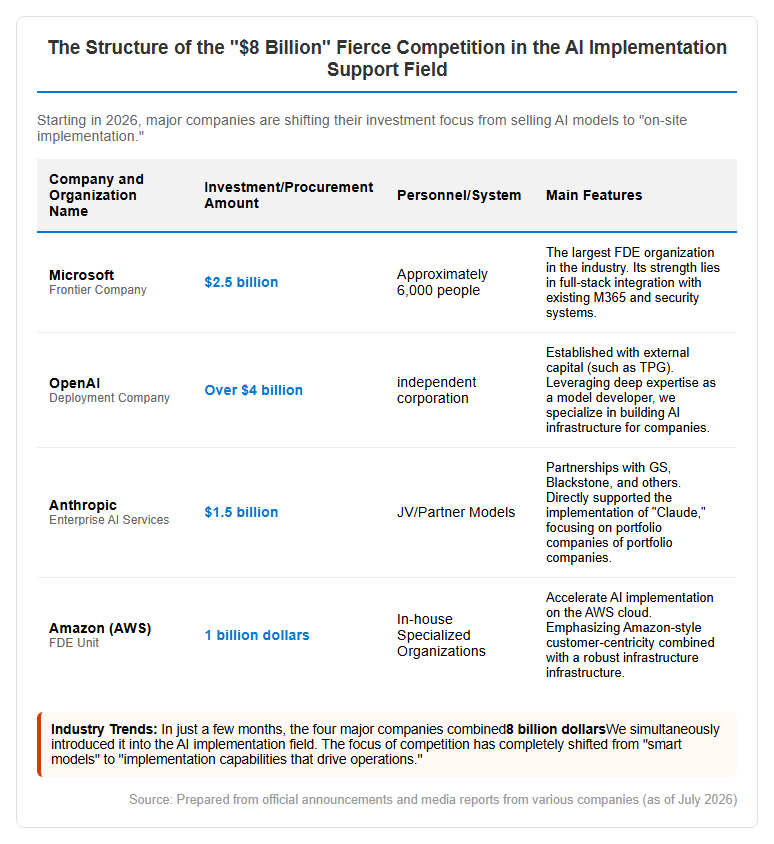
The competition to support AI implementation is not unique to Microsoft. Entering 2026, major players are announcing massive investments in this sector. Just two days before Microsoft’s announcement, Amazon (AWS) announced the establishment of a $1 billion FDE unit, and OpenAI raised over $4 billion to establish a new company specializing in implementation support, the OpenAI Deployment Company. Taken together, this means that in just a few months, the entire industry has invested $8 billion in “AI implementation.”
In this fiercely competitive arena, Microsoft differentiates itself by its overwhelming scale and integration capabilities. Specifically, he advocates the following three points.
-
One of the largest organizations with 6,000 employees and a $2.5 billion investment scale
-
Comprehensive support combining not only technology but also industry knowledge and organizational transformation (change management)
-
Full-stack integration capabilities covering everything from Microsoft 365 to security and cloud infrastructure
We also take pride in having an advantage over Palantir, a pioneer, in terms of the abundance of supported models and data connectors.
The comparison of investment amounts and structures among major companies is as follows.
Impact on existing SI and consulting partners and ecosystem restructuring
Microsoft’s move is sending significant ripples through the existing partner ecosystem. Although Microsoft claims to form “strong FDE partnerships” with global system integrators (SIs) such as Accenture, Capgemini, EY, KPMG, and PwC, in reality, Microsoft’s own implementation teams may compete with consulting and SI firms in project acquisition. In particular, the mid-tier SI demand previously offered to large enterprises is expected to face tougher competition as vendors themselves come down to the field.
On the other hand, for Microsoft, FDE offers the advantage of being able to directly identify “product shortcomings” and “patterns of business challenges” directly from customers’ sites. A powerful feedback loop is established by feeding problem-solving patterns obtained here back into your own products as standard features or templates, and then rolling them out horizontally to tens of thousands of other companies. This is a strategy unique to tech vendors, fundamentally different from traditional consulting that only solves individual challenges, and serves as a driving force to further enhance product competitiveness.
[Impact on Market and Stock Prices] Investor Expectations and Financial Reality
Expectations and Risks as a Solution to Stock Price Slumps
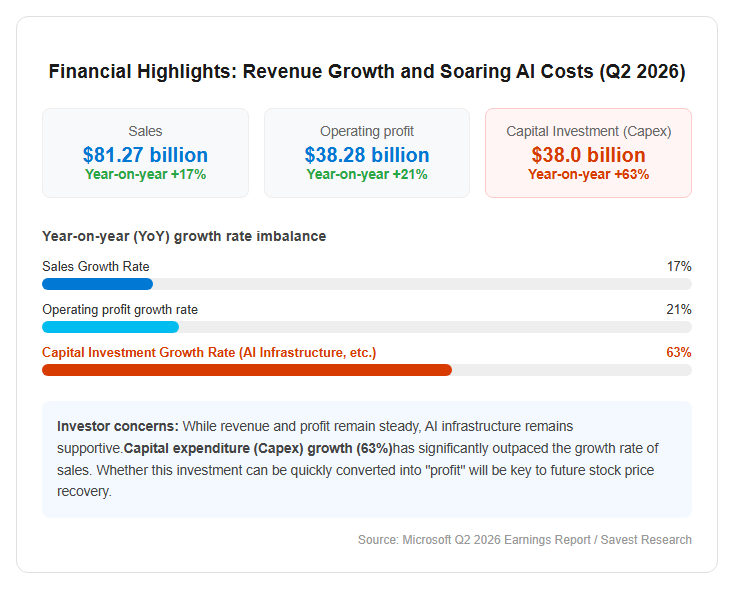
In its Q2 2026 results, Microsoft demonstrated solid results, achieving $81.3 billion in revenue, a 17% increase year-over-year, and $38.3 billion in operating profit, a 21% increase year-over-year. However, the market’s reaction has not always been optimistic. The stock price has fallen 21% since the start of 2026, reflecting investors’ frustration over the slower pace of monetization despite massive AI capital investments. Capital expenditure surged 63% year-over-year to $38 billion, raising concerns about shrinking free cash flow.
The establishment of the new organization, Microsoft Frontier Company, serves as a ‘trump card’ to dispel these doubts on Wall Street. This is because it is necessary to prove that AI is not just a factor in cost increases, but rather a “revenue engine” that reliably increases consumption (such as licenses and Azure usage) through improved customer ROI. Investors are closely watching how quickly this 6,000-strong “strike team” can turn pilot projects into production revenue.
The chart below shows recent trends in revenue and costs.
Timeline for Expanding Capital Investment (CapEx) and Monetization
Microsoft’s AI strategy is an extremely capital-intensive model, such as building data centers and procuring chips made by NVIDIA. In the second quarter, shareholder returns also expanded by 32% to $12.7 billion, leveraging balance sheet flexibility to balance investment and returns, but increased AI-related depreciation and operating costs are putting pressure on operating profit margins. The “Intelligent Cloud” division, including Azure, has maintained a high growth rate of 39%, accelerating the migration of AI workloads, but the question remains whether this is sustainable.
The new organization’s goal of pioneering the “last mile of AI” is a measure to accelerate the timeline for monetization. Microsoft recognizes that AI adoption is being hindered not only by technical challenges but also by barriers in corporate data structures and organizational culture, and aims to accelerate the speed at which AI services start turning the “meter” by directly overcoming these challenges. However, the market view is that reallocating about 6,000 people and committing to results will require certain execution risks and time before they actually translate into improved profit margins.
[Future Developments & Points to Watch] The future envisioned by AI-implemented “Last Mile”
Protecting customers’ “IQ” and building trust
As AI implementation deepens, client companies’ biggest concern is that their sources of competitive advantage (intellectual property and know-how) will be incorporated into AI models and used by other companies. In response, Microsoft has established the fundamental principle of “IQ protection,” which means not using customer data, IP, or competitive advantage to train models. CEO Satya Nadella has clearly stated, “There is no social acceptance of AI that devours the intelligence of its intended users,” positioning trust as the prerequisite for AI adoption.
The deeper FDE engineers get into the customer’s pockets, the deeper their access to confidential information becomes. By enforcing this pledge that “tutors don’t teach secret notes to others,” Microsoft aims to differentiate itself from emerging AI labs like OpenAI and Anthropic. Customers retain full ownership of their developed deliverables and are created in an environment where fine-tuning based on their own business data is not tied to a specific model.
Toward In-house Production and Completion of Vertical Integration After 2027
Microsoft’s ultimate goal is to complete its ecosystem through vertical AI integration. The policy to internalize AI production through 2027 aims to reduce supply risks and licensing costs caused by external dependencies, and to provide AI environments optimized for our own products at low prices. By adding its own frontier model to its cloud infrastructure (Azure), AI platform (Foundry), and application (Copilot), the company will be able to control the entire AI supply chain.
On the other hand, this vertical integration presents companies with a new challenge called “vendor lock-in.” Even if the model itself is replaced, migrating from the AI architecture or platform once built incurs significant switching costs. Implementing companies will be required not only to assess model performance but also to calculate ROI considering future costs and exit strategies. Now that the main battleground in the AI industry has completely shifted from “model intelligence” to “implementation capability and results on the ground,” how Microsoft’s new organization will dominate this “last mile” will be the biggest focus for the future direction of AI business.


コメント